
« Quotes on request. » Three words that silently drive away a significant portion of your prospects — gone to check with the competitor who, for their part, displays their prices. The pricing page is the most visited and most dreaded page on a service website: you fear scaring people, being compared, locking yourself in. Most often wrongly: well designed, it qualifies requests, builds trust, and saves everyone time. This guide shows you how to present your prices without scaring people off — and without discounting.
Why hiding your prices costs more than showing them
The reasoning behind hidden pricing (« let them call, I’ll convince them ») ignores real behavior: today’s visitor compares before contacting, and the absence of prices is interpreted — at best as « probably expensive », at worst as « price at the customer’s discretion ». Result: budget-conscious prospects flee without a word, and only unqualified requests remain, consuming your quotes for nothing. Displaying pricing information — even a range, even a « from » — reverses the mechanism: the prospect who contacts you knows the approximate cost and accepts it; the conversation starts on the project, not the price. Transparency doesn’t scare away good clients: it filters out those who would never sign.
If you hide your prices, people assume you’re expensive or playing games. Showing prices upfront helps good customers decide faster and weeds out those who’d never pay.

Formats based on your activity
- Fixed prices displayed — for standardizable services (session, monthly package, typical troubleshooting): maximum clarity, ideal with three compared formulas.
- The « from » — for variable services: it sets the realistic floor and the order of magnitude (« showcase website from X »); the golden rule: an honest floor, that real projects reach — the « from » bait that no one ever gets destroys trust at the first quote.
- Ranges by project type — the most reassuring format for custom work: three concrete examples with figures (« complete bathroom renovation: between X and Y ») that allow the prospect to gauge their position.
- The hourly or daily rate — for consulting and regulated professions: displayed with what an hour or a day typically accomplishes, to provide a scale.
The right reflex. Structure the offer in three formulas when possible (essential / recommended / premium): the prospect stops wondering « is this expensive? » to ask « which one suits me? » — a mental shift that changes everything. Highlight the middle formula (visually and with the mention « most chosen »): that’s the one most will take, and it enhances the other two by comparison.
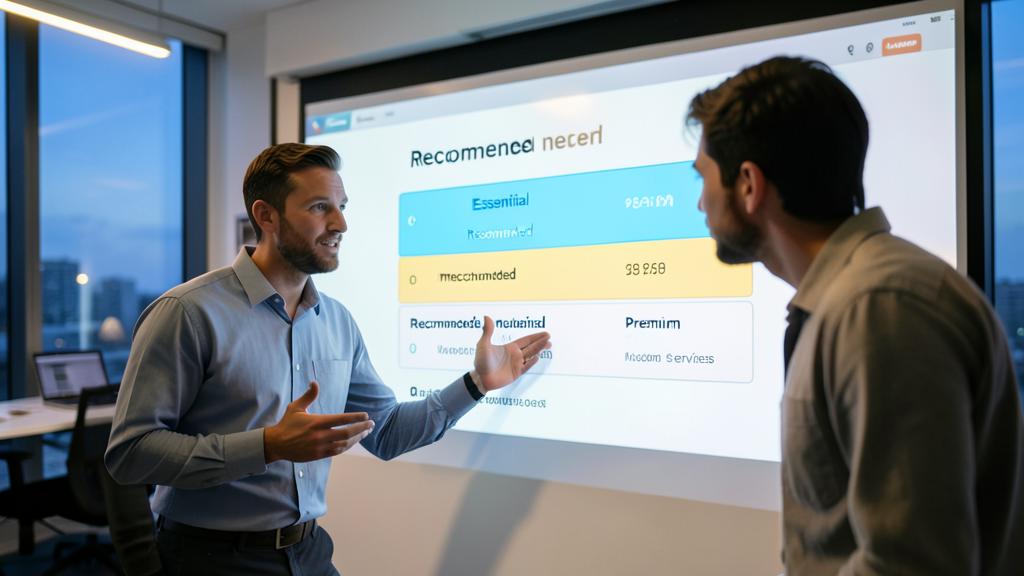
A web design agency offers three packages: Basic ($1,500), Standard ($3,000), and Premium ($5,000). The Standard package, highlighted as “most chosen,” includes 5 pages, SEO basics, and 2 rounds of revisions. This structure helps clients pick the right fit without endless back-and-forth.
Dressing up the price: value before the amount
A naked price is always too expensive — a dressed-up price is judged: detail what’s included (the concrete list under each price — the prospect often discovers there’s more than they thought), translate into benefits when relevant (duration of support, deliverables, warranties, deadlines), own your positioning — if you’re not the cheapest, explain why in one line (experience, warranty, availability): the assumed argument beats the shameful justification; and defuse ancillary concerns right next to the price: payment terms, no commitment, cancellation conditions, « free, no-obligation quote ». Finally, end the page with the obvious action: the contact or quote button — a pricing page without a clear exit is a dead end.

Classic objections (and why they rarely hold)
« My competitors will copy me »: they already know your prices (just ask for a quote) — only your prospects’ information changes. « Every project is unique »: all the more reason to provide benchmarks for typical projects — uniqueness justifies the range, not silence. « I’ll lock myself into negotiations »: displaying actually sets an anchor to your advantage — the discussion starts from your price, not from zero. « My market doesn’t do this »: being the first to display is precisely the opportunity — transparency is a powerful differentiator in opaque markets, and customers mention it spontaneously. There are still legitimate cases of non-public prices (large accounts, tenders): even then, a page explaining how the price is built reassures more than total silence.
Absolutely to avoid. The deceptive loss leader that no one gets (trust dies at the first quote), hidden asterisks and conditions that turn the page into a trap, outdated prices never updated (source of disputes and embarrassment), and jargon that masks what’s actually included. The pricing page is a moral contract with the prospect: every discrepancy between the page and the final quote costs you credibility — and public reviews.
Frequently asked questions
Won’t displaying your prices attract bargain hunters?
It’s the opposite: bargain hunters mostly call when nothing is displayed (to compare), and flee a clear positioning on their own. Displaying filters prospects upfront — your quotes focus on compatible leads.
How to handle a price increase?
Update the page on the day of the increase, honor ongoing quotes at the old price, and for regular clients, notify them with a delay. A transparent increase is well received; it’s the discovered increase that upsets.

Should prices be displayed before or after tax?
For individuals, the all-inclusive price is the rule (that’s what they’ll pay); for a professional clientele, the pre-tax price is standard — always specify the mention. Dual display removes all ambiguity when both audiences coexist.
Key takeaways
A well-designed pricing page doesn’t scare people off: it qualifies. Display honest information tailored to your activity — fixed prices, sincere «from» pricing, ranges by project types — structure in three formulas when possible, and dress up each price with what it includes and guarantees: value first, amount second, contact option at the end. Objections to displayed prices rarely hold up to scrutiny — and transparency, in an opaque market, is a competitive advantage in itself. Your price is the first trust test the prospect encounters: put it in the spotlight.



Your business deserves a real online presence: showcase site, store, SEO — we create the website that reflects you.
Leave a Reply
You must be logged in to post a comment.