
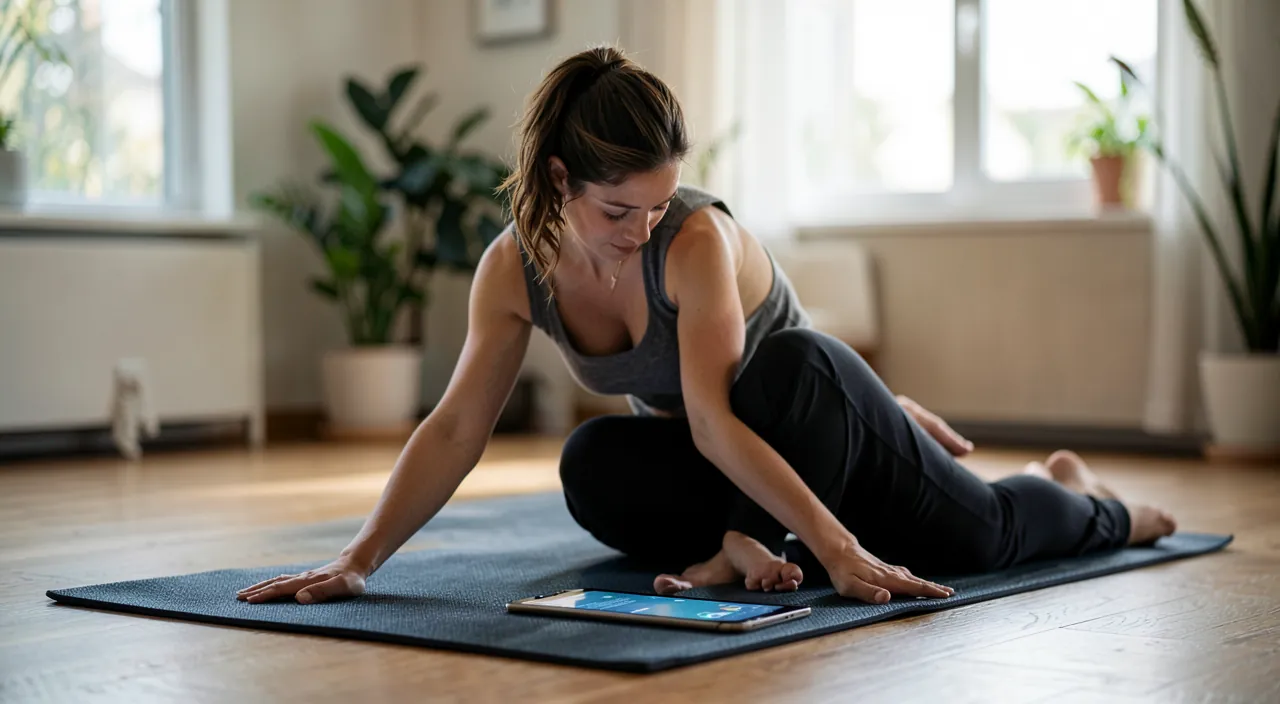
The aching back after sitting all day, the concrete shoulders, the reluctant sleep, and the shared intuition: « I should stretch, » without knowing what, how, or for more than a week. The yoga and guided stretching apps have solved the how: ten to thirty-minute sessions in the living room, the guiding voice posture by posture, programs by objective (back, stress, sleep, flexibility), zero commute and zero judgment from others. What really works, body precautions, and the ritual that sets in: the guide of the mat unrolled at home.
What the app yoga does well (and for whom)
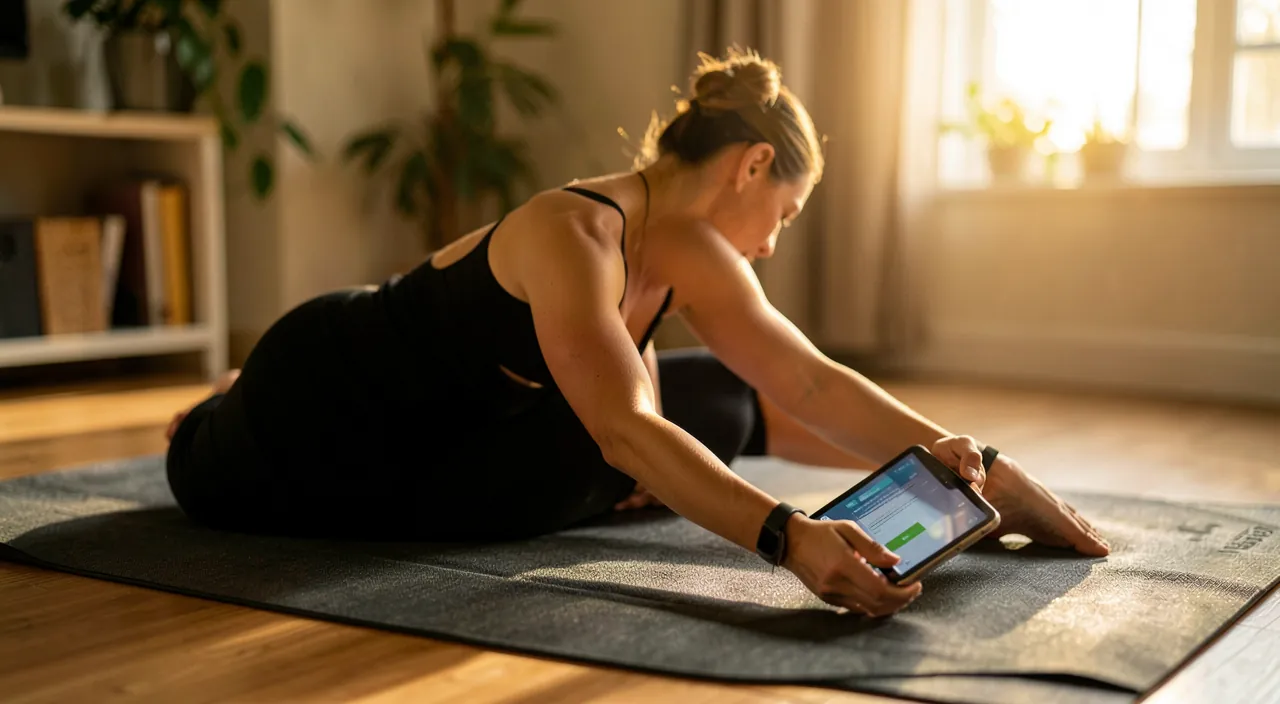
The proposition delivers on its promises in its domain: the radical accessibility — the session at the time that SUITS YOU (the 7 AM or 10 PM quarter-hour — the top obstacle of the studio class, the schedule, disappears), at the level that SUITS YOU (the « true beginner » programs that assume nothing — no flexibility or vocabulary — yoga has an image problem with Instagram’s flashy poses — the apps correct this: the true beginner’s yoga is modest and accessible to any body), and without the social barrier (the stiff beginner who dares not the studio — the living room does not judge: the entry point that counts a lot); the formats that fit in — the targeted micro-sessions (the seven-minute « neck and shoulders » of the screen break — our remote work guides: the desk stretch is the century’s medicine for sitting —, the « morning back, » the « legs after the run » — our sports guides: the post-exertion stretch that everyone skips), and the real weekend sessions; the schools for each need — the gentle and slow for beginners and recovery (the yin and hatha for starters), the dynamic for sweating (the flows — when the basics are there), the dry stretches without yoga dimension for those who prefer (the stretching and mobility apps — the same service, the packaging less: choose the vocabulary that makes you unroll the mat), and the respiration and stress as a thread — the cardiac coherence and guided breathing integrated (our sleep guides: the evening session that prepares for the night is one of the most documented uses of the genre — the gentle stretch + breathing duo beats many comfort sedatives).
Yoga apps make stretching easy by fitting into your schedule, offering beginner-friendly options, and avoiding social pressure. They also provide quick sessions for specific needs, like back pain or stress relief, making it easier to stick with a routine.
A 35-year-old office worker with chronic back pain tries a 10-minute “morning back” session from a yoga app. After two weeks of daily practice, they notice less stiffness and better posture, proving that even short sessions can make a difference.
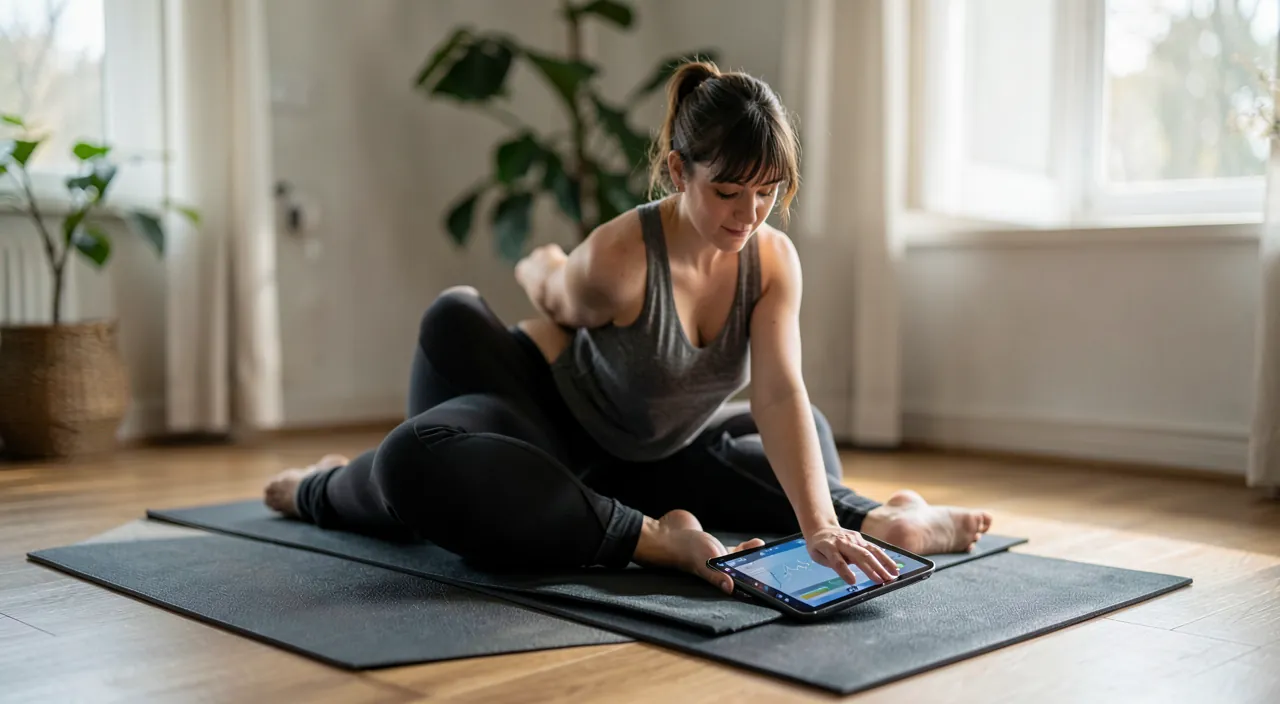
The body first: practice without hurting yourself
Yoga is seen as harmless — the body deserves better than this legend: the golden rules of home practitioner — pain is a boundary (stretching STRETCHES pleasantly, it NEVER hurts — sharp pain, tingling, cramping stop the pose — without a teacher to correct, your only corrector is the sensation — listen to it as boss), progress rules (flexibility is won over months, not sessions — forcing a stretch delays it — the forced muscle fights), joints are respected (painful knees in cross-legged pose rise — the cushion under the buttocks is the first « advanced pose » to learn, the variants offered by good apps are taken without ego — the easy version that respects YOUR body is the right one), and warming up exists (deep stretches on cold muscles, no — a well-structured session starts gently — the serious apps do it, check); the precautions by profile — the sensitive areas announced by the app (adapted programs exist: weak back, neck, knees — and our sports guides count: medical advice for special situations — pregnancy: only the dedicated prenatal, hernias and back pathologies: the green light and sometimes the physio first — therapeutic yoga exists, it is prescribed, not downloaded); and the comparison trap — the video model does the full pose (years of practice — your 40% version is the RIGHT version today: progress is measured by you, never by the screen: our guides). Practice without a teacher requires this maturity — it is acquired by naming it.
The right reflex. Anchor the practice with the visible mat and fixed slot — the mechanics of our guides’ habits, champion here: the mat UNROLLED constantly in a corner (or rolled but visible — the closet kills yoga like it kills the guitar), the slot attached to a daily pivot (the alarm, the end of remote work, the children’s bedtime), the default short session (the 10-15 minute program in base mode — the low bar that you clear even tired: the long session becomes the bonus of good days, not the condition), and the rule for bad days: three poses and two minutes of breathing COUNT. Flexibility and calm are compound interests — the capital, it’s regularity, not intensity.
Building your practice: programs, progression, variety
Beyond the isolated session: the objectives-based programs — the thread of several weeks that structures (the « strong back in 4 weeks, » « sleep yoga, » « morning energy » — the chosen program based on YOUR main complaint — the back of the sitters, the stress of the burdened, the stiffness of the athletes — gives the spine that random session consumption does not), and the loop of our sports guides (the felt feedback, the program adjusted); the honest progression — the markers that count (hands that go lower over weeks, the posture held comfortably, the back silent upon waking — yoga’s progress is subtle and real: a monthly photo of a pose makes it visible, the genre’s anti-disappointment), and the level change WITHOUT rushing (intermediate sessions when the beginners BORE — not when they still challenge); the variety that sustains — the alternation of styles (the gentle evening, the dynamic Saturday), the varied teachers of platforms (the voice that carries you counts — try several: the same content works or fails depending on the guide), and the event sessions (the long Sunday, the outdoor summer session); and the bridge to the real — the studio class from time to time (the human correction that recalibrates — our music guides: the same gesture logic — the pack of a few classes that verify the fundamentals is worth its price, and the occasional collective class feeds the home practice), the summer camps and outdoor classes (the social dimension that the living room does not offer — yoga is also a culture: it is savored in the real).
Expanded yoga: sleep, family, office
Practice irrigates the rest: the evening ritual — the gentle session + breathing as a night buffer (our sleep guides: the « stretch 10 min → breathe 5 min → bed » sequence is one of the most effective and pleasant protocols for falling asleep — and the most pleasant), the app in night mode and the phone that STAYS out of the bedroom after (the evening yoga that ends with scrolling missed its launch); the office and screen — guided micro-breaks (the reminders from our guides — the seven-minute neck-shoulder-wrist break at 11 AM and 4 PM: home TMS prevention, literally), and the discreet stretches during long meetings; the family — yoga for KIDS (dedicated apps and videos — animal poses, story-telling: five to ten minutes that channel beautifully, and the Sunday morning parent-child ritual that makes memories), the elderly (chair yoga — the entry into movement for reduced mobility: our guides for a good old age — seated programs are a hidden treasure), and couples (the two-person session — more fun than it seems); and the practice companions — the watch that follows (yoga mode, heart rate at the wrist — our guides), dedicated music (calm playlists — our guides), and simple equipment (the right mat — the only purchase —, the progression brick and strap: €40 all-in — yoga is one of the least equipped hobbies: beware of the marketing that claims otherwise).
Be wary of well-being that promises too much. The digital yoga-meditation aisle has its excesses: the therapeutic promises (cure your back, eliminate anxiety) — yoga HELPS (research documents its benefits for stress, sleep, mild chronic pain — as a complement) but does not CURE illnesses (a truly painful back consults before the mat — our guides: persistent pain is a medical appointment, not a four-week program; established anxiety needs a professional — our mental health guides: the app accompanies, it never replaces); the well-being subscriptions — the sector is rife with traps from our guides (trials that turn into commitments, weekly fees disguised: read before yes) while the free offer is immense (reference free yoga channels are worth many subscriptions — start free, pay if the usage warrants it); and the cartesian spirituality sold in parsley (everyone places their cursor — the app that respects yours, from purely physical to meditative, is the right one: yoga requires no adherence to stretch a back). The mat is a simple health tool — keep it simple.
Frequently asked questions
Yoga or simple stretches: what’s the difference for my back?
On a mechanical level, a broad overlap (yoga poses ARE structured stretches — with breathing and sequencing plus: the rhythm and relaxation that often make the difference in experience): choose the packaging that makes YOU PRACTICE — the back result will be comparable, regularity does the rest. And for strengthening (the other half of a strong back): dynamic yoga contributes, core work completes — our sports guides.
How long before « seeing » results?
Calm and sleep: immediate effect from the first sessions (the session effect is immediate — it’s what hooks you); daily tensions: two to three weeks of regularity; visible flexibility: two to three months (the monthly photo as witness); general posture: a season. The curve is gentle and sure — exactly the opposite of marketing promises: beware of miracles, trust weeks.
I’m as stiff as a board: yoga isn’t for the flexible?
The exact opposite — yoga IS FOR the stiff (the flexible take pleasure, the stiff gain benefits): stiffness is the ideal starting point (the motivating early months), variants exist for every body, and no one watches in your living room. « I’m too stiff for yoga » is exactly like « too dirty to take a shower » — the reason to go, not the obstacle.
What to remember
The yoga and app stretching hold their promise under three conditions: the anchored practice (visible mat, fixed slot, default short session — regular ten minutes beat all), the listened body (no pain, ego-free variants, monthly progress — and medical advice first for special situations: the app maintains a healthy body, it does not treat a sick one), and the construction (program based on your main complaint, micro-sessions for work, evening ritual for sleep, occasional human class to recalibrate). The equipment is limited to a mat, the free offer is immense, miracle promises are laughed at. The protesting back does not need a studio or flexibility — it needs ten minutes tonight, in the living room: unroll, the voice does the rest.
Want to go further with your phone and apps? Our practical trainings are for you.
Leave a Reply
You must be logged in to post a comment.