
The voice of your son on the phone — his tone, his intonations — asking for an urgent wire transfer; the video of the leader ordering a payment via video call; the known personality promoting a miracle investment in a strikingly real ad: deepfakes have left the labs for mass scams — just a few seconds of voice are now enough to clone it, and the image follows. Panic is not the answer — the method is: understand what the technology can do, know the real scenarios, and install the three family shields that break them all. The complete guide to an era where seeing and hearing are no longer enough.
What the technology really knows how to do (without fantasy)
An honest assessment: voice cloning is the most mature and dangerous — a few seconds of public audio (the voicemail message, the vacation video posted, the interview) are enough to generate a credible voice saying anything — on the phone (compressed channel, stress, urgency), ear detection is ILLUSORY — even close ones fall for it, it is documented; fake video progresses quickly — the face swapped or animated in real-time in a video call is technically possible (business video scams have proven it with record losses), with artifacts still detectable to the attentive eye (unstable contours, lip sync, inconsistent lighting — but count on these clues on hold: each year erases them a little); false ads and false statements — the mass reservoir: cloned celebrities promoting financial scams and miracle products flood the networks (our guides on investment scams — deepfake has become the standard hook); and the good structural news: the vast majority of attacks are not targeted-sophisticated but industrial-opportunistic — behavioral shields (see below) break both, and that’s precisely why they prevail over detection.
Deepfakes can copy voices and faces using just a few seconds of real recordings. They’re getting better, but they still leave small clues like odd lighting or lip-sync issues. Most scams aren’t super targeted—they’re mass attacks, so simple habits like verifying identities can stop them.
Real scenarios, from the living room to the company
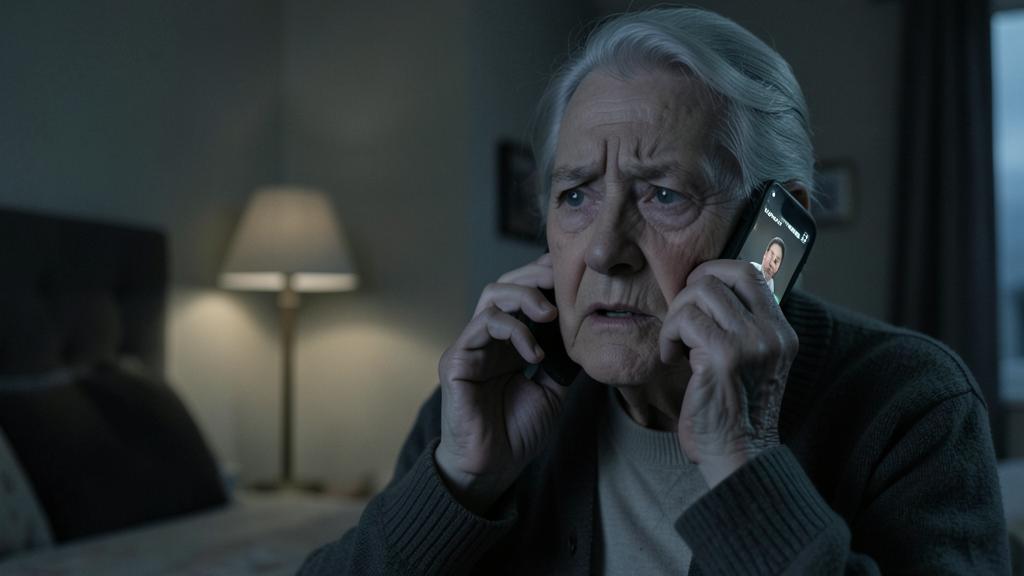
Proven attacks, by circles: the family — the cloned « near one in distress » call (the accident, the arrest, the foreigner — the historical scam to grandparents, overpowered by the real voice: urgency + emotion + familiar voice = the trifecta that short-circuits reason), and its variant « new number » on messaging apps (text first, cloned voice reinforcement if the target doubts); money — the fake bank advisor (our guides — cloning enters the scenario), blackmail with a fake intimate video (deepfake porn used in extortion — including against minors: a word to parents in the box); and known faces promoting investments — the mass reservoir: celebrities cloned promoting financial scams and miracle products flood the networks (our guides on investment scams — deepfake has become the standard hook); and the good structural news: the vast majority of attacks are not targeted-sophisticated but industrial-opportunistic — behavioral shields (see below) break both, and that’s precisely why they prevail over detection.
In 2024, a scammer cloned the voice of a CEO and called a finance manager, demanding an urgent $250,000 transfer for a “confidential acquisition.” The manager, trained to verify requests, hung up and called the CEO’s direct line, exposing the scam. Without that habit, the company would have lost the money.
The right reflex. Establish the outgoing call reminder as family law — the shield that breaks everything: any request for money, code, or sensitive information received by phone, voice, or video — even with the exact voice, even with the face — is treated by « I’ll call you back » on the known number (from the directory, not the one calling) — the clone doesn’t answer where the real one does. Complete for the close circle with the family code word — a word agreed upon, never written online, required in case of unusual request (« tell me the word ») — trivial technically, unbreakable in practice. Two rules, a dinner conversation: the family is vaccinated — the elders first, who are the primary targets.
Recognize what can be (and verify what counts)
Detection has its place — as the second curtain: signs of a suspicious call — less the voice than the BEHAVIOR: fabricated urgency, secret demanded (« don’t tell mom »), unusual channel, refusal to call back, evasive answers (ask a specific personal question whose answer is nowhere online — the clone recites, it doesn’t KNOW), and the request itself (wire transfer, gift cards, codes — our guides: these requests are the alarm, no matter who the requester is); video signs as long as they last — the edges of the face, hands, profiles (ask to turn the head, wave in front of the face — live tricks still stumble here), inconsistent lighting; content verification — the shocking statement or celebrity ad is verified before sharing (the official source, established media, reverse image search — our guides on verification: the viral deepfake thrives on reflex sharing — who verifies doesn’t propagate); and detection tools — improving, useful for professionals, not a magic talisman for the public (the tool that says « authentic » wrongly is worse than no tool) — trust shifts to the PROVENANCE — who published, on what official channel — and the emerging content authentication standards (image origin signature: to follow, not yet to wait). The rule that sums it up: a content is judged not by its plausibility — but by its source and what it DEMANDS.
Reduce your surface: the voice is also data
Upstream prevention: the publication hygiene — the voice and face published feed the clones (without paranoia: the world won’t shut up — but the public accounts of CHILDREN, videos where they speak at length, deserve restricted audience (our guides on networks and children — and the answering machine that says your name clearly can become a generic message again); credibility data — the deepfake succeeds when it KNOWS (the grandchild’s name, the bank, habits — gleaned from leaks and networks (our guides on personal data) — the less exposed, the less the scenario sticks); channel protection — the phone number and email are hardened (our guides: account theft often starts with a stolen channel — the pirated messaging account asking for money from contacts is the deepfake of the poor, and it works very well already); and the speak-truth family — the topic discussed without dramatization (the elders informed of the typical scenario don’t fall for it — information is the vaccine — show an example of current news, establish the outgoing call reminder and the code word, display the real numbers near the landline) — fifteen minutes of conversation worth all the software. The surface is reduced — it is not eliminated — from where the primacy of behavioral shields always prevails.
Beware of blackmail with fake videos — talk to the teens about it before. The scenario that rises and destroys: the fake intimate image or video made from public photos, used to extort (money, real images, silence) — adolescents are the primary targets, and shame is the weapon (the victim stays silent, pays, isolates) — the vaccine is a sentence said before any incident: « if someone threatens you with images, real or fake, you have done nothing wrong, come see me, we handle it — we never pay, we never negotiate » — then the actions — don’t pay (paying relaunches), capture everything, block, report (the platform, 3018 for minors, complaint — the intimate content of minors mobilizes dedicated and effective procedures). The extortion deepfake thrives on silence — the family that talked about it once is already half-protected.
Frequently asked questions
My bank uses voice recognition: is it dead?
Indeed, voice authentication ages poorly — institutions are complementing or abandoning it: on your side, favor robust factors offered (app, device biometrics, codes — our bank guides) and consider the voice as a comfort, never as proof — in both senses: what you hear doesn’t prove anything either.
A close one « recognized my voice » in a call I didn’t make: what to do?
Warn widely and quickly (the clone that called one will call the others — the family group message breaks the campaign), remind the rules (outgoing call reminder, code word), report (fraud platform, complaint if loss), and quick audit of YOUR channels (the compromised messaging account explains better than a clone — our guides on hacked accounts: check first the most likely).
Are deepfakes illegal?
Their USES are massively illegal: fraud, identity theft, non-consensual intimate montage (specific offense), defamation — and marking obligations for generated content are coming (our AI guides). Technical creation has legitimate uses (cinema, accessibility, declared satire): it’s the deception that is the crime — and it continues, with evidence: capture before blocking.
What to remember
Deepfakes have industrialized an old scam — the trust usurpation: the voice is cloned in seconds, the video follows, and ear or eye detection is a lost bet. The response is behavioral and familial: the systematic outgoing call reminder (the clone doesn’t answer where the real one does), the close circle code word, the personal question unfindable online, the alarm on the REQUEST (money, codes, secret, urgency — no matter the face that carries it), source verification for public content, and reduced surface (children’s publications, hardened channels, informed elders). Seeing is no longer believing — and it’s not a catastrophe: it’s a return to fundamentals — trust is verified through a channel we control, not through senses that can be deceived. Tonight’s dinner topic: two rules to establish, fifteen minutes — and your family will have a head start on the scam of the decade.
Any doubts about your security, an appliance to check or clean? Our support service guides you step by step.
Leave a Reply
You must be logged in to post a comment.