
Do you dream of learning the piano, guitar, or another instrument, but lessons are expensive and lack flexibility? AI can accompany you in this learning journey: explaining music basics, breaking down a piece, suggesting exercises, answering your questions at any time, encouraging you. It doesn’t replace a teacher or practice, but it democratizes access to musical learning, at your own pace and at a lower cost. Here’s how AI can help you learn music and progress on an instrument.
How AI can support musical learning
AI (generative AI tools — our guides on understanding generative AI) can play the role of a patient and available music tutor. What it can do. EXPLAIN the basics: basic music theory, notes, rhythm, chords, music theory, in simple terms and at your level. ANSWER your questions: at any time, without judgment (“what is a scale?”, “how do I read this sheet music?”, “why does it sound off?”). BREAK DOWN a piece or technique: explain how to approach a passage, a difficulty. SUGGEST EXERCISES and a progression: steps adapted to your level to progress regularly. Provide PRACTICE TIPS: how to train effectively, what to work on, how to overcome a blockage. EXPLAIN a concept you don’t understand: rephrase until it makes sense. MOTIVATE and structure you: help organize your sessions, stay on track. What it BRINGS: an ACCOMPANIMENT that’s AVAILABLE (at any time, at your pace), ACCESSIBLE (free or low-cost, compared to expensive lessons), PATIENT (ask the same question ten times without hesitation), and PERSONALIZED (adapted to your level and goals). FOR WHO? For BEGINNERS who want to get started without immediately taking expensive lessons, those who learn as SELF-TAUGHT and want a guide, those who COMPLEMENT lessons or video tutorials, and those who are returning after a break. What you need to understand — and which is ESSENTIAL in music: AI can EXPLAIN, GUIDE, and ANSWER, but it cannot LISTEN to you play or correct your MOVEMENT in real time (posture, fingering, intonation) — which a human teacher does; and above all, learning an instrument is primarily about REGULAR PRACTICE, which nothing can replace. AI is therefore an excellent THEORETICAL COMPLEMENT and a guide, not a teacher who sees and hears you, nor a substitute for training. The key idea: AI supports musical learning by explaining the basics, answering your questions at any time, breaking down pieces and techniques, suggesting exercises and progression. A patient, available, accessible, and personalized tutor who democratizes access to learning. But it doesn’t listen to you play or correct your movement (a human teacher does), and it doesn’t replace PRACTICE: it’s a precious complement, not a substitute.
AI is like a music tutor that never gets tired or impatient. It can explain concepts, suggest exercises, and answer questions 24/7. But it can’t hear you play or correct your posture like a real teacher. You still need to practice regularly yourself – AI is just a helpful guide, not a magic solution.
Imagine you’re learning piano and struggling with a difficult passage in Beethoven’s “Für Elise”. You can ask AI to break down the hand movements, suggest fingerings, and explain the rhythm. It might say: “Focus on the left hand’s arpeggios first, then add the right hand’s melody. Practice each hand separately at 50 BPM before combining them.” But AI won’t hear if your wrist is too tense or if your fingers aren’t curved properly – that’s where a human teacher would help.
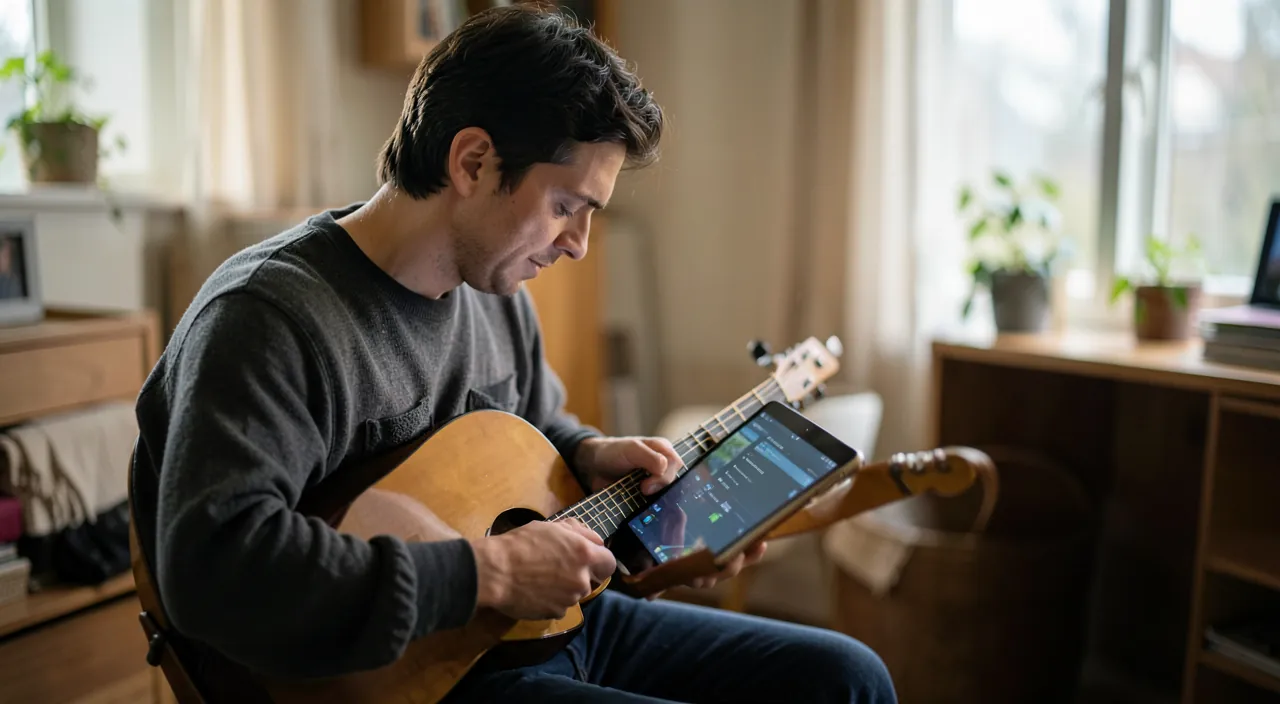
Learning music well with AI’s help
Here’s how to make the most of AI to progress, while keeping the right reflexes. Use it to UNDERSTAND — ask all your theory, reading, and technique questions; have it explain what’s blocking you, differently, at your level; that’s where it excels (a patient theoretical tutor). Ask for an ADAPTED PROGRESSION — tell it your instrument, your level, your goals; ask for steps, exercises, a work plan; it structures your learning. Have it BREAK DOWN the difficulties — a hard passage, a technique: ask how to approach it, where to start, how to practice it. Combine with TUTORIALS and resources that show/play — AI explains with words; but music is also learned by SEEING (videos of gestures, fingerings) and LISTENING; combine AI (understanding, questions) with video tutorials, sheet music, recordings (our guides on learning with tutorials). PRACTICE, again and again — that’s the key: no explanation replaces the act of PLAYING regularly; AI guides, but it’s by practicing (a little each day is better than a lot rarely) that you progress; ask it for tips on effective practice. Consider a real TEACHER for the movement — for posture, fingering, intonation, correcting bad habits before they set in, a human teacher (even a few occasional lessons) is invaluable; AI can’t see or hear you play. A few TIPS and LIMITS: keep a CRITICAL EYE — AI can make mistakes about music theory or give inaccurate explanations (cross-check with reliable sources if a point is important — our guides on AI hallucinations); on specific points (a sheet, a chord), verify. Don’t neglect the MOVEMENT: bad habits (posture, tension, fingering) taken alone are hard to correct; hence the interest of a human eye, at least occasionally. Be PATIENT: learning an instrument takes time; AI helps, motivates, but doesn’t work miracles; regularity and perseverance are key. Keep the FUN: music is a pleasure; don’t let yourself be discouraged, play what you like, celebrate your progress. A PRACTICAL POINT: AI is ideal for UNBLOCKING (understanding a stubborn concept) and for never being alone with a question; a tutor always available, free or almost, that lowers the barrier to musical learning. In short, to learn music well with AI: use it to understand and ask your questions, ask for an adapted progression, have it break down the difficulties, combine with tutorials that show and play, and above all PRACTICE regularly. Keep a critical eye (AI can be wrong), don’t neglect the movement (a human teacher helps), be patient, and keep the fun. AI guides and explains; you play and progress.
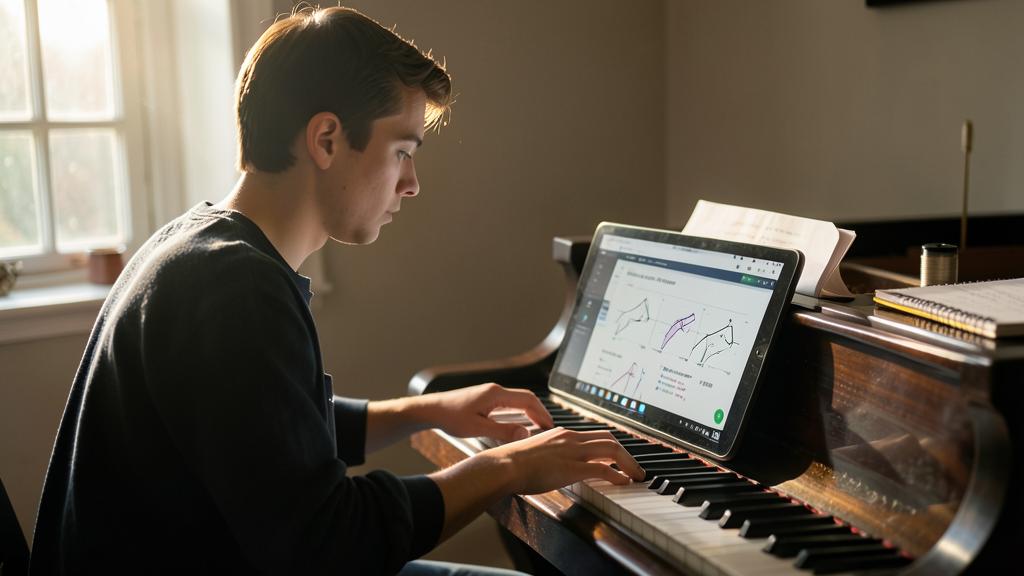
The right reflex. Use AI for what it does best in music: EXPLAIN and ANSWER. It’s a patient theoretical tutor always available: ask it all your questions (theory, sheet music reading, chords, “why does it sound off?”), have it explain what’s blocking you differently and at your level, without ever fearing to ask the same question again. Ask it for an ADAPTED PROGRESSION (tell it your instrument, your level, your goals — it suggests steps and exercises) and have it BREAK DOWN the difficulties (a hard passage, a technique: where to start, how to practice). It’s ideal for UNBLOCKING a stubborn concept and for never being alone with a question — a tutor free or almost, at any time, that lowers the barrier to learning. BUT keep three essential things in mind. One: PRACTICE is paramount. No explanation replaces the act of PLAYING regularly; AI guides, but it’s by practicing (a little each day is better than a lot rarely) that you progress; ask it for tips on effective practice, but it’s you who must play. Two: AI doesn’t SEE or HEAR you play — it can’t therefore correct your MOVEMENT (posture, fingering, intonation, tensions), which a human teacher does; or bad habits taken alone are hard to correct later; consider a real teacher, at least a few occasional lessons, for the movement. Three: keep a CRITICAL EYE — AI can be wrong about music theory; on a specific point (a sheet, a chord), cross-check with a reliable source. Finally, complement AI with VIDEO TUTORIALS (to SEE the gestures) and recordings (to LISTEN): music is learned through words, but also and especially through the eye and ear. Be PATIENT (learning an instrument takes time — AI helps and motivates, but doesn’t work miracles) and keep the FUN (play what you like, celebrate your progress). Understanding and being guided by AI, practicing regularly, combining with visual and auditory resources, and seeing a teacher for the movement: that’s how AI becomes a precious complement to your musical learning, without ever replacing practice or the human ear.
A complementary tutor, not a teacher or practice
AI democratizes access to musical learning, but remains a complement: the movement and practice are at the heart. A few reference points. DEMOCRATIZED ACCESS: music lessons are expensive and lack flexibility; AI offers an available, patient, accessible tutor who explains and guides at any time; it lowers the barrier to entry into music; a real asset, especially to get started or as a self-taught learner. THEORETICAL COMPLEMENT: AI excels at explaining, answering, breaking down, structuring; it’s a formidable support for understanding; but it’s only part of musical learning. IRREPLACEABLE PRACTICE: you learn an instrument by PLAYING, regularly; no explanation replaces training; AI can guide practice, not do it for you; regularity is the key. THE MOVEMENT and HUMAN EAR: AI doesn’t see or hear you play; it doesn’t correct posture, fingering, intonation; a human teacher (even occasionally) brings this precious eye and ear, especially to avoid bad habits. THE WINNING COMBINATION: AI (understand, question), video tutorials (see), recordings (listen), practice (play), and teacher if possible (the movement); each source brings its part. PATIENCE: learning music takes time and perseverance; AI helps and motivates, but doesn’t work miracles; celebrate the small progress. FUN at the center: music is a pleasure; don’t turn it into a chore; play what you like, let AI support you without pressure. In short, AI supports musical learning: it explains the basics, answers your questions at any time, breaks down pieces and techniques, suggests exercises and progression — a patient, available, accessible, and personalized tutor who democratizes access to music. To make the most of it: use it to understand and guide you, ask for a progression, break down the difficulties, combine with tutorials and recordings, and above all PRACTICE regularly. Keep a critical eye (it can be wrong), don’t neglect the MOVEMENT (a human teacher, even occasionally, is precious — AI doesn’t see or hear you), be patient, and keep the fun. At the bottom, AI is a COMPLEMENTARY tutor, not a teacher who sees you or a substitute for practice: it lowers the barrier, guides and explains, but it’s by playing, regularly and with fun, that you really learn music. Used as a support to your practice — and not in its place —, it makes musical learning more accessible and less solitary, at your own pace and at a lower cost. Now it’s up to you to play, literally.
Warning: AI doesn’t hear you play, practice is irreplaceable, and verify the theory. Points of vigilance. UNCORRECTED MOVEMENT — AI can explain theory and guide, but it doesn’t SEE or HEAR you play: it can’t therefore CORRECT your posture, your fingering, your tensions, your intonation; or BAD HABITS taken alone (bad position, tense gesture, inefficient fingering) set in quickly and are HARD to correct later; that’s exactly what a human teacher brings; consider a real teacher, at least a few occasional lessons, to check your movement — especially at the beginning and on instruments where posture matters (piano, strings, wind). IRREPLACEABLE PRACTICE — don’t expect AI (or any explanation) to make you progress without you PLAYING: learning an instrument is primarily about REGULAR PRACTICE; AI guides and motivates, but it’s by training (a little each day) that you progress; don’t confuse understanding a concept and knowing how to play it. THEORY TO VERIFY — AI can be wrong or give inaccurate musical explanations (theory, reading, chords); on a specific or important point, cross-check with a reliable source (method, teacher, recognized resource); don’t take everything at face value (our guides on AI hallucinations). Other points: be PATIENT (learning music takes time; AI doesn’t work miracles — regularity and perseverance are key; don’t get discouraged), keep the FUN (play what you like; don’t turn music into a chore under pressure), and COMBINE the resources (AI to understand, video tutorials to see the gestures, recordings to listen — music isn’t learned just with words). AI is a formidable COMPLEMENTARY tutor for musical learning — available, patient, accessible —, provided you don’t ask it to do what it can’t: it doesn’t hear your playing, doesn’t correct your movement, and doesn’t replace practice or a teacher’s ear. Use it to understand and guide you, practice regularly, have your movement checked by a human, and keep the fun: that’s how it really serves your progress, without illusions about its limits.
Frequently asked questions
Can AI teach me to play an instrument?
It can ACCOMPANY you, but not teach you entirely on its own: it’s a complement, not a complete teacher. What it does very well: explain the basics (theory, reading, chords, rhythm) at your level, answer all your questions at any time without judgment, break down a piece or technique, suggest a progression and exercises, advise you on practice and motivate you. It’s a patient theoretical tutor, available and accessible that lowers the barrier to learning. BUT it has two major limitations in music. First, it doesn’t SEE or HEAR you play: it can’t correct your posture, your fingering, your intonation — which a human teacher does (and bad habits taken alone are hard to correct). Then, learning an instrument is primarily about REGULAR PRACTICE, which nothing can replace: AI guides, but it’s by playing that you progress. The right use: AI to understand and guide you, video tutorials to see the gestures, recordings to listen, daily practice to progress, and if possible a teacher (even occasionally) for the movement. Thus, AI makes musical learning more accessible and less solitary — a precious complement to your practice.
Does AI replace a music teacher?
No: it complements, but doesn’t replace, especially for the movement. AI offers what a teacher can’t always: total availability (at any time), infinite patience (ask the same question without hesitation), low cost, and on-demand explanations. It’s excellent for theoretical understanding, questions, structuring. BUT a human teacher brings what AI can’t: it SEES and HEARS you play; it corrects in real time your posture, your fingering, your intonation, your tensions; it spots and corrects bad habits before they set in (they are then hard to undo); it finely adapts to what it observes; it transmits experience and an ear. For the MOVEMENT and listening, nothing replaces this human eye. The ideal: combine. Use AI daily (understand, question, guided training), and see a teacher (regularly or at least occasionally) to check and correct your playing. Both are complementary: AI democratizes access and supports practice; the teacher brings the eye, the ear, and the movement correction. Far from excluding each other, they form a powerful duo to progress effectively and without bad habits.
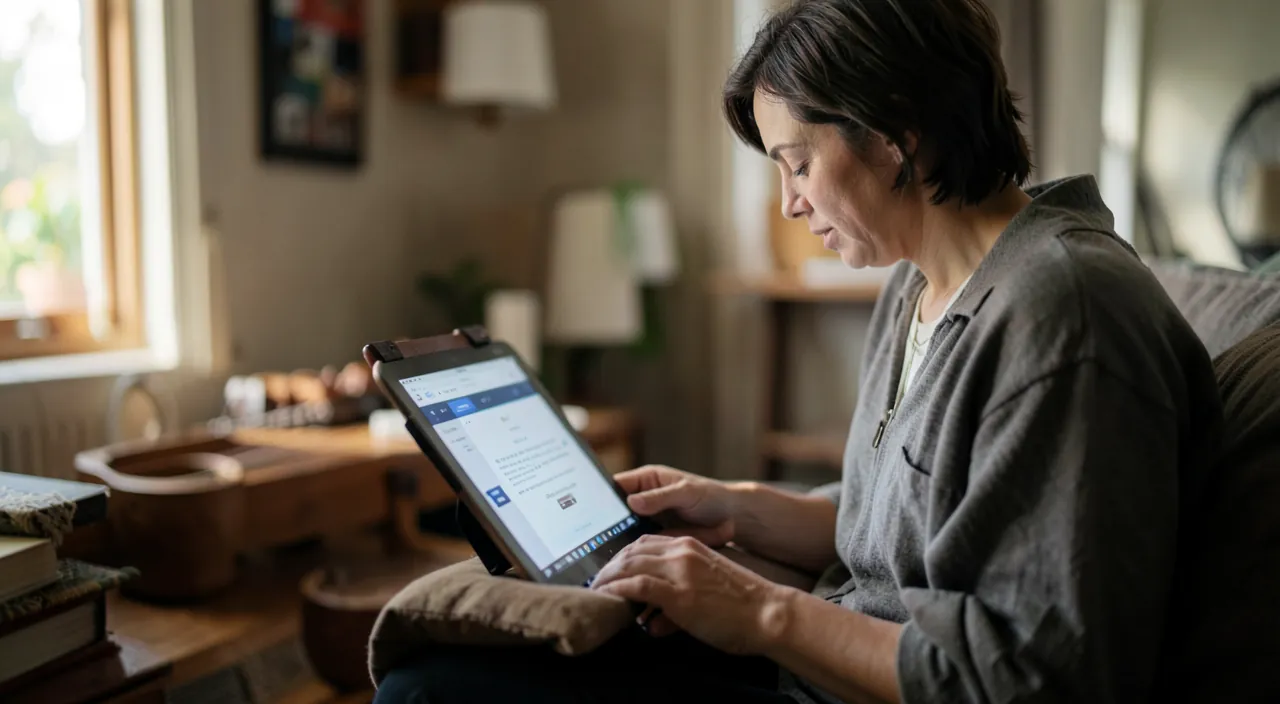
How to really progress with AI’s help?
The key lies in one word: PRACTICE. AI guides, explains, motivates, but it’s by PLAYING regularly that you progress — no explanation replaces training. The right use: (1) use AI to UNDERSTAND (ask your questions, have it explain what’s blocking you, break down the difficulties) and to STRUCTURE (ask for a progression and exercises adapted to your level); (2) PRACTICE a little each day (better than a lot rarely) — ask AI for tips on effective practice, but it’s you who must play; (3) COMBINE with video tutorials (to see the gestures) and recordings (to listen and immerse yourself); (4) have your MOVEMENT checked by a human teacher, at least occasionally (AI doesn’t hear you play and doesn’t correct posture or intonation); (5) keep a critical eye on the theory (AI can be wrong — cross-check important points). Finally, be PATIENT and keep the FUN: music is learned over time, play what you like, celebrate your progress, don’t get discouraged. AI makes learning more accessible and less solitary, but real progress comes from YOUR regular practice, supported by its explanations and, ideally, by a teacher’s eye for the movement. Understanding with AI, playing every day, listening, seeing, and being corrected: that’s the recipe.
What to remember
AI can support musical learning like a patient and available tutor: it EXPLAINS the basics (theory, reading, chords, rhythm) at your level, ANSWERS all your questions at any time without judgment, BREAKS DOWN pieces and techniques, suggests EXERCISES and PROGRESSION, and motivates you. Its strengths: an accompaniment that’s AVAILABLE (at any time, at your pace), ACCESSIBLE (free or low-cost, compared to expensive lessons), patient, and personalized. It democratizes access to musical learning, ideal for beginners, self-taught learners, or to complement lessons. BUT it has ESSENTIAL LIMITS in music. First, it doesn’t SEE or HEAR you play: it can’t CORRECT your MOVEMENT (posture, fingering, intonation, tensions) — which a human teacher does; and bad habits taken alone are hard to correct, hence the interest of a real teacher, at least occasionally, for the movement. Then, learning an instrument is primarily about REGULAR PRACTICE, which nothing can replace: AI guides, but it’s by PLAYING (a little each day) that you progress — don’t confuse understanding a concept and knowing how to play it. Finally, AI can be WRONG about theory: cross-check important points with a reliable source. The right use: use AI to UNDERSTAND and GUIDE you (questions, breakdown, progression), COMBINE it with video tutorials (to see the gestures) and recordings (to listen), PRACTICE regularly, and have your movement checked by a human teacher. Be PATIENT (music is learned over time; AI doesn’t work miracles) and keep the FUN (play what you like, celebrate your progress). At the bottom, AI is a COMPLEMENTARY tutor, not a teacher who sees and hears you, nor a substitute for practice: it lowers the barrier, explains and guides at any time, but it’s by playing regularly, combining resources (see, listen, practice), and ideally with a teacher’s eye for the movement, that you really learn music. Used as a support to your practice — and not in its place —, it makes musical learning more accessible, less solitary, and less costly, at your own pace. Understanding with AI, playing every day with fun, and having your movement corrected by a human: that’s how to really progress. Now it’s up to you to play.
Want to master AI and make it a real asset in your daily life? Our training programs support you at your own pace.
Leave a Reply
You must be logged in to post a comment.