
Between work, children, errands, appointments, household chores, and personal time, organizing your week can sometimes be a puzzle. You end up overwhelmed, forget things, and run without ever feeling like you’re making progress. Artificial intelligence (AI assistants you chat with) can become a valuable organizational assistant: it helps you structure your week, distribute tasks, remember everything, balance obligations and rest, and find methods that suit you. **Warning**: AI suggests an organization, but it doesn’t know the details of your real life, its advice is general and needs to be adapted, and it’s you who lives (and adjusts) your week. Used well, it brings clarity and lightens the mental load. Let’s see how AI can help you organize your week, and its limits.
How AI can help you organize your week
AI is an effective organizational assistant; let’s see its uses. **STRUCTURE** the week: give your obligations and AI suggests an organization (distribute tasks over days); a clear framework; see clearly; useful. **DISTRIBUTE** tasks: it helps to distribute intelligently (group, alternate, not everything on the same day); balance the load; effective; clever. **NOT FORGET** anything: list everything you have to do, AI helps structure a complete list; empty your mind; relieving; useful. **PRIORITIZE**: AI helps distinguish the important from the accessory, the urgent from the rest; focus on the essential; clarifying; precious. **BALANCE** obligations and rest: it reminds you to plan time for yourself, rest, not just tasks; a healthy balance; important; well-being. Find a **METHOD**: AI presents organizational methods (lists, time blocks, routines) to test; find what suits you; educational; useful. Lighten the **MENTAL LOAD**: putting your organization « in writing » with AI frees the mind; no longer keeping everything in your head; soothing; beneficial. Adapt to **YOUR** life: specify your constraints (hours, children, energy); AI adapts the organization; custom-made; relevant. **MANAGE** unexpected events: AI helps keep room for the unexpected, to reorganize when things go wrong; flexibility; realistic; useful. Establish **ROUTINES**: it helps create routines (recurrences) that simplify (grocery day, cleaning day); automate organization; effective. In summary, AI can be a valuable organizational assistant: give it your obligations and it helps you **STRUCTURE** your week (distribute tasks over days), to **DISTRIBUTE** them intelligently (group, alternate, not pile everything on the same day), and to **NOT FORGET** anything (structure a complete list: empty your mind). It helps to **PRIORITIZE** (distinguish the important from the accessory, the urgent from the rest), to **BALANCE** obligations and rest (plan time for yourself, not just tasks), and to find a **METHOD** that suits you (lists, time blocks, routines to test). It lightens the **MENTAL LOAD** (putting your organization in writing frees the mind), **ADAPTS** to your constraints (hours, children, energy), helps to **MANAGE** unexpected events (keep room, reorganize) and to establish **ROUTINES** that simplify. When the week looks like a puzzle, AI brings clarity and structure — a real relief, provided you keep in mind that it’s you who lives, and adjusts, your week.
AI helps organize your week by creating a framework, distributing tasks, and prioritizing what’s important. But it doesn’t know your personal energy levels or exact time constraints, so you need to adjust its suggestions to your real life. The key is to use it as a flexible tool, not a rigid plan.
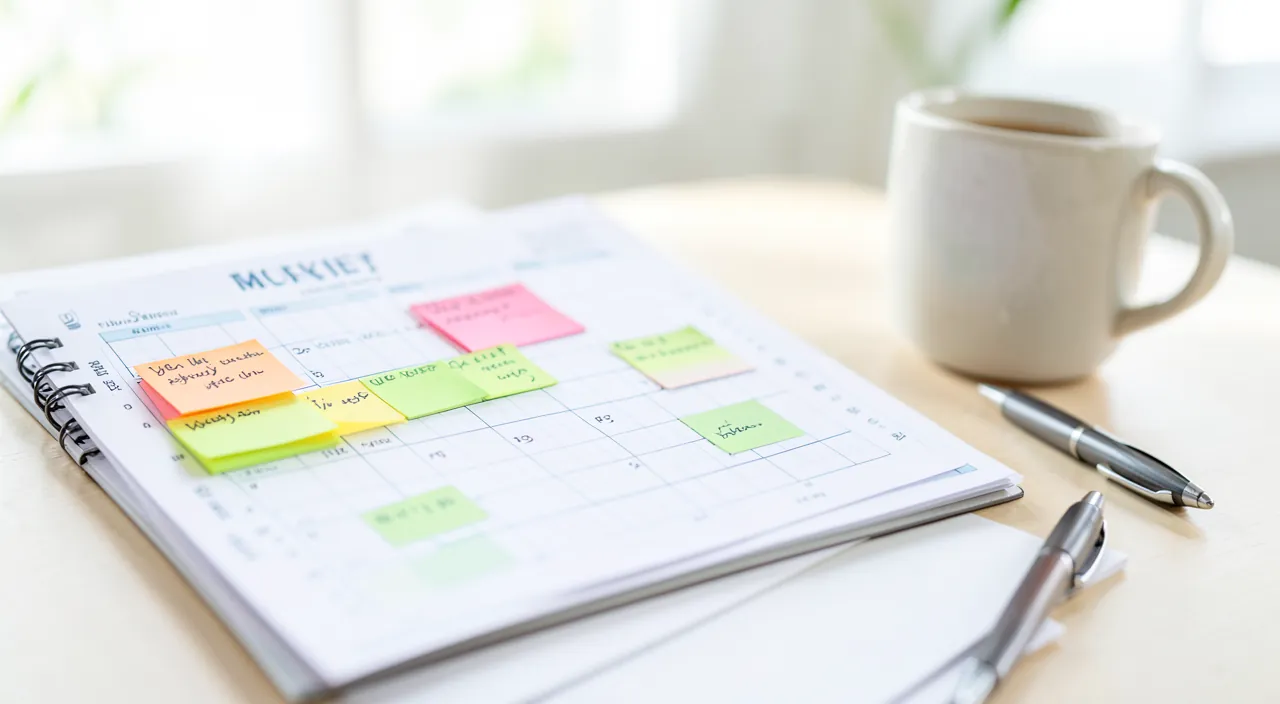
A working parent with two children might ask AI to organize their week. They provide their work hours (9 AM-5 PM), school drop-off/pickup times (8-9 AM, 4-5 PM), and energy peaks (morning). AI suggests: Monday (work + grocery delivery evening), Tuesday (work + kids’ sports after school), Wednesday (half-day work + doctor’s appointment), Thursday (work + meal prep evening), Friday (work + family movie night). The parent then adjusts, moving the doctor’s appointment to Thursday afternoon when they have more energy.
How to use AI effectively to plan
To get the most out of AI, a few good habits; here’s how to proceed. **LIST** everything first: give AI the list of your tasks, obligations, appointments; it organizes better with a complete view; empty your mind; base. Give your **CONSTRAINTS**: specify hours, children, energy times, days off; AI adapts to your reality; custom-made; relevant. Ask for a **PROPOSAL**: « organize my week with this »; AI suggests a framework; a starting point to adjust; useful. Ask to **PRIORITIZE**: « what is priority? « ; AI helps to hierarchize; focus on the essential; clarifying. Plan for **REST**: ask to include time for yourself and rest; a livable week, not just a to-do list; balance; healthy. Keep **MARGIN**: ask not to overload, to leave room for the unexpected; a realistic organization holds better; flexible; realistic. **ADJUST** the proposal: AI’s organization is a base; adapt it to your feelings, your reality; you know your life; adjust. **TEST** then refine: try the organization for a week, then tell AI what worked or not; refine together; iterate; effective. **DON’T OVER-PLAN**: be careful not to spend more time planning than doing; organization serves action, not the other way around; act; essential. Stay **FLEXIBLE**: an organization is a tool, not a prison; adapt without guilt when life interferes; flexibility; kind. In summary, to plan well with AI: **LIST** everything first (tasks, obligations, appointments; it organizes better with a complete view), give your **CONSTRAINTS** (hours, children, energy times, days off), ask for a **PROPOSAL** of organization, then ask to **PRIORITIZE** (the essential first). Make sure to **PLAN** for rest and time for yourself (a livable week, not just a to-do list) and to **KEEP** room for the unexpected (a realistic organization holds better). Key points: **ADJUST** the proposal to your reality (it’s a base, you know your life), **TEST** then refine with AI (tell what worked or not), **DON’T OVER-PLAN** (organization serves action, not the other way around; don’t spend more time planning than doing), and stay **FLEXIBLE** (an organization is a tool, not a prison; adapt without guilt when life interferes). Thus, AI brings you structure and clarity, while keeping your week yours, flexible and livable.
The right approach: empty your mind into AI, let it structure, then adapt to your reality and keep flexibility. AI excels at turning a mess of obligations into a clear week — provided you use it well. Here’s an effective and realistic method. Step 1: **EMPTY** your mind. The first benefit, immediate, is to get everything **OUT** of your mind. List to AI absolutely everything you have to do or not forget this week: work, appointments, errands, household chores, procedures, children’s activities, phone calls, moments for yourself… in a mess, as it comes. Just this « dump » already relieves the **MENTAL LOAD**: as long as you keep everything in your head, your mind spins and exhausts itself; once written, it frees itself. Step 2: give your **CONSTRAINTS** and let AI **STRUCTURE**. Specify the framework: your work hours, the times you have the children, your energy peaks and troughs (are you a morning or evening person?), your days off, the unchangeable slots. Then ask AI to organize all that: it will propose a distribution over the week (group similar tasks, alternate the demanding and the light, place the difficult when you have energy), a hierarchy of priorities (the important and urgent first), and — if you ask — slots for **REST** and time for yourself (crucial: a good organization is not just a list of chores, it’s a **LIVABLE** week). Step 3: **ADAPT** to your reality. AI’s proposal is a **BASE**, not a verdict: you know your life better than it does. Adjust what doesn’t fit, move, lighten if it’s too loaded. A key point: keep **MARGIN** for the unexpected (a week scheduled to the minute derails at the first grain of sand); don’t fill every slot, let it breathe. Step 4: **LIVE** the week, with flexibility. An organization is a **TOOL** at the service of your life, not a prison that stresses you. If an unexpected event disrupts everything, reorganize without guilt (you can even ask AI to readjust). The goal is not to follow the plan to the letter, but to move forward more serenely and not forget anything important. Step 5: **REFINE** over the weeks. After a few days, take stock: what worked? What was unrealistic? Tell AI, which will adjust. Little by little, you will find **YOUR** method and your routines (grocery day, cleaning evening…), which simplify everything. In summary, the right approach is in four steps: **EMPTY** your mind into AI (list everything: immediate relief of mental load), let it **STRUCTURE** according to your constraints (distribution, priorities, and especially rest: a livable week), **ADAPT** to your reality keeping **MARGIN** for the unexpected (its proposal is a base, not a prison), and **LIVE** with **FLEXIBILITY** refining over the weeks (reorganize without guilt, find your routines). AI brings structure and clarity; you bring the knowledge of your life and flexibility. Together, a week less suffered, less forgetful, and above all less heavy on the mind.

Concrete uses to organize your week
Here are concrete ways to use AI for your organization. « Organize my **WEEK** with this »: give your obligations, AI suggests a distribution; a starting framework; useful. « Help me **PRIORITIZE** »: AI hierarchizes the important, the urgent, the accessory; focus on the essential; clarifying. « I feel **OVERWHELMED**, help me »: empty everything, AI helps to order and dramatize less; regain control; soothing. « Make me a **CHECKLIST** »: a clear list of everything to do; forget nothing; concrete; useful. « Propose a **ROUTINE** »: for recurring tasks (cleaning, errands, meals); simplify the recurring; effective. « Help me fit in **TIME** for myself »: integrate rest, leisure, sports; a balanced week; well-being; healthy. « Plan the **MEALS** of the week »: ideas and organization of meals; lighten a daily load; practical. « How to manage this **BUSY** week? »: AI helps to absorb a peak; get through a tough time; supportive. « An **ORGANIZATION** method for me? »: AI presents methods to test; find yours; educational. **ADJUST** and live: adapt these proposals to your reality and live the week with flexibility; organization serves action; act. In summary, use AI in concrete ways: to **ORGANIZE** (« organize my week with this », « make me a checklist »), to **PRIORITIZE** (« help me prioritize », « I feel overwhelmed, help me »), to **SIMPLIFY** the recurring (« propose a routine », « plan the meals of the week »), to **BALANCE** (« help me fit in time for myself »), to **GET THROUGH** a tough time (« how to manage this busy week? »), and to **FIND** your method (« an organization method for me? »). But in all cases, **ADJUST** these proposals to your reality and **LIVE** the week with flexibility: organization is at the service of action, not an end in itself. These uses, from the simple « mind dump » to the well-oiled routine, make AI an organizational assistant that brings clarity and serenity to everyday life.
Warning: AI doesn’t know your real life, don’t plan instead of acting, and keep flexibility rather than a stressful organization. As useful as it may be, AI has limits that you need to know so that organization remains a relief, not a new source of pressure. First point: AI doesn’t know your **REAL LIFE**. It doesn’t know your real energy throughout the days, the true duration of your tasks, the thousand constraints and uncertainties of your daily life, your family, your fatigue. Its proposals are therefore **GENERAL** and theoretical: an organization that looks perfect on paper can be unrealistic in practice (too loaded, poorly paced, ignoring your real rhythms). It’s up to **YOU** to adapt its suggestions to your reality: you are the only expert of your life. Never follow a schedule to the letter if it doesn’t fit your daily life; adjust it without hesitation. Second point, the classic trap: **PLANNING** instead of **ACTING**. It can be strangely satisfying to spend time refining a beautiful organization, discussing methods with AI, redoing your schedule… while not actually doing much. Be careful: organization is a **MEANS** at the service of action, not an end in itself. The goal is not to have the most beautiful schedule, but to **DO** what needs to be done and live more serenely. Don’t spend more time organizing than acting: a simple and followed organization is worth a thousand times better than a sophisticated system that occupies you without producing anything. Third point: keep **FLEXIBILITY**, don’t become a slave to your schedule. A too rigid organization can become a source of **STRESS** and guilt: if you feel bad as soon as a box isn’t checked, if the slightest unexpected event angers you, the tool turns against you. Yet life is made of unexpected events: always keep **MARGIN** (don’t fill every minute), accept to reorganize when things go wrong, and don’t feel guilty for not doing everything. Organization must **SERVE** you (reduce mental load, avoid forgetting, move forward more serenely), not **ENSLAVE** you. If it stresses you more than it helps, lighten it. Fourth point: don’t forget **REST** and the human. A week is not just a list of tasks to complete: make sure to keep time for yourself, for your loved ones, to breathe. An organization that only plans chores leads to exhaustion. Finally, be careful with **PERSONAL DATA**: avoid sharing very sensitive information about your private life in detail with AI (stay in the general organization). In summary, AI doesn’t know your **REAL LIFE** (its schedules are **GENERAL** and theoretical: adapt them to your reality, you are the only expert of your daily life), be careful not to **PLAN** instead of **ACT** (organization serves action, it is not an end: don’t spend more time organizing than doing), keep **FLEXIBILITY** (a rigid organization stresses and makes you feel guilty: keep margin, reorganize without guilt, the tool must serve you, not enslave you), and don’t forget **REST** (a livable week, not just a list of chores). Used as a flexible assistant that brings clarity and serenity, AI really lightens everyday life; transformed into a rigid and time-consuming schedule, it adds stress. The goal remains simple: a week less suffered and lighter — not a perfect schedule that weighs on you.

Frequent questions
Can AI really help me be better organized?
Yes, as an assistant to structure, prioritize and not forget anything: it brings clarity and lightens the mental load; but it’s you who lives and adjusts your week, and organization doesn’t replace taking action. Let’s see. YES, for **STRUCTURE**: AI really helps to structure, prioritize, list; put order in the mess; real support; useful. Lighten the **MENTAL LOAD**: getting everything out of your head and putting it with AI frees the mind; an immediate and real benefit; soothing; precious. See **CLEARLY**: when you’re overwhelmed, AI helps you see clearly, to hierarchize; regain control; clarifying; relieving. **NOT FORGET** anything: a structured list avoids forgetting; externalized memory; reassuring; useful. BUT you live the week: AI suggests, but it’s you who live, act, adjust; organization doesn’t do the tasks; you have to act; clear. Adapt to **YOUR** reality: its plans are general; adapt them; you are the expert of your life; adjust; essential. **DON’T OVER-PLAN**: be careful not to organize instead of acting; organization serves action; act; vigilance. Find **YOUR** method: AI helps you test methods until you find yours; personalize; progressive; useful. A real **PLUS** for many: for those who struggle to organize, this support makes a real difference; a daily ally; positive. The **ADVICE**: yes, AI really helps to be better organized (structure, prioritize, not forget, lighten mental load), but it’s you who live and adjust your week; adapt its plans to your reality, and don’t forget that organization serves action. In summary, yes, AI can really help you be better organized — provided you understand its role. Its contribution is real on several levels: it helps to **STRUCTURE** (put order in the mess of obligations), to **PRIORITIZE** (distinguish the important from the accessory when you’re overwhelmed), and to **NOT FORGET** anything (a structured list serves as an external memory). Above all, it lightens the **MENTAL LOAD**: the simple fact of getting everything you have in mind and putting it in writing with AI frees the mind, which no longer has to remember and ruminate everything — an immediate and often underestimated benefit. For many people who struggle to organize or feel overwhelmed, this support makes a real difference. BUT you need to keep two things in mind. First, AI **SUGGESTS**, but it’s **YOU** who live the week, act and adjust: an organization doesn’t do the tasks for you, and taking action remains your part (be careful not to spend more time planning than acting). Then, its plans are **GENERAL** and theoretical: you are the only expert of your real life (your energy, your constraints, your uncertainties), so always adapt its suggestions to your reality rather than following them to the letter. Used this way — as an assistant that brings clarity, structure and mental relief, whose proposals you adapt and that you complete with action — AI is a precious ally to better organize your daily life. It doesn’t organize you in your place, but it gives you the means to do so, more easily than ever.

How to avoid spending more time organizing than acting?
Set yourself a short time limit for planning, keep a simple organization, and quickly get into action: the goal is to **DO**, not to have the perfect schedule; an imperfect plan followed by action is better than a sophisticated system that occupies you. Let’s see. The **TRAP** of over-planning: endlessly refining your organization can become a (satisfying) way not to act; disguised procrastination; beware; vigilance. The **GOAL**: act; remember that the goal is to **DO** things, not to have the most beautiful schedule; action is the finality; refocus; essential. **LIMIT** yourself in time: give yourself a short time to plan (10-15 min), then stop; don’t plan for hours; frame; effective. Stay **SIMPLE**: a simple organization (a list, a few priorities) often suffices; no need for a complicated system; simplicity holds better; clever. **START** quickly: once minimally organized, get into action; don’t postpone behind « a little more planning »; start; act. An **IMPERFECT** plan is enough: an imperfect plan followed by action is better than a perfect plan never applied; don’t aim for perfection; act with the imperfect; pragmatic. **ADJUST** as you go: you adjust the organization by acting, not by perfecting it in advance; action informs the plan; adjust on the go; realistic. AI **QUICKLY**, then act: ask AI for a quick organization, then get into action; don’t discuss method indefinitely; use it quickly; effective. Measure by **FACT**: judge your organization by what it makes you **ACCOMPLISH**, not by its beauty; action is the criterion; concrete; lucid. The **ADVICE**: set yourself a short time limit for planning, keep a simple organization, and quickly get into action; the goal is to do, not to have the perfect schedule; an imperfect plan followed by action is better than a sophisticated system that occupies you without producing. In summary, to avoid the trap (common and sneaky) of spending more time organizing than acting, keep the focus on the **ESSENTIAL**: the goal of any organization is to **DO** things and live more serenely, NOT to have the most beautiful schedule in the world. Endlessly refining your organization can indeed become a form of disguised procrastination: it’s satisfying, it gives the impression of moving forward, but concretely you do nothing. To avoid this, a few simple rules. First, **LIMIT** yourself in time: give yourself a short slot to plan (10 to 15 minutes often suffice to organize a day or a week), then stop — don’t plan for hours. Then, stay **SIMPLE**: a list and a few priorities are better than a sophisticated and time-consuming system; simplicity holds over time, complexity is abandoned. Then, **START** quickly: once minimally organized, get into action without postponing behind « a little more preparation ». Accept that an **IMPERFECT** plan followed by action is infinitely better than a perfect plan never applied: you actually adjust your organization much better by **ACTING** (action reveals what works) than by perfecting it in advance in a vacuum. Concretely with AI: ask it for a **QUICK** organization, then get into action — don’t lose yourself discussing method indefinitely with it. And judge your organization by a single criterion: what it actually makes you **ACCOMPLISH**, not its beauty on paper. By keeping this discipline — plan quickly and simply, then act — you benefit from the benefits of organization (clarity, priorities, fewer forgets) without falling into the trap of organization that replaces action.
Won’t a too strict organization risk stressing me?
Yes, a too rigid organization can become a source of stress and guilt: always keep flexibility and margin, accept the unexpected, and remember that organization should serve you, not enslave you. Let’s see. YES, the risk exists: a too strict organization can stress (guilt as soon as a box isn’t checked, anxiety at the slightest unexpected event); the tool then turns against you; vigilance. Life is made of **UNEXPECTED EVENTS**: you don’t control everything; a rigid schedule derails at the first hiccup; plan for the unexpected; realistic. Keep **MARGIN**: don’t fill every minute; leave free spaces to absorb the unexpected; margin avoids stress; breathe. Stay **FLEXIBLE**: see organization as a flexible guide, not a rigid law; adapt without guilt; flexibility preserves; kind. **DON’T FEEL GUILTY**: if you don’t do everything, it’s not serious; postpone, adjust; guilt doesn’t help; indulgence. The tool must **SERVE** you: organization should reduce your stress (fewer forgets, more clarity), not increase it; if it weighs on you, lighten it; it’s at your service. **LIGHTEN** if needed: if your organization stresses you more than it helps, simplify it, soften it; adapt the tool to you; adjust; healthy. Plan for **REST**: integrate rest and time for yourself; an organization that only plans tasks exhausts; balance; well-being. Ask AI for **FLEXIBILITY**: ask for a realistic organization, with margin and rest, not overloaded; AI can be flexible if you ask; frame. The **ADVICE**: yes, a too strict organization can stress; keep flexibility and margin, accept the unexpected without guilt, plan for rest, and lighten if it weighs on you; organization should serve you, not enslave you. In summary, yes, a too strict organization **CAN** indeed stress you — and it’s an important trap to avoid, because the tool would then turn against its purpose. The mechanism: a too rigid schedule generates **GUILT** as soon as a box isn’t checked, and **ANXIETY** at the slightest unexpected event that makes it derail. Yet life is, by nature, made of **UNEXPECTED EVENTS** and uncertainties that we don’t control: an organization scheduled to the minute is doomed to fail, and to frustrate you. The key is therefore **FLEXIBILITY**. Concretely: always keep **MARGIN** (don’t fill every minute; leave free spaces to absorb the unexpected and breathe), see your organization as a **GUIDE** flexible and not a rigid law (adapt, move, reorganize as life goes), and above all **DON’T FEEL GUILTY** if you don’t do everything: postpone what needs to be, adjust, move forward. Don’t forget to also plan for **REST** and time for yourself: an organization that only aligns tasks leads straight to exhaustion. The fundamental principle to remember: organization must **SERVE** you, not **ENSLAVE** you. Its role is to **REDUCE** your stress (by avoiding forgets, by bringing clarity, by lightening the mental load), certainly not to **INCREASE** it. So, if you notice that your organization weighs on you and angers you more than it helps, it’s a sign that you need to **LIGHTEN** it: simplify it, soften it, adapt the tool to you (and not the other way around). Moreover, when you ask AI to organize you, specify that you want a **REALISTIC** and flexible organization, with margin and rest, rather than an overloaded schedule — it will adapt. A good organization is the one that makes your life lighter and more serene, not the one that adds pressure: always keep this objective in mind.
What to remember
Between work, family, errands, appointments and all kinds of tasks, organizing your week can quickly turn into an exhausting puzzle. Artificial intelligence can become a valuable organizational assistant: it helps to **STRUCTURE** the week, to **DISTRIBUTE** tasks intelligently, to **PRIORITIZE** the essential, to **NOT FORGET** anything, to **BALANCE** obligations and rest, to establish **ROUTINES**, and above all to lighten the **MENTAL LOAD** (putting everything in writing frees the mind). The right approach is in four steps: **EMPTY** your mind into AI (list everything you have to do: immediate relief), let it **STRUCTURE** according to your constraints (distribution, priorities, and especially rest for a livable week), **ADAPT** its proposal to your reality keeping **MARGIN** for the unexpected (it’s a base, not a verdict), and **LIVE** the week with **FLEXIBILITY** refining over time (reorganize without guilt, find your routines). But keep in mind its **LIMITS**. AI doesn’t know your **REAL LIFE** (your energy, the true duration of tasks, your uncertainties): its schedules are **GENERAL** and theoretical, to be absolutely adapted to your daily life, of which you are the only expert. Beware of the trap of **PLANNING** instead of **ACTING**: organization is a means at the service of action, not an end — don’t spend more time organizing than doing (plan quickly and simply, then get into action; an imperfect plan followed by action is better than a perfect system never applied). And keep **FLEXIBILITY**: a too rigid organization generates stress and guilt (as soon as a box isn’t checked, at the slightest unexpected event); always keep margin, accept the unexpected without guilt, plan for rest, and lighten your system if it weighs on you. The fundamental principle: organization must **SERVE** you (reduce mental load, avoid forgets, move forward more serenely), not **ENSLAVE** you. In short, used as a flexible assistant that brings clarity and relief — whose proposals you adapt, that you complete with action, and that you keep flexible — AI really transforms a suffered and heavy week into a clearer, less forgetful and lighter week. The goal is never the perfect schedule: it’s a daily life better mastered and more serene.



Want to master AI and make it a real asset in your daily life? Our training courses accompany you at your own pace.
Leave a Reply
You must be logged in to post a comment.