
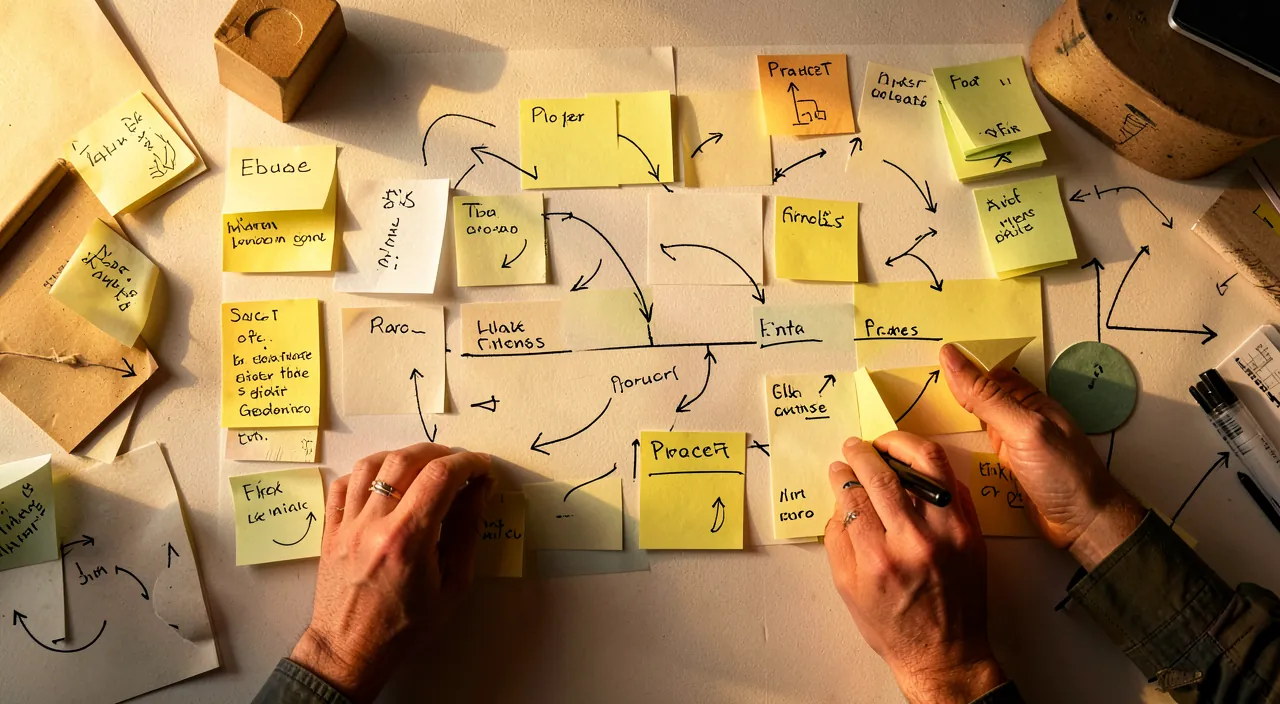
Do you have a personal project that you care about—writing a book, launching a small business, organizing a big trip, renovating a room, creating a vegetable garden, learning a skill, starting an association…—but it remains in your head, vague and intimidating, because you don’t know where to start? Artificial intelligence (AI assistants you chat with) can help you STRUCTURE it: clarify the goal, break the project into steps, identify tasks, anticipate obstacles, and build a concrete plan. Warning: AI helps you organize and think, but it doesn’t carry out the project for you, doesn’t know everything about your real situation, and its advice is general and needs to be adapted. When used well, it turns a vague, paralyzing idea into a clear, actionable plan that makes you want to get started. Let’s see how AI can help you structure a personal project, and its limits.
How AI can help you structure your project
AI turns vagueness into a clear plan—let’s see its uses. CLARIFY the goal: AI helps you define what you really want to achieve; a clear goal guides everything; defining the purpose is essential. BREAK DOWN into steps: it divides the project into major steps, then into tasks; the overwhelming becomes a series of steps; making it feasible is key. IDENTIFY tasks: AI helps you list everything you need to do; nothing is forgotten; a complete overview; useful. ESTABLISH an order: it helps you sequence the steps (what first, what next); a logical progression; structuring; useful. ANTICIPATE obstacles: “what difficulties should I expect?”; AI helps you anticipate and prepare; being proactive; strategic. ESTIMATE time and resources: AI helps you think about time, budget, and necessary resources; measuring the effort; realistic; useful. ASK the right questions: it helps you identify what you might have missed (what have I forgotten?); filling in blind spots; insightful; useful. OVERCOME paralysis: a vague project paralyzes; structuring it makes it manageable; unlocking action; liberating; precious. BUILD a concrete plan: AI helps you formalize a clear action plan; moving from idea to action; structuring; useful. ADAPT to your reality: specify your constraints (time, budget, skills); AI adjusts the plan; custom; relevant. In summary, AI can help you structure your personal project in several ways: it helps you CLARIFY the goal (define what you really want to achieve: a clear goal guides everything), BREAK DOWN the project into major steps, then into tasks (the overwhelming becomes a series of feasible steps), IDENTIFY all tasks (nothing is forgotten) and ORDER them logically (what first, what next). It helps you ANTICIPATE obstacles (“what difficulties should I expect?”), estimate TIME, budget, and necessary resources, ASK the right questions (what have I forgotten?), and build a concrete PLAN of action adapted to your reality (time, budget, skills). Above all, it helps you overcome PARALYSIS: a vague, intimidating project stays in your head; once structured into clear steps, it becomes manageable and makes you want to get started. AI thus transforms a vague idea into an actionable plan—the first step, often the hardest, toward realization.

AI helps you break down a big project into smaller, manageable steps. It’s like having a coach who helps you see the path clearly, but you’re the one who has to walk it. The key is to start with a very small, easy step to overcome the fear of starting.
Imagine you want to write a book. Instead of feeling overwhelmed by “write a book,” AI helps you break it down: “Outline the chapters,” “Write 500 words a day,” “Find a beta reader.” Suddenly, the project feels doable.
How to use AI effectively to organize a project
To make AI truly helpful, a few good habits; here’s how to proceed. DESCRIBE your project: explain your idea, your goal, your context; the more AI knows, the better it structures; detail; base. CLARIFY the goal first: “help me clarify my goal”; a clear goal before planning; define the target; essential. ASK for a breakdown: “break this project into steps”; clear milestones; making it feasible; structuring. ASK for tasks: “list everything I have to do”; a complete overview; nothing forgotten; useful. ASK for a plan: “make me an action plan”; a roadmap; taking action; concrete. ANTICIPATE difficulties: “what obstacles should I expect?”; prepare countermeasures; being proactive; strategic. GIVE your constraints: available time, budget, skills, deadline; AI adapts; realistic; relevant. ADJUST the plan: the AI plan is a starting point; adapt it to your reality and means; you know your situation; adjust. START with a small step: ask “what should I start with?”; a first concrete step launches the project; begin; essential. TAKE action: AI structures, but you carry it out; don’t plan endlessly, act; the plan serves action (we’ll come back to this); act. In summary, to organize a project well with AI: DESCRIBE your project, goal, and context (the more AI knows, the better it structures), clarify the GOAL first (“help me clarify my goal”: a clear goal before planning), then ask for a BREAKDOWN into steps, the LIST of tasks, and an ACTION PLAN. ANTICIPATE difficulties (“what obstacles should I expect?”), give your CONSTRAINTS (time, budget, skills, deadline) for a realistic plan, and ADJUST it to your reality (it’s a starting point, you know your situation). Two essential points: START with a small concrete step (“what should I start with?”: a first step launches the project), and TAKE action (AI structures, but it’s YOU who carries it out: don’t plan endlessly). Thus, AI helps you turn a vague idea into a clear plan—but it’s your action that will bring the project to life.
The right approach: clarify the goal, break the project into steps, identify the first small step—and then get started. What often prevents a personal project from moving forward isn’t a lack of desire, but PARALYSIS in the face of a vague, intimidating project you don’t know where to start with. AI is excellent at lifting this paralysis, by turning vagueness into a clear plan. Here’s the method. Step 1: CLARIFY the goal. First, you need to know exactly what you want to achieve. A vague goal (“write a book,” “launch a business”) makes any planning impossible. Describe your idea to the AI and ask it to help you PRECISE it: what is the exact goal? What would the completed project look like? A clear, concrete goal is the compass for everything else. Step 2: BREAK DOWN into steps. This is the heart of structuring, and AI’s great strength. A whole project, seen as a block, is overwhelming; broken down into major STEPS, then into concrete TASKS, it becomes a series of feasible steps. Ask: “Break this project into major steps, then detail the tasks for each step.” You’ll then see your intimidating project transformed into an ordered list of precise actions—and suddenly, what seemed impossible appears achievable, one step at a time. Also ask the AI to ORDER these steps logically (what to start with, what depends on what). Step 3: ANTICIPATE and adapt. Ask the AI what OBSTACLES to expect and how to prepare for them, and give it your real CONSTRAINTS (available time, budget, skills, deadline) so it can adapt the plan. Then ADJUST everything to your reality: the AI’s plan is an excellent starting point, but you know your situation better than it does. Step 4, the most important one: identify the FIRST SMALL STEP, and get started. A plan, no matter how beautiful, is useless if it stays on paper. Ask the AI: “What should I start with concretely? What is the very first small step?” Then DO that first step. It’s what transforms the project from an idea into a reality in motion: once started, the momentum kicks in. The psychological trick: a first step that’s VERY SMALL and easy (making a phone call, writing a page, buying a material) is less intimidating and is enough to get started. Step 5: MOVE forward step by step, returning to the AI if needed to adjust the plan, unblock a difficulty, or take stock. In summary, the right approach to structuring a project: CLARIFY the goal (know exactly what you want), break the project into concrete, ordered steps and tasks (the intimidating vagueness becomes a series of feasible steps—the great power of AI), ANTICIPATE obstacles and adapt to your real constraints, then identify the FIRST SMALL STEP and GET STARTED (the most important: a plan is only worth the action that follows; a very small first step is enough to set the momentum in motion). Then move forward step by step. This method lifts the paralysis that blocks so many projects: AI turns a vague, overwhelming idea into a clear path, marked by concrete steps. Then it’s up to you to walk it.

AI at every stage of your project
AI accompanies the project from start to finish; here are its uses at each phase. AT THE START: clarify the goal, break it down, make a plan; lay the foundations; structuring; essential. TO PRIORITIZE: distinguish what’s important, urgent, what unlocks the rest; move forward effectively; clarifying; useful. FACING A BLOCKAGE: stuck on a step? AI helps you unblock, find solutions; overcoming obstacles; supporting; useful. TO TAKE STOCK: come back to review progress, adjust the plan; keep on track; follow-up; motivating. TO STAY MOTIVATED: remind yourself of the “why,” celebrate milestones; keep the momentum; encouraging; useful. TO SOLVE a problem: a concrete issue? AI helps you think through options; move forward despite the unexpected; useful; practical. TO LEARN what you need: a project often requires learning; AI explains, guides; fill in the gaps; useful. TO REORGANIZE: the project evolves; AI helps you adjust the plan; adapt to reality; flexible; realistic. TO COMPLETE: finalize, check nothing is forgotten; bring to completion; thorough; satisfying. AS A TRAVEL COMPANION: available throughout, AI supports the realization; a constant ally; present; motivating. In summary, AI accompanies your project AT EVERY STAGE: AT THE START (clarify, break down, plan—lay the foundations), to PRIORITIZE (what’s important, urgent, what unlocks the rest), facing a BLOCKAGE (find solutions to overcome an obstacle), to TAKE STOCK (follow progress, adjust), to STAY MOTIVATED (remind yourself of the “why,” celebrate milestones), to SOLVE a concrete problem, to LEARN what the project requires (it explains, guides), to REORGANIZE when the project evolves, and to COMPLETE (finalize without forgetting anything). As a TRAVEL COMPANION available throughout, it supports the realization from start to finish. But remember that this support remains an accompaniment: AI helps you think, plan, and unblock, while the concrete realization—the action, the effort, the perseverance—is up to you. It’s this complementarity that makes a project move forward: AI structures and supports, you carry it out.
Warning: AI structures but doesn’t carry out the project; don’t plan instead of acting, and adapt its general advice to your reality. As useful as it may be for structuring, AI has limits you need to know so your project actually comes to fruition. First point, fundamental: AI STRUCTURES, but it doesn’t REALIZE the project for you. It can help you clarify, break down, plan, unblock, motivate—but the action, the effort, the concrete work, the perseverance over time depend only on YOU. No plan, no matter how perfect, writes the book, launches the business, or renovates the room for you. AI is an architect and a consultant; you are the builder. Don’t confuse “having a beautiful plan” with “moving forward”: the plan is only the starting point. Second point, the most common trap: PLANNING instead of ACTING. It’s very tempting, and falsely satisfying, to spend a lot of time refining the plan, structuring, re-structuring, discussing the project with AI… while never actually moving it forward concretely. This “active procrastination” gives the illusion of progress while you stay at square one. Warning: the goal isn’t to have the perfect plan, it’s to REALIZE the project. Once the goal is clarified and the first step identified, STOP planning and START acting. A flawed plan followed by action is better than a perfect plan never executed; and you actually refine a plan much better by acting than by perfecting it in a vacuum. Third point: AI’s advice is GENERAL, to be adapted to your reality. It doesn’t know everything about your situation (your real constraints, your actual resources, your context, the specifics of your field): its plan can be theoretical, too ambitious, or miss important particularities. It’s up to YOU to adapt its suggestions to your concrete reality, of which you are the only expert. Don’t follow a plan to the letter if it doesn’t fit your situation. Fourth point: for projects with STAKES or specialized aspects, AI doesn’t replace real experts. If your project involves legal (creating an association, launching a business), financial, highly technical, or regulatory aspects, AI can give general pointers, but VERIFY important information with reliable sources and consult real professionals (lawyers, accountants, specialists) for what has consequences. It can also be wrong: keep your critical thinking. Fifth point: keep the PROJECT YOURS. It’s YOUR dream, your vision: AI helps you organize it, but don’t let it distort your project or impose a direction that isn’t yours. The important decisions are yours. In summary, AI STRUCTURES but doesn’t REALIZE the project (the action and perseverance depend only on YOU: a beautiful plan isn’t a realized project), beware of PLANNING instead of ACTING (the goal is to realize, not to have the perfect plan: at some point, stop planning and get started), its advice is GENERAL (adapt it to your reality, of which you are the only expert), for SPECIALIZED STAKES (legal, financial, technical) consult real experts and verify the info, and keep the PROJECT YOURS (the important decisions are yours). Used as an architect who helps you build the plan and pushes you to act, AI is a formidable ally for your projects; expected to carry out the work for you, or followed blindly, it disappoints or misleads. Your project will only come to life through your action—the AI just gives you the plan to get there better.

Frequently asked questions
Can AI help me start a project that intimidates me?
Yes, very well: by clarifying the goal and breaking the project into small, concrete steps, AI turns the intimidating vagueness into a clear, manageable path; identifying a first small step is often enough to unblock and get started. Let’s see. YES, this is a strong point: helping to get started is one of AI’s best uses; it lifts the paralysis that blocks so many projects; effective; liberating. The problem: the VAGUENESS that intimidates: a project seen as a vague, huge block paralyzes; you don’t know where to start; hence the intimidation; that’s what needs to be lifted. CLARIFYING reassures: defining the goal makes the project less vague, more graspable; clarity calms; define the purpose; useful. BREAKING DOWN into small steps: broken down into concrete steps, the huge becomes a series of feasible steps; each step is manageable; making it possible; key. The FIRST step: identifying a very first small, easy step is enough to get started; starting is the hardest part; a small step unblocks; essential. The MOMENTUM kicks in: once started, the drive comes; the hardest part is to begin; the first step sets everything in motion; motivating. Seeing the PATH reassures: seeing a clear plan (instead of fog) restores confidence; the project seems feasible; reassuring; positive. One step at a time: focus on the current step, not the immensity; less overwhelming; move forward step by step; soothing. BUT you have to act: AI helps you get started, but you take the step; the plan invites action, it doesn’t replace it; act; key. The ADVICE: yes, AI helps very well to get started; by clarifying the goal and breaking the project into small, concrete steps, it turns the intimidating vagueness into a clear path; identify a first small, easy step and do it—the momentum kicks in. In summary, yes, AI can very well help you start a project that intimidates you—it’s even one of its most precious uses, as it directly addresses what blocks so many projects: PARALYSIS in the face of the unknown. First, understand where the intimidation comes from: a project seen as a BLOCK that’s vague and huge (writing a book, launching a business) seems insurmountable, because you don’t know where to take it. AI dissolves this fear in two ways. First by CLARIFYING the goal: defining exactly what you want to achieve makes the project less vague, more concrete, therefore less scary. Then, and above all, by BREAKING IT DOWN into small, concrete steps: what seemed an insurmountable wall becomes a SERIES OF STEPS, each manageable individually. Seeing your project transformed into a clear list of precise actions is in itself extremely reassuring—you go from paralyzing fog to a marked path. The key to starting, then, is the FIRST SMALL STEP: ask the AI what the very first, concrete, easy gesture to make is (make a call, write a page, buy a material), and DO IT. Because the hardest part in a project is to start: once this first step is taken, the MOMENTUM kicks in, and it becomes much easier to continue, one step at a time (focus on the current step, not the immensity of the whole). AI thus gives you exactly what you need to overcome intimidation: a clear goal, a path broken down into feasible steps, and a first step identified. One imperative: it’s you who must TAKE that first step—the AI puts you in the best conditions to get started, but the gesture is yours. And often, this simple first step changes everything.

How to avoid spending more time planning than realizing your project?
Limit planning time, settle for a “good enough” plan, and quickly get into action: the goal is to REALIZE, not to have the perfect plan; you refine a plan much better by acting than by endlessly perfecting it. Let’s see. The TRAP of over-planning: endlessly refining the plan is a disguised form of procrastination; satisfying but sterile; beware; vigilance. The GOAL: to realize: remember that the goal is to DO the project, not to have the most beautiful plan; action is the finality; refocus; essential. A “good enough” plan: a sufficient plan is better than a perfect plan never followed; don’t aim for perfection; “good enough” is enough; pragmatic. LIMIT yourself in time: allocate a defined time to planning, then stop; don’t plan indefinitely; frame; effective. GET STARTED quickly: once the first step is clear, act; don’t put it off behind “just a bit more planning”; begin; act. REFINE while moving forward: you adjust the plan while realizing, not by perfecting it in advance; action informs the plan; adapt along the way; realistic. The first STEP above all: focus on the first concrete step, not on the overall plan; starting unblocks; take action; key. Alternate PLAN and action: plan just what you need for the next step, do it, then plan the following one; action rhythms the plan; balance; effective. Measure by the REALIZED: judge your progress by what is DONE, not by the beauty of the plan; action is the criterion; concrete; lucid. The ADVICE: limit planning time, settle for a “good enough” plan, get started quickly, and refine while moving forward; the goal is to realize, not to have the perfect plan; focus on the first concrete step. In summary, to avoid the very common trap of spending more time planning than realizing, always keep the ESSENTIAL in mind: the goal of a project is to REALIZE it, not to have the most beautiful plan. Endlessly refining your organization is indeed a form of disguised procrastination: it’s comfortable, it gives the impression of progress (you’re “working on the project”), but concretely you stay at square one. To avoid this, a few principles. First, settle for a “good enough” plan: a plan that’s sufficient to get you started is infinitely better than a perfect plan that will never be followed. Don’t try to predict everything in minute detail before starting: it’s impossible, and useless. Then, LIMIT yourself in time: allocate a defined time to initial planning, then stop planning. Then, GET STARTED quickly: once the goal is clear and the first step identified, move to ACTION without putting it off behind an eternal “just a bit more preparation.” The secret is to understand that you refine a plan much better by MOVING FORWARD than by perfecting it in advance in a vacuum: action teaches you what works, reveals the real obstacles, and allows you to adjust the plan in a much more relevant way than any theory in the world. A good technique is to ALTERNATE: plan just what you need for the next step, realize it, then plan the following one—rather than planning everything at once. Concretely with AI: ask it for a plan and especially the first step, then CLOSE the discussion and go ACT; come back to it later to adjust or unblock, not to re-plan indefinitely. And judge your progress by one criterion: what you have actually REALIZED, not the beauty of your plan. By keeping this discipline—plan just enough, then act—you benefit from the advantages of structuring without falling into the trap of planning that replaces action.
Can AI manage a complex project with legal or financial aspects?
It can provide general pointers and help structure, but for legal, financial, or technical aspects with stakes, it doesn’t replace real professionals: verify important information and consult experts for what has consequences. Let’s see. STRUCTURE, yes: AI can help organize a complex project (steps, tasks, overview); useful for the overall structure; in its place; useful. GENERAL pointers: on legal/financial aspects, it gives pointers, a first idea; to explore; but not more; limited. NOT an expert: it doesn’t replace a lawyer, an accountant, a specialist; these fields require real expertise; don’t rely on it alone; caution. The risk of ERROR: on legal/financial, a mistake can have serious consequences; AI can be wrong or outdated; the stakes are too high; vigilance. VERIFY with reliable sources: verify any important information (rules, obligations) with official sources; don’t rely on AI info; rigor. CONSULT real pros: for what has consequences (business creation, contracts, taxation), consult a lawyer, accountant, specialist; human expertise secures; essential. AI for PREPARATION: use AI to understand the big picture, prepare your questions for experts; arrive prepared; complementary; useful. Proportionate to the STAKES: the more serious the stakes (money, law), the more human verification is necessary; adapt to the stakes; sensible. KEEP a critical mind: don’t take legal/financial info from AI at face value; always cross-check; caution; lucid. The ADVICE: AI can structure a complex project and provide general pointers, but for legal, financial, or technical aspects with stakes, it doesn’t replace real professionals; verify important info with reliable sources and consult experts for what has consequences; use AI to prepare, pros to secure. In summary, AI can help you STRUCTURE a complex project (organize it into steps and tasks, give an overview) and obtain GENERAL POINTERS on its different aspects—but for everything related to LEGAL, FINANCIAL, or TECHNICAL aspects with stakes, it doesn’t replace real professionals, and it would be reckless to rely on it alone. The reason is clear: these fields require real expertise, and a mistake can have serious consequences (financial, legal). Yet AI can be wrong, give outdated information (rules evolve), or remain too general for your specific case. It’s neither a lawyer, nor an accountant, nor a specialist. The right approach divides the roles. Use AI for what it does well: structure the project globally, explore topics, understand the big picture, and PREPARE your exchanges with experts (identify the questions to ask them). But for everything that has CONSEQUENCES—creating an association or a business (statutes, formalities), signing contracts, managing taxation, complying with regulations—do two things: VERIFY important information with OFFICIAL and up-to-date sources, and CONSULT real professionals (lawyer, accountant, domain expert) who alone can advise you reliably and appropriately, and assume responsibility. Proportion your vigilance to the stakes: the more serious the consequences (money, law), the more human verification is indispensable. Never take legal or financial information from AI at face value: always cross-check, and keep your critical thinking. In short, AI is an excellent assistant to organize and explore a complex project, but on its specialized aspects with stakes, it prepares the ground—it’s the real experts and official sources that secure. Use it to move forward, not to replace the professionals your project needs.
What to remember
A personal project that you care about but remains vague and intimidating in your head: artificial intelligence can help you STRUCTURE it and, above all, get started. It helps you CLARIFY the goal (know exactly what you want to achieve), BREAK DOWN the project into major steps, then into concrete, ordered tasks (the immense becomes a series of feasible steps—that’s its great power), IDENTIFY all tasks, ANTICIPATE obstacles, estimate time and resources, and build an ACTION PLAN adapted to your reality. It thus lifts the PARALYSIS that blocks so many projects: it turns a vague, overwhelming idea into a clear, manageable path. The right approach: clarify the goal, break the project into small steps, identify the FIRST SMALL STEP (easy and concrete), then GET STARTED—because a plan is only worth the action that follows, and a very small first step is enough to set the momentum in motion. Then move forward step by step, returning to the AI to adjust, unblock, or take stock: it accompanies you at every phase (start, prioritization, blockages, follow-up, motivation, reorganization, completion). But keep in mind its LIMITS. AI STRUCTURES, but doesn’t REALIZE the project for you: the action, the effort, and the perseverance depend only on YOU (a beautiful plan isn’t a realized project; AI is the architect, you are the builder). Beware of the trap of PLANNING instead of ACTING: the goal is to realize, not to have the perfect plan—settle for a “good enough” plan, get started quickly, and refine while moving forward (you adjust a plan much better by acting than by perfecting it in a vacuum). Its advice is GENERAL: adapt it to your reality, of which you are the only expert. And for SPECIALIZED aspects with stakes (legal, financial, technical: business creation, contracts, taxation), AI gives pointers but doesn’t replace real professionals: verify important information with reliable sources and consult experts for what has consequences. Finally, keep the PROJECT YOURS: it’s your dream, the important decisions are yours. In short, used as an architect who helps you build the plan and pushes you to act—whose advice you adapt and that you complement with real experts on the stakes—AI is a formidable ally for your projects. It does the hardest part: it turns the paralyzing vagueness into a clear path and gives you the momentum for the first step. But your project will only come to life through your action: AI structures and supports, you realize. And often, that first step, once taken, changes everything.



Want to master AI and make it a true daily asset? Our training programs support you at your own pace.
Leave a Reply
You must be logged in to post a comment.