
Learning a language, we often do it through writing; but speaking, boldly launching into oral communication, is another matter. A patient interlocutor, available at any time, who does not judge our hesitations: exactly what neither an application nor a human partner can always provide. It is here that artificial intelligence changes the game. Conversational AI now knows how to hold an oral conversation, correct, rephrase, adapt to your level, and never get tired or judge. An ideal training partner to gain confidence and progress. Here’s how to use it to practice a language orally, and how to get the most out of it.
Why AI is a good conversation partner
AI (generative AI tools — our guides understand generative AI) offers, for oral practice of a language, advantages that no traditional method can unite. The AVAILABILITY: it is always there, as much as you want, without appointments; you practice for five minutes or an hour, whenever it suits you. THE ABSENCE OF JUDGMENT: perhaps its greatest asset; one can make mistakes in front of a machine much more easily than in front of a human; this freedom lifts the inhibition that blocks so many learners. INFINITE PATIENCE: it repeats, rephrases, slows down, and reexplains without ever getting annoyed. ADAPTATION TO LEVEL: tell it your level (beginner, intermediate), and it adjusts its vocabulary, pace, and complexity. FREE CONVERSATION: unlike a fixed exercise app, you can talk about what interests you, improvise, ask questions, go off script; it is much closer to a real conversation. REQUESTED CORRECTION: you can ask it to correct your mistakes, explain a rule, suggest a better formulation, or translate a missing word. SITUATION PLACEMENT: it can play a role (a waiter in a restaurant, an airport agent, a colleague) to train you in real-life situations. Concretely, how does it work? Modern conversational AIs often handle VOICE: you speak, it listens, and responds orally; some apps are dedicated to language learning and integrate this natively. You can also use a general-purpose AI by activating the voice mode. What is it for? To PRACTICE speaking (the hardest part), GAIN confidence (dare, without fear of judgment), ENRICH your vocabulary in context, WORK on oral comprehension, and PREPARE for real-life situations (a trip, an interview, a professional exchange). The main idea: AI offers a conversation partner that is available, patient, and judgment-free — precisely what most learners lack to cross the oral threshold. It does not replace immersion or human exchanges, but it constitutes a formidable training ground to gain confidence and practice as much as you want.
AI is like a language coach that never gets tired or judges you. It lets you practice speaking without fear, adjusts to your level, and even plays roles to prepare you for real conversations. The key is to use it regularly to build confidence before talking to real people.
Imagine you want to practice Spanish for a trip to Barcelona. You tell the AI: “I’m a beginner, speak slowly, and correct my mistakes.” Then you ask: “How do I order a coffee in a café?” The AI responds in slow, clear Spanish, corrects your pronunciation, and even role-plays as a waiter. This way, you practice real-life conversations without stress.
How to effectively practice orally
Here’s how to get the most out of AI to speak a language. Set the FRAMEWORK at the start — tell it your target language, your level, and your goal: « I want to practice English, I’m a beginner, correct my mistakes and speak slowly »; this framing makes the practice much more useful. Activate the VOICE if possible — to work on the oral, really speak: use the tool’s voice mode, listen to its responses, answer aloud; reading and writing are useful, but the goal here is to SPEAK and LISTEN. Launch yourself, even imperfectly — the goal is to practice, not to be perfect; dare to make sentences, even if you make mistakes; it’s in speaking that you progress, and the machine won’t judge you. Request targeted CORRECTIONS — specify how you want to be corrected: « correct my main mistakes at the end of each response, » or « rephrase what I just said correctly »; too many corrections at once can discourage you, not enough don’t make progress; find your balance. Put yourself in SITUATION — ask it to play a role: « act like you’re a waiter in a London café, » « simulate an interview in Spanish »; these role-playing games prepare you for real-life situations. Vary the TOPICS — talk about your interests, your day, a movie; free conversation is more motivating and formative than repetitive exercises. Ask for EXPLANATIONS — when a rule eludes you, ask: « why do they say it that way? » « what’s the difference between these two words? »; the AI is always available as a tutor. Be REGULAR — ten minutes every day is better than an hour once a week; regularity makes all the difference in language. Some TIPS: actively listen (repeat aloud what the AI says to work on pronunciation); note new words that keep coming up; and when possible, complete with real human exchanges (the AI prepares, immersion confirms). In summary: set the practice framework, really speak (voice mode), launch yourself without fear, request targeted corrections, put yourself in situations, vary the topics, get explanations, and practice regularly. AI is the ideal partner to dare to speak; it’s up to you to play the game.
- Set the framework (language, level, goal)
- Activate voice mode to speak and listen
- Launch yourself even with mistakes
- Request targeted corrections (not too many, not too few)
- Put yourself in situations (role-playing)
- Vary the topics (free conversation)
- Ask for explanations (grammar, vocabulary)
- Be regular (daily practice is better)
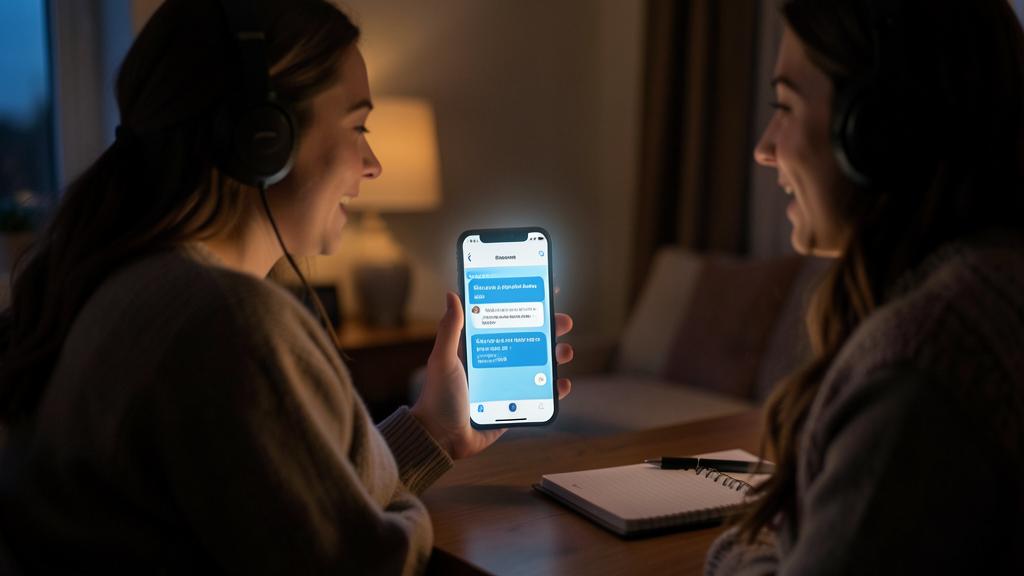
The right reflex. The biggest obstacle to speaking a language is not vocabulary or grammar: it’s the FEAR of making mistakes in front of someone. And this is precisely where AI is unbeatable: it will never judge you, it is infinitely patient, and always available. Use it to DARE. Start by giving it the framework: « I want to practice such a language orally, I’m at such a level, speak slowly and correct my main mistakes at the end. » Activate the VOICE — the goal is to speak and listen, not to write —, then really launch yourself, even with shaky sentences. The secret: prioritize FREE CONVERSATION and ROLE-PLAYING (act like you’re a waiter, an airport agent, a recruiter) over repetitive exercises — talk about what interests you most, it’s much more motivating and formative. Dose the corrections: too many, and you’ll get discouraged; not enough, and you won’t make progress — ask to be rephrased correctly at the end of each exchange. And above all, be REGULAR: ten minutes every day are much better than a long session once a week. Repeat aloud what the AI says to work on your pronunciation, note the words that keep coming up, and as soon as possible, go confirm all this in real human exchanges. AI helps you cross the oral threshold without stress; real immersion will transform the training into ease.
Limits to keep in mind
Useful as it is, AI is not a miracle solution and has limits. It does not replace the HUMAN: a real conversation with a native speaker brings things that AI does not — hesitations, local expressions, accent, real rhythm, body language, the unexpected, cultural nuances; AI is an excellent training tool, but immersion and human exchanges remain irreplaceable for mastering a language. PRONUNCIATION: depending on the tool, AI does not always finely evaluate your pronunciation or accent; some specialized applications do a better job than generalist AIs; do not blindly trust its « understanding » of what you say. POSSIBLE ERRORS: AI can make mistakes, give an approximate grammatical explanation, or use an unnatural turn of phrase (our guides on the limits of AI); for important points, cross-check with a method or a teacher. Lack of CULTURAL AUTHENTICITY: a language is also a culture, usages, registers; AI knows some of this, but nothing beats real contact to grasp the nuances. MOTIVATION: the freedom of AI (no imposed program) is an asset but also a risk: without structure or goals, one can go round in circles; set clear goals and, if needed, rely on a method in addition. DEPENDENCY on the device: practicing in front of a screen does not fully prepare you for the stress of a real conversation; use AI as a stepping stone toward real exchanges, not as a refuge to avoid them. PRIVACY: as with any online tool, avoid sharing very personal information throughout your training conversations (our guides on AI and privacy). In summary: AI is a formidable training partner, but it does not replace the human, immersion, or a structured method; consider it as a stepping stone to dare and practice, to be complemented by real exchanges. It helps you cross the oral threshold; mastery, however, is also achieved elsewhere.
Be careful: AI prepares, but does not replace the human. The main pitfall would be to believe that a language can be learned entirely in front of a machine. AI is an exceptional training partner to DARE speaking and gain confidence, but a real conversation with a native speaker brings things that no AI reproduces perfectly: an authentic accent, living expressions, the real rhythm of speech, the unexpected, body language, the culture that accompanies the language. Use AI as a STEPPING STONE toward real exchanges, never as a refuge to avoid them; practicing alone in front of a screen does not fully prepare you for the stress and richness of a real discussion. Also keep a critical eye: AI can make MISTAKES — give an approximate grammatical explanation, use an unnatural turn of phrase, or poorly « understand » your pronunciation (generalist AIs often misjudge accents, unlike some specialized applications). For important points, cross-check with a reliable method or a teacher. Finally, be careful about MOTIVATION: the total freedom of AI, without a program or goals, can make you go round in circles; set clear goals and regularity. And for prudence, do not share very personal information throughout your training conversations. Well used, AI lifts inhibition and makes you practice without counting; but it is in going toward others, in real life, that you will transform this training into mastery. AI gives you a leg up; the journey is made with real interlocutors.

Frequently asked questions
Can we really progress orally with AI?
Yes, and remarkably for a specific but crucial aspect: DARE speaking and gain confidence. The biggest block for learners is not a lack of knowledge, but the fear of making mistakes in front of someone; or AI does not judge, it is patient and always available, lifting this inhibition. By regularly practicing conversations with it (orally, via the voice mode), you gain in ease, active vocabulary, fluency, comprehension reflexes: all very concrete progress. You can also practice real-life situations through role-playing. That said, « progress » does not mean « learn everything »: AI does not replace immersion or human exchanges, which bring the accent, culture, the unexpected, the real rhythm. The best use: AI as a daily training ground to gain confidence and practice as much as you want, in addition to a structured method and, whenever possible, real conversations. Combined, it significantly accelerates your oral progress — the area where, precisely, we lack the most practice opportunities.
Do we need a specialized app or is a general AI sufficient?
Both work, with different advantages. A GENERAL AI (a common conversational assistant) is sufficient for holding a free conversation, role-playing, requesting corrections and explanations: activate its voice mode, set the framework (language, level, goal), and launch yourself; it is flexible, free or low-cost, and very effective for daring to speak. A LANGUAGE LEARNING SPECIFIC app offers additional structure (lessons, progress, reviews), sometimes finer pronunciation evaluation, and a framework that helps stay regular and motivated. The best choice depends on you: if you are autonomous and mainly want to practice free oral communication, a general AI does a very good job; if you need a guided program and follow-up, a specialized app will better guide you. Nothing prevents combining them: a method or app for structure and basics, a conversational AI to practice oral communication without limits. The essential is not the tool, but REGULARITY and the fact of really speaking: choose what will make you practice the most and with the most pleasure.
Can AI correct my accent and pronunciation?
Partially, but with limits. Specialized apps for language learning often integrate voice recognition designed to evaluate your pronunciation and signal sounds to correct: this is their strength. General AIs understand your speech to converse, but evaluate your accent less finely; they can respond correctly even if your pronunciation is approximate, without necessarily signaling it. To work on your accent with a general AI, a trick: ask it to pronounce a word or phrase (in voice mode), listen carefully, and REPEAT aloud imitating; you can also ask it for explanations on how to produce a sound. But be clear: for a truly authentic accent, nothing replaces listening to native speakers (films, podcasts, real exchanges) and, ideally, feedback from a teacher or a human partner. AI helps you practice and dare; the refinement of pronunciation mainly passes through active listening and imitation of real speakers.
What to remember
Speaking a language is the hardest to work on, due to lack of opportunities and fear of judgment; AI precisely lifts these obstacles. It offers a conversation partner that is AVAILABLE at any time, PATIENT, JUDGMENT-FREE, that ADAPTS to your level, allows FREE CONVERSATION and ROLE-PLAYING, and corrects or explains on request. Its greatest asset: it makes you DARE to speak without fear of making mistakes, unlocking so many learners. To get the most out of it: set the framework (language, level, goal), activate the VOICE for real speaking and listening, launch yourself even imperfectly, request targeted CORRECTIONS, put yourself in SITUATION, vary the topics according to your interests, get explanations for rules, and above all be REGULAR (ten minutes a day are better than an hour weekly). But keep its limits in mind: AI does not replace the HUMAN (accent, culture, the unexpected, body language), nor IMMERSION, nor a structured method; it can make MISTAKES (cross-check important points); and general AIs poorly evaluate pronunciation, unlike some specialized apps. The right mindset: see AI as a STEPPING STONE to gain confidence and practice without counting, never as a refuge to avoid real exchanges. Complete it with listening to native speakers and, whenever possible, real conversations. Combined, it significantly accelerates your progress where you lack the most training: the oral. AI gives you a leg up and helps you cross the speaking threshold; it is in going toward others that you will transform this momentum into true ease.


Want to master AI and make it a real asset in your daily life? Our training programs will accompany you at your own pace.
Leave a Reply
You must be logged in to post a comment.