
Attracting visitors to your site is good; turning them into customers is even better. That’s the whole point of the sales funnel (or conversion funnel): the journey that takes a simple curious visitor all the way to a purchase. Well-designed, it boosts your results; neglected, it lets customers slip away at every step. Here’s how to create an effective sales funnel, explained simply.
The funnel principle
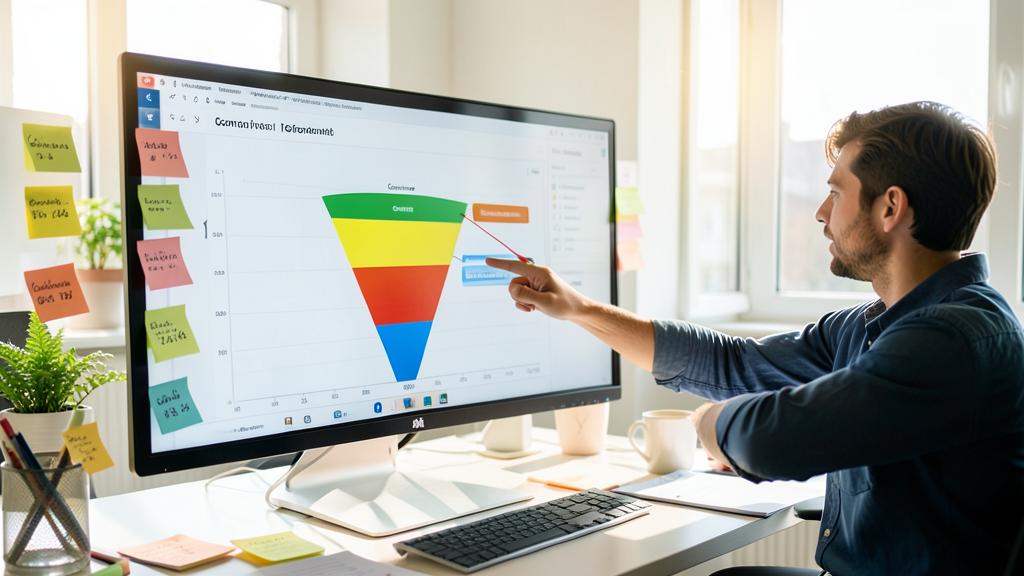
It’s called a funnel because at each stage, some visitors drop off. Many arrive at the top; few make it to the purchase. The goal of the sales funnel is to reduce losses at every step by guiding the visitor, addressing their hesitations, and naturally leading them to take action. Every leak you plug means more revenue.
Imagine a funnel: lots of liquid goes in, but only a little comes out. The same happens with visitors on your site. The goal is to keep as many as possible moving toward the purchase.
An e-commerce site sees 10,000 visitors per month. Only 2% make a purchase. By fixing the checkout page (reducing friction), they double conversions to 4%. That’s 400 more sales per month without extra traffic.

The key stages of a funnel
- Attract: bring in qualified visitors (SEO, social media, ads).
- Engage: capture attention with useful content and a clear offer.
- Persuade: reassure with proof, address objections, and demonstrate value.
- Convert: make it easy to take action with a clear call and a simple process.
- Retain: turn a customer into a loyal one, and even an advocate.
The right reflex. Identify the stage where you lose the most people and focus your efforts there. Improving the weakest link in your funnel has far more impact than optimizing a step that’s already working. Measure to know where to act.
Reduce friction
At every stage, the slightest obstacle scares people off: a long form, a complicated checkout, lack of reassurance, a slow page. Tracking and eliminating these frictions is one of the most profitable levers. Often, simplifying a path—fewer fields, fewer clicks, more clarity—increases conversions more reliably than any marketing trick.

Reassure to convert
Trust is the fuel of conversion. Testimonials, guarantees, customer reviews, visible contact info, secure payment: all elements that ease doubts at the decisive moment. A hesitant visitor needs reassurance before committing. Anticipating their concerns and addressing them unlocks the sale.
Avoid this. Don’t try to sell too quickly to a visitor who just discovered you. Rushing the steps alienates the prospect. A good funnel respects the pace: inform and reassure before offering the purchase. Rushing scares people off; guidance converts.

Frequently asked questions
Do you need complicated tools?
No. An effective funnel relies first on clear logic and a simplified path, not on sophisticated tools. The method matters more than the technique.
How do I know if my funnel works?
By measuring conversions at each stage. These numbers reveal where you’re losing visitors and where to focus improvements.

Key takeaways
An effective sales funnel guides the visitor from discovery to purchase by reducing losses at every step. Attract, engage, persuade, convert, retain: every link matters. Eliminate friction, reassure at the right time, and focus efforts where you lose the most people. Optimizing your funnel is often the most profitable way to increase sales without spending more on traffic.


Want a sales funnel that converts your visitors?
Leave a Reply
You must be logged in to post a comment.