
A personal coach is expensive, the gym is intimidating, pre-made internet programs know nothing about you — and solo motivation fizzles out in three weeks: home workouts always hit the same walls. AI knocks several of them down: truly personalized programs, adjusted week after week, exercises explained and adapted to YOUR capricious knee, constant dialogue with a coach who never judges. What an AI coach does well, what it won’t replace, and how to get started without getting hurt.
The custom program: finally YOURS
The number one strength: the program built on your reality — describe everything that matters (age, honest level, concrete goal, available equipment — “two dumbbells and a mat” —, real time — “3 × 30 minutes, in the evening” —, history — “fragile back, right knee operated on”) and ask for the plan: detailed sessions, progression over several weeks, alternatives per exercise. The difference with a generic program is exactly there: the crossed constraints — the plan “beginner, 30 minutes, no jumps (neighbors below), knee spared” doesn’t exist in any magazine, it’s written for you in one minute. The demands that raise the level: the explicit progressivity (“start very easy, increase by 10% per week” — the anti-injury safeguard that enthusiasm forgets), the fallback sessions (“plan a 10-minute version for busy days” — the short session done beats the perfect session skipped), and the balance (cardio, strengthening, mobility — ask for all three: the AI knows how to balance, but you have to ask it). Then, the program lives: each week, the report (“session 2 too hard, shoulder pain on push-ups”) adjusts the rest — it’s this dialogue that makes the coach, and that no PDF will ever offer.
An AI coach creates a workout plan just for you, based on your time, equipment, and health. It changes the plan every week if you tell it what worked or hurt. It’s like having a personal trainer who never gets tired of adjusting things for you.
A 45-year-old with a bad knee and 30 minutes daily asks for a plan. The AI suggests: 10-minute warm-up, 15-minute seated leg lifts (no knee strain), 5-minute stretching. Next week, the user reports knee pain, so the AI removes leg lifts and adds arm exercises instead.

During the session: guidance, form, and the missing link
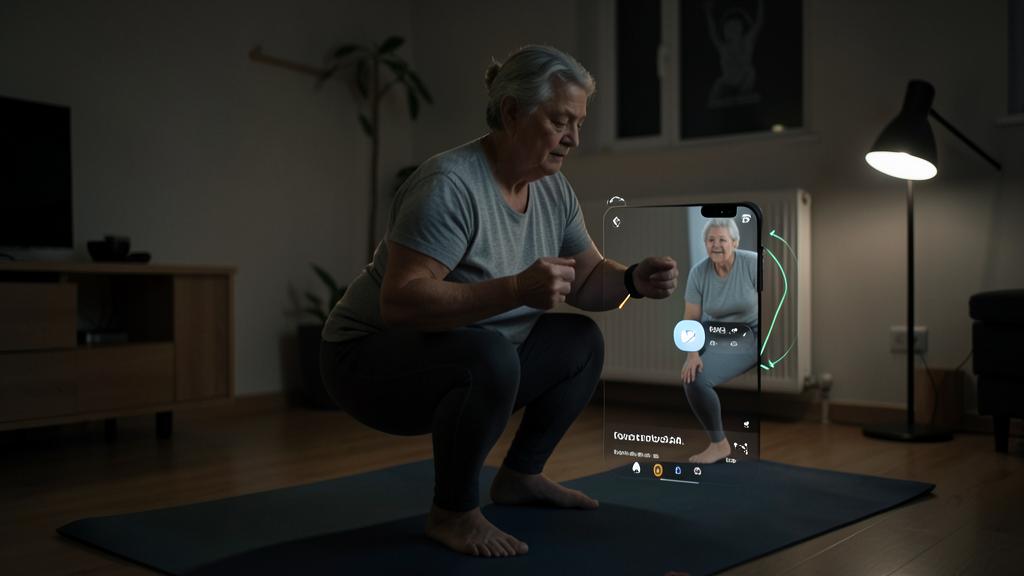
During training, several levels of support: the verbal guidance — the session dictated by the voice assistant (exercises, repetitions, timed rest), hands-free; the execution explanations — each exercise described in detail on demand (position, movement, common mistakes, “where I should feel the effort”): read them BEFORE the first time — the description of the target sensation is the best text-based safeguard; the camera-correction apps — the rising generation: the phone placed in front of you, the app counts the repetitions and signals gross errors (rounded back, short amplitude): imperfect but truly useful for basic movements; and the connected watch as the intensity judge (heart rate — “stay in the moderate zone” becomes verifiable). Let’s be honest about the missing link: the fine posture correction — a deep squat, a lift, a technical movement are corrected by an expert eye present: for loaded or complex movements, one or two sessions with a real coach (or a group class) are worth all the pixels — learn the movement in person, maintain it with AI. The winning combo for the home athlete: AI program + demonstration videos from serious sources + occasional human validation of risky movements.
The right reflex. Keep the three-line journal after each session (done/not done, feeling on a scale of 10, any pain) — in a note or directly in a message to the AI coach. It’s him who makes the weekly adjustment relevant (“here’s my journal, adapt next week”), him who reveals the real trends (energy rising, shoulder always protesting on Thursdays), and him who motivates — the series of checked sessions is the oldest engine in the world. Thirty seconds per session: that’s the price of customization that lasts.

Motivation: where AI surprises the most
Sport is 80% mental, and the AI coach finds an unexpected role there: the negotiation of bad days — “no motivation tonight” gets no sermon or guilt, but a counteroffer (“just do the warm-up and stretches, 8 minutes — we keep the series alive”): this judgment-free flexibility is exactly what rigid programs lack — and it works; the on-demand variety — boredom kills routines: “same goal, completely different session” renews without derailing; the renegotiated goals — life changes (injury, move, baby): the program rebuilds in a conversation instead of being abandoned; and the pace of encouragement adjustable — some want drill sergeant, others want kindness: say it (“talk to me like a demanding but kind coach”). Supplement with the human levers that AI doesn’t replace: a workout partner (social commitment beats everything), a real deadline (a race, a summer hike), and the fixed time ritual — the AI orchestrates all of this well if you give them as constraints.
Safety limits: what you can’t delegate
The framework to set once and for all: the prior medical opinion for situations that require it (long-term sedentary lifestyle, over 50 years old and getting back into it, significant overweight, cardiac history, pregnancy — the doctor’s visit BEFORE the program, with recommendations then given to the AI as constraints); the pain as absolute stop — the AI will say it if you ask, but engrave the rule: joint or sharp pain = stop the exercise, not “lighter version” (muscle fatigue is normal, localized pain never — our running guide details the nuance); the rehabilitation outside the scope — after an injury or surgery, the program comes from the physiotherapist: the AI can help follow it (reminders, explanations), not design it; and the distrust of extreme goals — the over-solicited AI (“make me lose 10 kg in a month”, “champion program in 6 weeks”) may follow instead of slowing down: if your request is unreasonable, its answer will be sometimes too — healthy progress benchmarks (loads +5-10% per week maximum, one rest day between two intense sessions, regular lighter weeks) take precedence over any plan that ignores them. Well framed like this, the risk of an AI coach is low — and far lower than that of a YouTube program attacked full-on without adaptation.

Be careful with the nutrition advice that comes with it. The AI coach easily slips into the plate (“for your goals, eat…”) — and that’s where caution increases: generated meal plans can be restrictive, unbalanced, or simply unsuited to your real health. Take the general (sufficient protein, hydration, varied plate — documented common sense), refuse the specific numbers (tight calories, supplements, fasting) without professional advice — and for any complicated relationship with food, the doctor/dietitian duo is the only legitimate coach. AI for sports, yes; AI for diet, with caution — the two subjects don’t have the same risk level.
Frequent questions
General AI assistant or dedicated fitness app?
The dedicated app wins on execution (demonstration videos, integrated timers, camera correction, automatic history); the general assistant on customization and dialogue (crossed constraints, fine adjustments, motivation). The natural duo: the general assistant designs and adjusts the program, an app (even free) executes it during the session. And for complete beginners in running: dedicated guided programs remain the royal way.

Does it work for seniors too?
Particularly well — balance, mobility, gentle strengthening can be programmed to fit (chair as support, no floor if getting up is difficult), and the format “10 minutes daily explained calmly” matches exactly the recommendations for healthy aging. The conditions: medical clearance, extreme progressivity, and ideally a close person to help set up the ritual the first few weeks.
Can the AI coach analyze my connected watch data?
Yes — copy your numbers (resting heart rate, sleep, session load) and ask for the analysis: trends, overwork signals, adjustments. It’s an excellent interpreter of data that apps display without explaining — keeping the usual rule: persistent anomalies (heart, unusual shortness of breath) should be shown to a doctor, not a chatbot.

What to remember
The AI coach succeeds where the fixed program never could: the evolving customization — a plan built on your real constraints (time, equipment, body), adjusted each week based on your three-line journal, negotiated on bad days instead of being abandoned. Its territory: design, explanation, logistics, motivation. Its boundaries: learning technical movements (occasional human validation), medical (prior clearance, pain = stop, rehab with a physiotherapist), and numbered nutrition (professionals). Minimal equipment, almost zero cost, total availability: the classic walls of home sports — price, intimidation, anonymous programs, loneliness — have just fallen. Only one remains that the AI won’t cross for you: putting on your sneakers. But for the first time, everything else is moving in the right direction.


Want to master AI and make it a real daily asset? Our training programs support you at your own pace.
Leave a Reply
You must be logged in to post a comment.