
Fake contests are rampant on social media. These posts promising extravagant gifts (often in the name of major brands) are often FAKE. They exploit the desire to win and the viral mechanics of sharing. The good news: they can be recognized by clear signals, and it’s enough to stay cautious. Let’s see how fake contests work, how to spot them, and how to react without getting caught.
How fake contests work
Fake contests are traps disguised as games. The PRINCIPLE: a fake contest is a post (often in the name of a brand) promising an EXTRAVAGANT GIFT (phone, money, trip) in exchange for actions (like, share, comment, click). The contest is not real; it’s bait; the gift is the lure. The REAL GOALS: behind the fake contest, collect your PERSONAL DATA, redirect you to SCAMS, ARTIFICIALLY inflate a page (subscribers, shares), or EXTRACT money from you (« fees » for the prize). The « contest » serves other purposes; beware. Data collection: you are asked to « sign up », provide your contact details, fill out a form « to participate ». These data are collected (and exploited/resold). The real « prize » is your info; you pay in data. REDIRECTION to scams: clicking on the « contest » often leads to trap sites (phishing, fake forms, hidden subscriptions). The contest is a gateway to the scam; the click is dangerous; consult our guides on trap links. PAGE INFLATION: some fake contests are used to inflate a page (get « likes », shares, mass subscribers) to sell or exploit it. Your shares serve their interests; you are being used; the viral mechanism exploited. FAKE FEES: like the lottery scam; you are told you have « won », then asked for « fees » to receive the gift. The prize doesn’t exist, the fees are the scam; a real prize doesn’t cost anything; consult our guides on the lottery scam. BRAND IMPERSONATION: fake contests often impersonate the name/logo of major brands (to appear credible). The real brand is not involved; the impersonation deceives; verify authenticity (we’ll come back to this). The VIRAL mechanism: by asking to SHARE to « participate », the fake contest spreads on its own (each share reaches new victims). You become a relay of the trap; virality is the weapon; beware of « share to win ». Exploitation of DESIRE: the fake contest plays on the desire to win, the lure of the gift, hope. These emotions lull suspicion; you participate without thinking; emotion is the lever; keep a cool head. Very COMMON: fake contests are rampant on social media. They are numerous and varied; knowing how to spot them is useful in daily life; it’s a common nuisance; stay vigilant. Why it MATTERS to understand: knowing that the « contest » is a lure to collect data, redirect to scams, or inflate pages helps not to participate blindly; awareness foils the trap. The main idea: a fake contest is a post (often in the impersonated name of a major brand) promising an EXTRAVAGANT GIFT in exchange for actions (like, share, comment, click, sign up). But the contest is not real: it’s BAIT. The real goals: collect your PERSONAL DATA (via « to participate » forms), REDIRECT you to scams (trap sites, hidden subscriptions), ARTIFICIALLY inflate a page (thanks to your shares and « likes »), or EXTRACT money from you (fake « fees » to receive the « prize »). They exploit the DESIRE to win and the VIRAL mechanics of sharing (by making you share, they spread and turn you into a relay of the trap). Very common on social media, they often impersonate the names of well-known brands to appear credible. Understanding that the gift is a lure serving other purposes helps not to participate blindly: the first step to not getting caught.
Fake contests are fake posts that promise big prizes to trick you. They want your personal data, to redirect you to scams, or to make you pay fake fees. They spread by asking you to share them. Always check if the contest is real before participating.
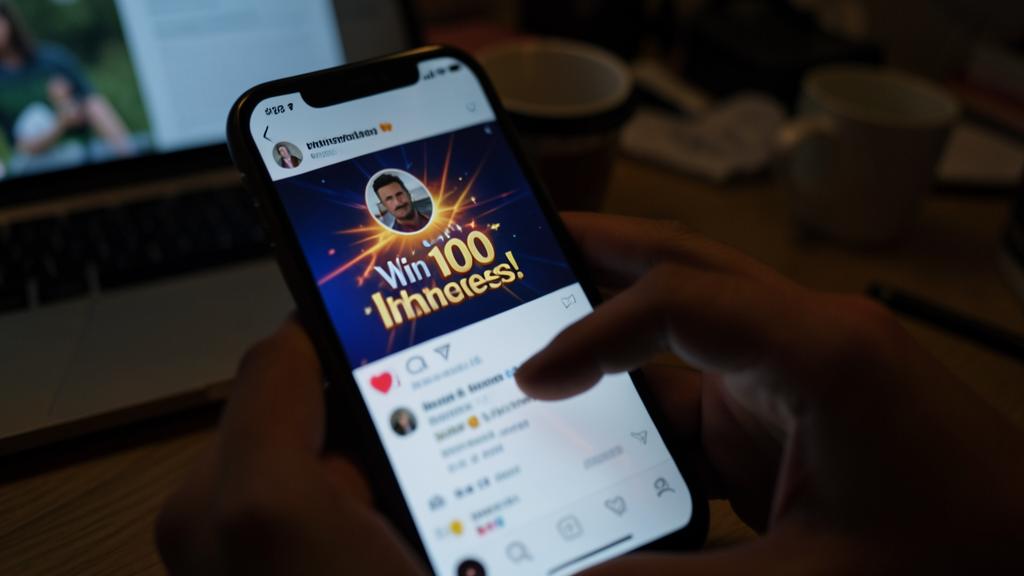
A fake contest on Facebook claims to give away 100 iPhones. It asks you to like, share, and comment to participate. If you click the link, you’re taken to a fake website asking for your email and phone number. Later, you receive a message saying you’ve won but must pay a $50 « processing fee ». The prize doesn’t exist, and your money is stolen.

How to spot a fake contest
Fake contests can be recognized by several signals. Here’s how to unmask them. An EXTRAVAGANT GIFT: « 100 iPhones to win », « €10,000 », huge and numerous gifts. The too-good-to-be-true is suspicious; real brands don’t give away extravagant gifts left and right; the extravagance alerts. A DUBIOUS or impersonated PAGE: check the page organizing it. Is it the REAL official page of the brand (verified, old, with many subscribers) or a page that imitates it (slightly different name, recent, few subscribers)? Impersonation betrays; check the page (we’ll come back to this). An UNVERIFIED page: real brand pages are often « verified » (badge). An unverified page impersonating a brand is suspicious; the absence of verification alerts; look for the badge. EXCESSIVE requests to participate: « like, share, comment, tag 10 friends, sign up ». These multiple requests (especially sharing and tagging) serve virality. A real contest doesn’t turn you into a massive relay; beware of sharing requests. A LINK to a dubious external site: if « participate » leads to an external site asking for your info, a form, a registration. It’s a strong signal; the external link is often the trap; beware of the click. PERSONAL DATA requested: you are asked for contact details, personal info, even banking info « to participate/receive ». A real contest doesn’t collect your sensitive data like this; the request for data betrays; don’t give anything. URGENCY: « only 2 hours left », « the first 100 ». Urgency pushes you to act without thinking; a manipulation signal; beware of the pressure; take your time. MISTAKES and a weird tone: spelling errors, awkward phrasing, exaggerated tone. A real brand communicates properly; the mistakes betray the scam; observe the quality. Little CREDIBLE engagement: suspicious comments (bots, fake winners), artificial engagement. Or, on the contrary, victims who are surprised; observe the reactions; engagement sometimes reveals the truth. PAYMENT to « receive »: if after « winning » you are asked to PAY fees to receive the gift. Certain scam; a real prize is never paid for; this signal is decisive; don’t pay anything. VERIFY on the official website: in case of doubt, check the OFFICIAL WEBSITE of the brand to see if the contest really exists. Real contests are announced there; the absence on the official website confirms the fake; verify at the source. In summary, to spot a fake contest: beware of an EXTRAVAGANT GIFT (too good to be true), a DUBIOUS or impersonated page (unverified, different name, recent, few subscribers), EXCESSIVE requests to participate (especially sharing and tagging, which serve virality), a LINK to an external site asking for your info, PERSONAL or banking data requested, URGENCY, MISTAKES and a weird tone, and especially a PAYMENT requested to « receive » the prize (certain scam). In case of doubt, VERIFY on the official website of the brand if the contest exists. These signals unmask fake contests; the extravagance of the gift, the impersonated page, the requests for sharing/data, and the payment to « receive » are the giveaways.
The key reflex: verify the official page of the brand, and beware of anything that asks you to share, sign up, or pay. Faced with an « attractive » contest on social media, two simple reflexes will help you avoid falling into the trap. The first: verify the AUTHENTICITY of the page organizing the alleged contest. Fake contests almost always impersonate the name and logo of a well-known brand to appear credible and reassuring. But this impersonation is easily unmasked by examining the page. Ask yourself: is this the REAL official page of the brand? A real page of a major brand is generally VERIFIED (it has a certification badge), ANCIENT, and has a very large number of subscribers. A fake page, on the other hand, has revealing signals: a name slightly different from the official one (a typo, an added word, an underscore or an extra number), the ABSENCE of a verification badge, a RECENT creation, FEW subscribers (incoherent for a « major brand »), and few posts other than the « contest ». The best way to be sure: go find the REAL official page of the brand (or its OFFICIAL WEBSITE) yourself, and check if this contest is actually announced there. Real brands announce their real contests on their official channels; if the « contest » exists ONLY on a dubious page and not on the brand’s official channels, it’s a fake. This simple check foils most impersonating fake contests. The second reflex: beware of anything that asks you to SHARE, SIGN UP (give your data), or PAY. These are the three major warning signs, as they correspond to the three real goals of fake contests. The request to SHARE (and often to « tag friends ») serves the VIRAL mechanism: by sharing, you spread the trap to your loved ones and turn their feed into a relay for the scam — a real contest doesn’t need to turn you into a propagation agent. The request to SIGN UP or fill out a form with your CONTACT DETAILS is used to collect your personal data (to exploit or resell them): beware of any « to participate » form, especially if it leads to a dubious external site, and never give sensitive information (and even less banking info). Finally, and this is the most decisive signal: if at any point you are asked to PAY « fees » to « receive your prize », it’s a 100% scam — a real contest NEVER asks you to pay to receive a gift (exactly like the lottery scam: a real prize is never paid for). By combining these two reflexes — verifying that the page and the contest are authentic via the brand’s official channels, and being wary of any request to share, sign up, or pay — you unmask and avoid almost all fake contests. And remember the general principle that sums it all up: if it’s too good to be true (an extravagant gift offered to everyone), it’s fake. In doubt, don’t participate, don’t share, don’t give anything: you only lose a gift that didn’t exist anyway.

How to react and protect yourself
Faced with a fake contest, the reaction is simple. Here are the right steps. DON’T participate: the first reflex. Don’t participate in a suspicious contest; don’t give your info, don’t click on the links. A fake contest you don’t participate in can’t harm you; abstention protects; abstain. DON’T share: above all, DON’T SHARE (or tag friends). Sharing spreads the trap to your loved ones and serves the scammers. Don’t become a relay; sharing is exactly what they want; don’t do it. DON’T click on the links: don’t click on the « contest » links (they often lead to trap sites). The click is dangerous; abstain; don’t give them any leverage. DON’T give your data: don’t fill out any form, don’t give contact details or banking info. Your data would be collected/exploited; keep them; don’t « sign up ». NEVER pay: NEVER pay « fees » to receive a « prize ». It’s the scam; a real gift is never paid for; refuse any payment; payment is the final trap. REPORT the fake contest: report the fraudulent post/page to the social network (report option). You help to have it removed and protect others; reporting is useful; participate in the cleanup. VERIFY with the brand: if you doubt, check the brand’s official channels (website, verified page) to see if the contest is real. Real brands confirm their real contests; verify at the source; don’t rely on the post alone. PROTECT your loved ones: warn your loved ones (especially the less aware) about these fake contests. Explain how to spot them; awareness prevents your contacts from getting caught; share vigilance, not the contest. The « too good » reflex: apply the principle. If it’s too good to be true, it’s fake. An extravagant gift offered to everyone is a sign of the scam; lucidity against desire; keep this reflex. React if you’ve PARTICIPATED: if you’ve participated (given info, clicked). Monitor your accounts, beware of follow-ups (messages, scams), change your passwords if you’ve entered credentials, don’t pay anything; react according to what you’ve given (we’ll come back to this). Real CONTESTS exist: real brand contests exist (on their official channels, without payment or excessive data requests). Caution doesn’t mean refusing everything; know how to distinguish; verify authenticity. In summary, to react to a fake contest: DON’T PARTICIPATE, don’t SHARE (or tag friends — you’d be spreading the trap), don’t CLICK on the links, don’t GIVE your data, and NEVER PAY « fees » for a « prize ». REPORT the post to the social network, VERIFY with the brand’s official channels in case of doubt, and WARN your loved ones. Apply the « too good to be true = fake » reflex. If you’ve already participated, monitor your accounts and react according to what you’ve given. Know that real contests exist (on official channels, without payment or excessive data requests): vigilance allows you to distinguish. Abstention (not participating, not sharing, not paying) and verification at the source are the keys.
Warning: by sharing a fake contest, you spread the trap to your loved ones; and NEVER pay to receive a « prize ». Two points of vigilance deserve special emphasis. The first is often overlooked, as it doesn’t only concern your safety but that of your LOVED ONES: by SHARING a fake contest, you become an involuntary relay of the scam and spread it to your circle. This is the whole mechanism of fake contests: they ask you to SHARE the post and « tag friends » under the pretext that it’s necessary « to participate ». But in reality, this sharing serves their VIRAL mechanism: every time you share, the post appears in your friends’ and family’s feed, with your implicit endorsement (since it’s you who shared it, they tend to trust it). You thus expose your loved ones to the same trap — collection of their data, redirection to scams, possible extraction of money — and you contribute to the massive spread of the scam. You become, without wanting to, an unwitting accomplice of the scammers. That’s why you should NEVER share a suspicious contest, even « just in case it’s true ». Sharing has no interest for you (a real contest doesn’t rely on viral sharing), and it puts your loved ones at risk. On the contrary, if you see a fake contest, the right thing to do is to REPORT it to the social network (to help have it removed) and possibly WARN your loved ones to beware of it — share vigilance, not the trap. Keep in mind that the trust your loved ones have in you is precious: don’t put it at the service of a scam by relaying a fake contest. The second point of vigilance, decisive: NEVER PAY to receive a « prize ». This is the ultimate and infallible sign of the scam, common to all fake contests and prize scams. The scenario is classic: after announcing (often via a private message) that you have « won » the extravagant gift, you are asked to PAY « fees » to « unlock », « release », « ship » or « clear customs » your prize — shipping fees, customs, file, transfer fees. THIS IS THE TRAP that steals your money: the prize doesn’t exist, and these « fees » are the money the scammer pockets. An absolute principle: a real gift, a real contest prize is NEVER PAID for to be received. No legitimate organizer will ever ask you to take money out of your pocket to receive a prize you would have won. Similarly, NEVER communicate your BANKING DETAILS « to receive the prize » or « to pay the fees ». You would be opening the door to theft. As soon as a « contest » or a prize announcement asks you to pay anything or give your banking details, stop everything: it’s a scam, no exception. This mechanism is the same as that of the lottery scam: be particularly wary of PRIVATE MESSAGES telling you that you have « won » (especially in a contest you didn’t really participate in), as this is often where the payment request comes. In summary, remember these two vigilances: NEVER share a fake contest (you would spread the trap to your loved ones, putting them at risk, in the service of scammers — report and warn instead), and NEVER pay « fees » or give your banking details to receive a « prize » (this is the central trap that steals your money — a real prize is never paid for). These two reflexes protect you and your loved ones from most of the damage caused by fake contests.
Frequent questions
How to know if a contest on social media is real or fake?
Check that the organizing page is the REAL official page of the brand (verified, old, many subscribers), and that the contest is announced on its official channels. Beware of requests to share, give data, or pay. Let’s see. Check the PAGE: examine the page organizing the contest. Is it the REAL official page of the brand, or an imitation? This is the most important check; the authenticity of the page reveals everything (we’ll detail). Signs of a REAL page: a real brand page is generally VERIFIED (certification badge), ANCIENT, with a VERY large number of subscribers, and many varied posts. These signs reassure; the official is recognizable. Signs of a FAKE page: name slightly different from the official (typo, added word, number), NO verification badge, RECENT creation, FEW subscribers (incoherent for a major brand), little content other than the « contest ». These signs betray the impersonation; spot them. VERIFY on the official channels: the decisive test. Go to the OFFICIAL WEBSITE of the brand or its real verified page, and see if this contest is announced there. A real contest is relayed on the official channels; its absence confirms the fake; verify at the source. Beware of the requested SHARE: a fake contest often asks to SHARE and TAG (for virality). A real contest doesn’t rely on these mass propagation requests; the request to share is a signal; beware. Beware of the requested DATA: if « participate » requires filling out a form with your contact details (especially on an external site), beware. Real contests don’t collect data like this; the request for data betrays; don’t give anything. PAYMENT, decisive signal: if you are asked to PAY to « receive » the prize, it’s 100% fake. A real prize is never paid for; this single sign is decisive; don’t pay. The EXTRAVAGANT gift: an enormous and numerous gift (« 100 iPhones ») offered to everyone is suspicious. Real brands don’t give away gifts like this; the extravagance alerts; beware of the too-good-to-be-true. MISTAKES and tone: typos, weird phrasing, exaggerated tone. A real brand communicates properly; the mistakes betray; observe the quality of the post. In case of DOUBT, abstain: if you still doubt, abstain (don’t participate, don’t share). You only lose a potential uncertain gift; in doubt, caution; abstention costs nothing. The ADVICE: to distinguish real from fake, verify the authenticity of the page (verified, old, many subscribers) and the announcement of the contest on the brand’s official channels. Beware of requests to share, give data, or pay, and the extravagant gift; in doubt, abstain. In summary, to know if a contest on social media is real or fake, the most important check is to verify the AUTHENTICITY of the organizing page. A REAL brand page is generally VERIFIED (it has a certification badge), ANCIENT, with a very large number of subscribers and a lot of varied content. A FAKE page has revealing signals: a name slightly different from the official (typo, added word or number), the absence of a verification badge, a recent creation, few subscribers (incoherent for a major brand), and little content other than the « contest ». The decisive test: go verify on the OFFICIAL WEBSITE of the brand or its real verified page if this contest is actually announced — real brands relay their real contests on their official channels, so the absence of the contest on these channels confirms that it’s fake. Beware of the classic signals: requests to SHARE and TAG friends (which serve the virality of the trap), collection of your DATA via a form (especially on an external site), the EXTRAVAGANT gift offered to everyone, typos and exaggerated tone, and especially — decisive and infallible signal — any request to PAY « fees » to receive the prize (a real prize is never paid for). Note that real contests do exist: caution doesn’t mean refusing everything; it means verifying authenticity. In case of persistent doubt, the wisest thing is to abstain: not participating or sharing doesn’t make you lose anything but an uncertain gift, whereas participating in a fake one can cost you your data or your money.
What are the real risks of participating in a fake contest?
You risk having your data collected and exploited, being redirected to scams, spreading the trap to your loved ones (by sharing), and sometimes losing money (fake « fees »). The consequences vary depending on what you do. Let’s detail. DATA theft: by « signing up » or filling out a form, your personal contact details are COLLECTED. They will be exploited (spam, solicitation) or resold. You become a target; your data is the first loot. REDIRECTION to scams: by clicking on the links, you can be led to trap sites (phishing, fake forms, hidden subscriptions, malware). The contest is a gateway to other scams; the click exposes; the cascading risk. SPREADING to your loved ones: by SHARING, you expose your friends/family to the trap (with your endorsement). You become a relay of the scam; you put your circle at risk; a consequence for others, not just you. MONEY loss: if you are asked for « fees » to receive the « prize » and you pay. It’s lost money (the prize doesn’t exist); sometimes repeated (new fees). The financial risk is real; never pay. BANKING theft: if you give your banking details « to receive/pay ». They can be diverted; a serious risk; never give them; banking theft is the worst case. TARGETED SCAMS later: once your data is recovered, you can be retargeted by other scams (messages, fake prizes, phishing). The fake contest puts you on lists of victims; the follow-ups can last; beware over time. HIDDEN SUBSCRIPTION: some fake contests lead to hidden costly subscriptions (subscribed without understanding). You end up paying; read and beware; the subscription trap. The SEVERITY VARIES: the risk depends on what you do. Just seeing the post is low-risk; sharing, clicking, giving data, paying progressively worsen the risk. The less you do, the less you risk; abstention protects. No REAL prize: in all cases, you will NOT win the promised gift (it doesn’t exist). Participating brings nothing and can cost you; the « game » is losing from the start; no benefit to expect. The ADVICE: participating in a fake contest can cost you your data (collected, exploited), expose you to scams (links, subscriptions), spread the trap to your loved ones (sharing), and make you lose money (fake fees). The risks increase with what you do; don’t participate, it’s without benefit and with risks. In summary, participating in a fake contest involves several real risks, the severity of which depends on what you do. The most common: theft of your PERSONAL DATA (by « signing up » or filling out a form, your contact details are collected, then exploited — spam, solicitation — or resold, making you a lasting target for other scams). By clicking on the links, you risk being REDIRECTED to trap sites (phishing, hidden costly subscriptions, or even malware). By SHARING, you spread the trap to your loved ones (with your implicit endorsement), putting them at the same risk. And if you go as far as PAYING fake « fees » to « receive » the prize, or giving your BANKING DETAILS, you lose money (the prize doesn’t exist) or expose your account to theft — the most serious consequences. After a fake contest, you can also be RETARGETED by other scams (your data having been recovered and shared among scammers). The important thing to understand: the severity increases progressively with your involvement (just seeing the post is low-risk; sharing, clicking, giving data, then paying progressively worsen the risk), and in ALL cases, you will NOT win the promised gift, which doesn’t exist. Participating in a fake contest is therefore a « game » that’s losing from the start: no possible benefit, and real risks. The conclusion is simple: don’t participate, don’t share, don’t give anything, don’t pay anything — you only lose a gift that never existed.
Do real contests exist on social media, or should we refuse everything?
Real contests do exist. Caution doesn’t mean refusing everything, but verifying authenticity. A real contest is held on a brand’s official channels, without asking for payment or excessive data. Let’s nuance. Real CONTESTS exist: yes, real brands organize real contests and games on social media. It’s not because many are fake that they all are; don’t become so paranoid as to refuse everything; the real exists. CAUTION, not total refusal: the right attitude is not to refuse everything, but to VERIFY authenticity before participating. You distinguish the real from the fake by clear criteria; vigilance, not paranoia; keep the measure. Signs of a REAL contest: organized by the REAL official page (verified, old, many subscribers), also announced on the brand’s official website, with a clear ruleset, without asking for payment or excessive data. These signs reassure; the official is recognizable. A real contest doesn’t ask for PAYMENT: a real contest will NEVER ask you to pay to participate or receive a prize. This criterion is absolute; payment = fake, always; remember it. A real contest remains REASONABLE: real contests have plausible gifts and reasonable functioning. Beware of the extravagant (« 100 iPhones to win »); reasonableness distinguishes the real; the reasonable reassures. VERIFY before participating: for a contest that interests you, take the time to verify (official page, announcement on the website, ruleset). If everything is authentic, you can participate; verification allows you to enjoy the real ones; check first. Stay CAUTIOUS even for a real one: even for a real contest, stay reasonable about the data you give. Only communicate what’s necessary; caution about data always applies; participate without excess. Don’t PRIVE yourself by excess: it would be a shame to deprive yourself of real contests by excessive caution. The goal is to distinguish, not to flee everything; enjoy the real ones by verifying; the balance. DISCERNMENT, the key: learning to distinguish real from fake (via the criteria) allows you to enjoy real contests while avoiding traps. Discernment replaces fear; it’s the right approach; cultivate it. The ADVICE: real contests exist; don’t refuse them all, but verify authenticity (real official page, announcement on the website, no payment or excessive data) before participating; vigilance, not paranoia. In summary, yes, real contests do exist on social media: real brands organize real contests and games. The right attitude is therefore not to REFUSE EVERYTHING by principle (that would be excessive paranoia), but to VERIFY authenticity before participating — vigilance, not fear. A REAL contest can be recognized by several signs: it is organized by the REAL official page of the brand (verified, old, with many subscribers), it is also announced on the BRAND’S OFFICIAL WEBSITE, it offers a clear ruleset, and above all, it does not ask for PAYMENT or excessive data. Two absolute criteria allow you to rule out the fakes: a real contest will NEVER ask you to PAY to participate or to receive a prize (a requested payment always signs a scam), and it remains REASONABLE in its gifts (beware of the extravagant, like « 100 iPhones offered »). For a contest that really interests you, therefore, take the time to verify these elements: if the page is authentic, the contest announced on the official channels, and that no payment or excessive data collection is requested, you can participate. Even then, stay reasonable about the information you communicate (only give what’s necessary). The idea is therefore not to deprive yourself of real contests by excessive caution, but to develop the DISCERNMENT that allows you to distinguish the real from the fake: by applying these simple criteria, you can enjoy real contests while avoiding the many traps. Verification advantageously replaces either naivety (participating in everything) or paranoia (refusing everything): it allows you to make the right distinctions in complete safety.
What to remember
Fake contests are rampant on social media. These posts promising extravagant gifts (often in the impersonated name of a major brand) in exchange for actions (like, share, comment, sign up) are not real contests, but BAIT. Their real goals: collect your PERSONAL DATA (via « to participate » forms), REDIRECT you to scams (trap sites, hidden subscriptions), ARTIFICIALLY inflate a page (thanks to your shares), or EXTRACT money from you (fake « fees » to receive the « prize »). They exploit the desire to win and the VIRAL mechanics of sharing. Fortunately, they can be spotted by clear signals. Two key reflexes unmask them: first, VERIFY the authenticity of the organizing page (a real brand page is verified, old, with many subscribers; a fake one has a slightly different name, no badge, is recent, has few subscribers) and above all, go verify on the BRAND’S OFFICIAL WEBSITE if the contest really exists (real brands announce their real contests on their official channels). Then, beware of anything that asks you to SHARE (viral mechanism of the trap), SIGN UP (data collection), or PAY — the latter being the decisive and infallible signal: a real prize is NEVER PAID for to be received. Complete with vigilance about the other signals: extravagant gift (too good to be true), urgency, typos, exaggerated tone, request for banking details. The reaction to a fake contest is simple: DON’T PARTICIPATE, don’t CLICK on the links, don’t GIVE your data, NEVER PAY « fees », REPORT the post to the social network, and above all, don’t SHARE. This last point is crucial and often overlooked: by sharing a fake contest, you spread the trap to your loved ones (with your implicit endorsement), putting them at the same risk, and you become an involuntary relay for the scammers. Share vigilance instead: warn your loved ones to beware. Be particularly wary of private messages telling you that you have « won » (especially in a contest you didn’t really participate in), as this is often where the payment request comes. If you’ve already participated, monitor your accounts and react according to what you’ve given (change your passwords if you’ve entered credentials, contact your bank if you’ve given banking details, don’t pay anything). Finally, keep a sense of measure: REAL contests do exist (organized on the brands’ official channels, without payment or excessive data requests), so the right attitude is not to refuse everything out of paranoia, but to VERIFY authenticity before participating. In short, apply the principle that sums it all up: if it’s too good to be true (an extravagant gift offered to everyone), it’s fake. In doubt, don’t participate, don’t share, don’t give anything, don’t pay anything: you only lose a gift that didn’t exist — and you protect yourself and your loved ones from real traps.
Doubts about your security, a device to check or clean up? Our support service guides you step by step.
Leave a Reply
You must be logged in to post a comment.