
School holidays are long, and the famous phrase « I’m bored » quickly resurfaces. Finding activity ideas to keep children occupied—adapted to their age, the weather, your budget, without necessarily spending money or relying solely on screens—can become a real headache for parents. Artificial intelligence can give you a great helping hand: in an instant, it generates activity, game, craft, outing, and recipe ideas to do together, tailored to your criteria. It’s a precious source of inspiration against the lack of ideas. Let’s see how AI can help you keep children busy during the holidays, with its strengths and proper use—without forgetting the essential: shared time and real play.
How AI helps find activity ideas
AI excels at generating custom ideas; here’s what it brings to parents lacking inspiration. A WEALTH of IDEAS: faced with a lack of inspiration, AI instantly proposes a multitude of activity ideas—games, crafts, manual activities, outdoor games, experiments, recipes to make together, treasure hunts; enough to revive the holidays. IDEAS ADAPTED to your criteria: that’s its great strength; specify the AGE of the children, the WEATHER (indoor ideas for a rainy day), the TIME available, the BUDGET (free or low-cost activities), the MATERIALS you have, the number of children; AI adapts its suggestions to YOUR situation. Occupying according to DESIRES: calm or high-energy activities, creative or sports, educational or fun, in autonomy or with you; AI suggests according to what you’re looking for. EDUCATIONAL and fun activities: it can suggest activities that entertain while teaching (simple experiments, discovery games, activities around a theme); the pleasure of learning. Helping to ORGANIZE: planning a day, a week of holidays, alternating types of activities; AI helps structure. IDEAS WITHOUT screens: specify that you want screen-free activities; AI then suggests concrete, hands-on, real things; useful for balancing screen time. Helping with RECIPES and crafts: it can give ideas and explanations for easy recipes to make with children, simple crafts; shared activities. What AI DOESN’T DO: it doesn’t know YOUR children (their specific tastes, their temperament); it gives general ideas to adapt; and above all, it doesn’t replace the time you spend with them or their free play. What it’S FOR: to find IDEAS when you’re out of them; to VARIETY activities; to ADAPT to age, weather, means; to ORGANIZE days; to BALANCE (screen-free activities); in short, to never run out of ideas when faced with « I’m bored. » The main idea: AI helps keep children busy during the holidays by instantly generating a multitude of activity ideas tailored to YOUR criteria—the age of the children, the weather, time, budget, materials, the moment’s desire, with or without screens. It’s a precious source of inspiration against the lack of ideas, to vary, organize, and balance days. But AI doesn’t know your children and gives general ideas to adapt; and above all, it doesn’t replace the essential: the time you spend with them, their free play, and their creativity. A formidable reservoir of ideas, at the service of real shared moments.
AI is like a magic idea generator that gives you tons of fun things to do with kids. You tell it what you need (like their age or if it’s raining), and it suggests activities. But remember, it doesn’t know your kids personally, so you should always check if the ideas are safe and right for them. The best part is doing these activities together – that’s what kids really remember.
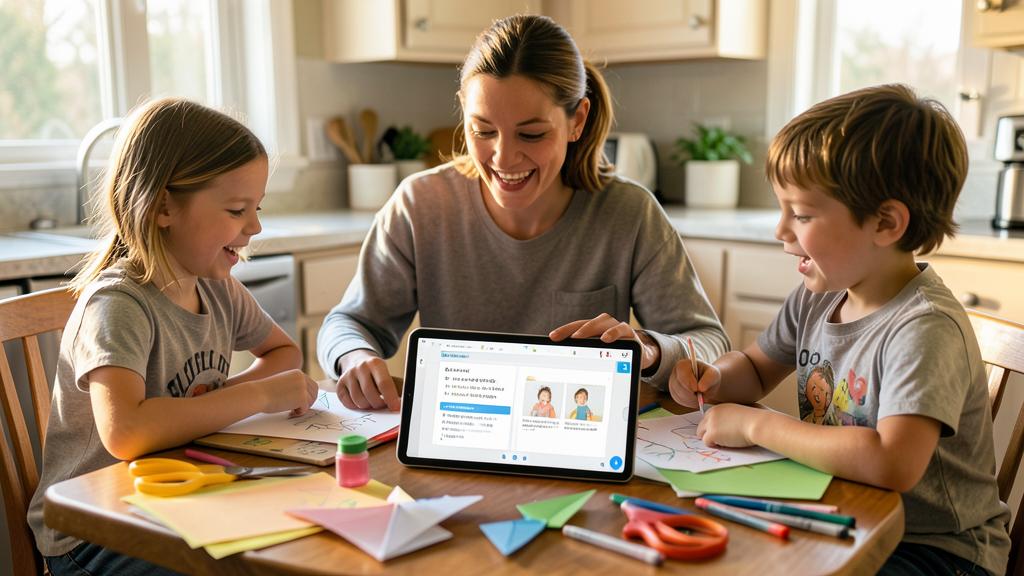
On a rainy afternoon, you ask AI: “Give me 5 screen-free activities for a 6-year-old and 8-year-old, using only paper, glue, and markers.” It might suggest making a paper city, creating comic strips, or designing a treasure map. You pick one, and everyone has fun together without needing screens or expensive materials.

How to properly use AI to keep children busy
To get the most out of AI without losing the essential, here’s the right approach. SPECIFY your criteria: that’s the key to good ideas; tell AI the age of the children, the weather, the time you have, your budget, the materials available, the number of children, the type of activity desired; the more precise you are, the more the ideas fit your situation. ASK for VARIED ideas: request a list of diverse ideas (calm and active, creative and sports, with and without you); you pick according to the moment and the children’s mood. ADAPT to YOUR children: AI doesn’t know their tastes; adapt its suggestions to what YOU know about them—what they’re passionate about, their temperament, what has already worked; you’re the best judge. PRIORITIZE screen-free and shared activities: ask for screen-free activities and activities to do TOGETHER; these are the most precious; AI can help you balance and find shared moments. CHECK safety and suitability: for any proposed activity (experiment, craft, outing), check that it is SAFE and SUITABLE for the age of your children; AI may suggest things that are unsuitable or requiring supervision; your parental vigilance takes precedence (we’ll come back to this). Leave room for CREATIVE boredom: don’t fill every minute; boredom pushes children to invent, imagine, play alone; it’s beneficial; AI helps have ideas in reserve, not to fill every moment. KEEP free play: free, undirected play is essential to development; let children play their way; « organized » activities are a complement, not a replacement. INVOLVE the children: offer them the choice among the ideas, or even ask them to ask AI (accompanied) for ideas; they thus appropriate the activities. Don’t put PRESSURE on yourself: you don’t have to be a « permanent entertainer »; the goal is to have good times and to help with the lack of ideas, not to fill a perfect program; relax. STAY present: AI gives ideas, but it’s YOUR presence, your attention, the shared time that count the most for children; don’t delegate the relationship to activities. In summary: specify your criteria for adapted ideas, ask for variety, adapt to YOUR children, prioritize screen-free and shared activities, always check safety and suitability for age, leave room for creative boredom and free play, involve the children, and don’t put pressure on yourself. AI is a reservoir of ideas; the essential remains the time and attention you offer your children.
- Specify your criteria (age, weather, time, budget, materials)
- Ask for varied ideas (calm/active, creative/sports, with/without you)
- Adapt to your children’s tastes and temperament
- Prioritize screen-free and shared activities
- Check safety and suitability for age
- Leave room for creative boredom and free play
- Involve the children in choosing activities
- Don’t put pressure on yourself to be a perfect entertainer
- Stay present – your attention matters most
The ideal use: a custom idea reservoir for days of shortage. AI is particularly precious for parents in a very specific and frequent situation during the holidays: the moment when you run out of ideas, often at the worst time (a rainy day, the end of the afternoon, a repeated « I’m bored »), and when you lack both inspiration and energy to find some. There, AI works wonders, provided you use it well. The secret to truly useful ideas is the PRECISION of your request. Don’t just ask « activity ideas for children » (you’ll get generalities); give as much context as possible: « Give me 10 activity ideas to occupy two children aged 5 and 8, a rainy afternoon at home, without screens, with simple materials we already have (paper, markers, cardboard), some of which they can do independently. » With such a precise request, AI instantly proposes a list tailored to YOUR exact situation—the age, the weather, the place, the budget, the materials, the desired level of independence. It’s like having a friend always full of ideas, available at any time, who adapts to your momentary constraints. A few reflexes to get the most out of it: ask for a LIST of varied ideas rather than just one, so you can pick according to the children’s mood and keep ideas in reserve for the following days; specify if you want CALM activities (for a quiet moment) or HIGH-ENERGY (to burn energy), to do WITH you or INDEPENDENTLY; and don’t hesitate to specify themes that your children like (dinosaurs, space, cooking, a story they love) for ideas that will hit the mark. A nice idea: involve the children themselves in the process; offer them the choice among the generated ideas, or even, with the older ones and under your supervision, ask AI for ideas on a theme they’re passionate about—they thus appropriate the activities and are more motivated. But always keep in mind the right balance: AI is there to HELP you on days of shortage and give you a reservoir of ideas, not to turn the holidays into a permanent entertainment program. It is just as important to leave children free time, boredom (which stimulates their imagination and pushes them to invent their own games), and spontaneous play. AI takes away the anguish of the blank page in front of « I’m bored, » which is a real relief; but it shouldn’t put pressure on you to fill every minute. Used as a punctual helping hand for low moments—and not as a full-time program generator—it makes the holidays easier and more varied, while leaving plenty of room for free play and shared moments that make the best memories.

The essential not to forget
AI is a good idea reservoir, but you mustn’t lose sight of what really matters for children; here are the essential points. SAFETY and suitability for age: crucial point; any activity proposed by AI must be verified by you—is it SAFE? Suitable for the age? Does it require supervision? AI may suggest things that are unsuitable, dangerous without supervision, or with risky materials; your parental judgment is the safeguard; never follow an idea without evaluating it (we’ll come back to this). FREE PLAY, irreplaceable: spontaneous, undirected play, where the child invents and imagines in their own way, is essential to their development; you mustn’t « organize » everything; leave large stretches of free play; the proposed activities are a complement, never a replacement. BOREDOM, beneficial: contrary to intuition, boredom is useful; it’s from boredom that imagination, creativity, and the ability to occupy oneself alone are born; don’t be afraid to let your children get a little bored; don’t fill every minute; AI helps have ideas in reserve, not to eliminate all downtime. SHARED TIME, the most precious: what children will remember is not the perfect activity, but the moments spent WITH you—your presence, your attention, your complicity; prioritize shared activities and, above all, the quality of your presence; don’t delegate the relationship to activities that « occupy. » BALANCE with screens: holidays are an opportunity for varied activities, not just screens; use AI to find screen-free ideas and rebalance; real play, movement, contact with others and nature count (our screen and children guides). Don’t OVER-PROGRAM: holidays where every minute is planned tire out children and parents and stifle spontaneity; leave flexibility, free time, improvisation; holidays are also made to relax. Adapt to YOUR children: you know their tastes, their temperament, their rhythm; adapt AI’s ideas to their reality, rather than following a generic program. Don’t put PRESSURE on yourself: you don’t have to be a perfect entertainer; the goal is good times, not performance; a little boredom, free play, and simplicity make for very good holidays. SHARED pleasure: the essential is that children and parents have good times, together and each; AI helps with the lack of ideas, but the heart of the holidays is elsewhere: in the simple joy of being together and playing. In summary, the essential not to forget: always check the SAFETY and suitability for age of activities; preserve FREE PLAY and leave room for CREATIVE boredom (both essential); prioritize SHARED TIME and your presence (the most precious); balance with screens; don’t over-program and don’t put pressure on yourself. AI is a formidable idea reservoir to help and vary; but the heart of children’s holidays is free play, imagination, and above all the moments shared with you. Never let the tool make you forget this essential.
Warning: always check the safety and suitability for age of each proposed activity—and don’t forget that free play and shared time are better than a perfectly filled program. Two essential points deserve all your parental vigilance. The first, non-negotiable: SAFETY. AI generates activity ideas based on your criteria, but it doesn’t know your children, your environment, and it doesn’t have a parent’s judgment; it can therefore propose activities unsuitable for the age, requiring close supervision, or involving materials or gestures presenting a risk (scissors, products, heat, height, small objects for toddlers, risky « home » experiments…). NEVER follow an activity idea without having evaluated it yourself: is it really suitable for the age and abilities of your children? Is it safe? Does it require your constant supervision? Is the material safe? Your parental judgment is the indispensable safeguard: you know your children, your home, the risks; AI only proposes, it’s up to you to validate and supervise. Be particularly vigilant with activities involving experiments, tools, cooking (heat, cuts, oven), or anything requiring supervision, and always adapt to the real age of your children; never leave the youngest alone with a potentially risky activity. The second point, more subtle but just as important: don’t let AI lead you to OVER-PROGRAM your children’s holidays. The ease with which AI generates ideas can create an insidious pressure—that of wanting to fill every minute, to chain « enriching » activities, to turn the holidays into a permanent entertainment program. Resist this temptation, because you would miss what is most precious for a child. FREE PLAY—that where the child invents, imagines, plays in their own way without directed activity—is essential to their development; leave them large stretches of unstructured time. BOREDOM itself is beneficial: it’s often from boredom that imagination, creativity, and the ability to occupy oneself alone emerge; a child who never gets bored never learns to invent their own games. And above all, what your children will remember is not the perfect activity found by AI, but the SHARED MOMENTS with you—your presence, your attention, your complicity, your laughter. Never delegate the relationship to activities that « occupy »: a simple activity done together, with your full presence, is worth infinitely more than a sophisticated program where you’re elsewhere. Finally, don’t put pressure on yourself: you don’t have to be a perfect entertainer; a little boredom, free play, simplicity, and shared moments make for very beautiful holidays, much better than a meticulously planned schedule that would exhaust everyone. AI is an excellent idea reservoir to help you on days of shortage and vary activities; use it for that, with pleasure. But always keep two reflexes: validate the safety of each idea with your parental judgment, and leave plenty of room for what really matters—free play, imagination, and time spent together. That’s where, much more than in a perfect program, happy childhood holidays are built.

Frequent questions
Does AI know activities suitable for the age of my children?
Yes, if you specify the age, AI adapts its suggestions, but it’s up to YOU to VERIFY that the activities really suit your children and are safe; AI proposes, you validate. Let’s detail. What AI CAN do: if you indicate the age of your children in your request, AI adjusts its proposals—it will (in principle) avoid suggesting activities that are clearly too complex or too simple, and will propose ideas generally within the age range; the more you specify (exact age, but also abilities, interests), the more the ideas are relevant; in this respect, AI is a good starting point to find activities « of the right age range. » The LIMITS to know: AI reasons on generalities; it doesn’t know YOUR children (their real level, their temperament, what they like or puts them at a disadvantage), and its assessment of what is suitable for an age can be imperfect; above all, it can propose activities that, even « within the age range, » require supervision, present a risk, or are not suitable for YOUR specific child; AI doesn’t have the judgment or knowledge of a parent. Your ESSENTIAL ROLE: it’s up to YOU to validate each idea; ask yourself: does this activity really suit the age and abilities of my child? Is it safe? Does it require my supervision? Will it please them? You know your children; adapt the suggestions to their reality, discard what doesn’t suit, and supervise what needs it; AI proposes, you decide and supervise. The good REFLEX: specify the age (and more) in your request for better ideas, but never follow an activity without having evaluated it yourself; consider the proposals as tracks to filter with your parental judgment, not as guaranteed recommendations. A TIP: for activities involving materials, tools, cooking, or handling, redouble your vigilance on the suitability for age and safety, and ensure the necessary supervision, especially for the youngest. In summary, yes, AI can propose activities suitable for the age if you specify it, and it’s a good starting point; but it reasons on generalities, doesn’t know your children, and can suggest unsuitable things or requiring supervision. Your role is essential: always validate each activity with your parental judgment (real suitability for age, safety, your children’s tastes) and supervise what needs it. AI proposes tracks; it’s you, who knows your children, who decides and ensures their safety.
Are the activities proposed by AI safe?
They are not guaranteed safe: AI may propose activities requiring supervision, risky materials, or unsuitable ones; you must ALWAYS verify the safety of each activity before proposing it to your children. This is an essential point of vigilance. Why CAUTION is necessary: AI generates ideas based on your criteria, but it doesn’t have a parent’s judgment, nor the knowledge of your children and your environment; it can therefore propose activities that present risks: use of scissors, products, heat (cooking), pointed or small objects (danger for toddlers), activities at height, risky « home » experiments, or simply activities requiring supervision that it may not necessarily signal; nothing guarantees that a generated idea is safe as is. Your RESPONSIBILITY: the safety of your children is up to YOU, not AI; before proposing an activity, evaluate it: does it present a risk? Is the material safe? Is constant supervision required? Is it suitable for the age and abilities? Is the environment secure? Never apply an idea without this evaluation. Points of PARTICULAR VIGILANCE: be especially attentive to activities involving TOOLS (scissors, glue, pointed objects), COOKING (heat, cuts, oven), PRODUCTS (even household or food products in experiments), SMALL objects (risk of ingestion for young children), WATER, or HEIGHT; these activities require close supervision, or are to be discarded depending on the age. SUPERVISION: many activities are safe… provided they are supervised; ensure the necessary presence and supervision, especially for the youngest; don’t leave a young child alone with a potentially risky activity. The good REFLEX: treat each AI idea as a proposal to be filtered by your safety judgment; in case of doubt about an activity, discard it or adapt it; prioritize simple and clearly safe activities; and always supervise what needs it. In summary, no, the activities proposed by AI are not guaranteed safe: AI may suggest risky activities, requiring supervision, or unsuitable ones, without signaling it. You must ALWAYS verify yourself the safety of each activity before proposing it to your children, by evaluating the risks, the material, the suitability for age, and the need for supervision. The safety of your children is up to your parental judgment, never AI’s: be particularly vigilant with tools, cooking, products, small objects, and height, and supervise what needs it. AI proposes ideas; it’s you who guarantees the safety.

Is it a good idea to let children ask AI themselves?
It can be an interesting and empowering activity, but only in an ACCOMPANIED and supervised way, taking into account the age; letting a child use AI alone and without supervision is not recommended. Let’s nuance. The interest of INVOLVING children: offering children the opportunity to participate in the search for ideas (choosing from proposals, or, for the older ones, formulating a request to AI themselves) can be positive: they appropriate the activities, are more motivated, and it can be an opportunity to discover a tool and learn to use it; under your supervision, this can become an activity in itself. The ESSENTIAL conditions: this use must be ACCOMPANIED and SUPERVISED, for several reasons; AI can give inaccurate information or unsuitable ideas that a child won’t be able to evaluate; it’s not designed as a safe space for children alone; and the use of online tools by a child raises questions of safety, content, and privacy; your presence is therefore necessary to guide, filter, and explain. Taking into account the AGE: for the youngest, it’s you who interact with AI, the child simply choosing from the ideas; for the older ones, they can formulate requests, but always with you by their side; adapt to the child’s maturity, and don’t let a child use AI independently without supervision. What to AVOID: leaving a child alone in front of AI without supervision (risks of unsuitable content, false information taken at face value, privacy issues); and turning this into an additional unsupervised screen time; the goal is an accompanied activity, not a « nanny screen. » The BENEFITS of accompanied use: done together, this can be an opportunity to teach the child to formulate a request, to sort the ideas, to keep a critical spirit (AI sometimes makes mistakes), and to discover a tool of their time in a supervised way; a bit of digital education, in short. The GENERAL framework: remember that even an activity « with AI » remains screen time, to be integrated into a balance; and that the essence of the holidays is elsewhere (real play, shared time). In summary, letting children ask AI themselves can be an interesting and empowering activity, but only in an ACCOMPANIED and supervised way, adapted to their age: your presence is necessary to guide, filter unsuitable ideas, explain that AI sometimes makes mistakes, and ensure safety and privacy. Don’t let a child use AI alone and without supervision. Well supervised, this shared use can even be an opportunity for digital education; but it remains screen time to be dosed, and the heart of the holidays remains real play and shared moments.
What to remember
AI helps keep children busy during the holidays by instantly generating a multitude of activity ideas tailored to YOUR criteria—the age of the children, the weather, the time available, the budget, the materials, the moment’s desire, with or without screens. It’s a precious source of inspiration against the lack of ideas, particularly useful on low days (a rainy afternoon, a repeated « I’m bored »), when you lack both inspiration and energy. The secret to truly useful ideas is the PRECISION of your request: give as much context as possible (age, place, weather, materials, without screens, independently or with you, themes that your children like), and AI proposes a list tailored to your exact situation—like a friend always full of ideas, available at any time. Ask for variety to pick according to the mood, and possibly involve the children in the choice. But keep two essential points of vigilance. First, SAFETY: AI doesn’t have a parent’s judgment, nor the knowledge of your children; it can propose activities unsuitable for the age, requiring supervision, or involving risky materials, without signaling it. ALWAYS verify each activity with your parental judgment before proposing it (real suitability for age, safety, need for supervision), be particularly vigilant with tools, cooking, products, small objects, and height, and supervise what needs it. Safety is up to you, never AI. Then, don’t let AI lead you to OVER-PROGRAM the holidays: the ease of generating ideas can create the insidious pressure to fill every minute, but you would miss the essential. FREE PLAY (where the child invents in their own way) is essential to their development, BOREDOM itself is beneficial (it stimulates imagination and the ability to occupy oneself alone), and above all, what your children will remember are not the perfect activities, but the SHARED MOMENTS with you—your presence, your attention, your complicity. Never delegate the relationship to activities that « occupy »: a simple activity done together is better than a sophisticated program where you’re elsewhere. Balance with screens (AI helps find screen-free ideas), don’t put pressure on yourself to be a perfect entertainer, and always adapt to YOUR children, whose tastes and temperament you know. AI is a formidable idea reservoir to help and vary; but the heart of children’s holidays is free play, imagination, and the moments shared with you. Use the tool to relieve the lack of ideas, while keeping your parental judgment for safety and leaving plenty of room for what makes the best childhood memories: simplicity, spontaneity, and time spent together.



Want to master AI and make it a real asset in your daily life? Our training courses accompany you at your own pace.
Leave a Reply
You must be logged in to post a comment.