
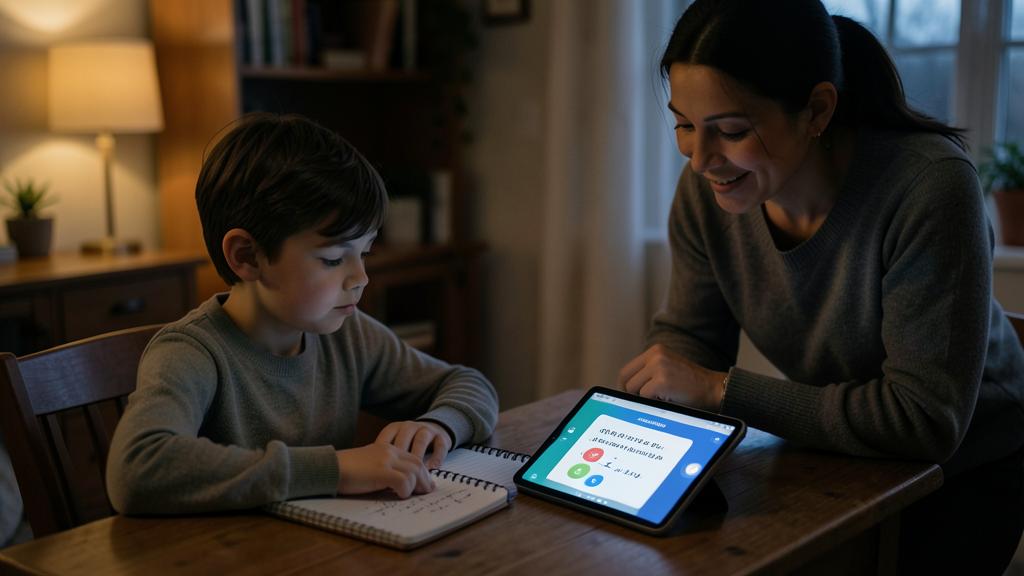
In the evening, homework time can turn into a headache: a misunderstood math exercise, a lesson to review, a composition that blocks, and a parent who is not always at ease with the subject. Artificial intelligence arrives in homes as a possible aid: it can explain a concept, propose exercises, and help understand a statement. But it is a delicate use, as the risk is great: that it does the homework instead of the child, depriving them of the essential—learning. Properly used, it is a precious tutor; improperly used, it sabotages learning. Here’s how to accompany your children’s homework with AI on the right side of this line.
What AI can bring to homework
AI (generative AI tools — our guides understand generative AI) can support homework support, provided it aims at learning. EXPLAIN a CONCEPT: rephrase a grammar rule, a math concept, a scientific phenomenon, in terms adapted to the child; useful when the parent does not master the subject or does not know how to explain it. HELP to UNDERSTAND a STATEMENT: break down a task, clarify what is requested, without giving the answer. GUIDE step by step: rather than solving, propose a method, ask questions that make the child think, indicate the first step. PROPOSE additional EXERCISES: generate additional exercises to practice on a poorly mastered concept. VERIFY understanding: question the child, make them explain what they have understood. GIVE examples: illustrate an abstract concept with concrete and relatable examples. SUPPORT the parent: remind of a forgotten rule, suggest how to approach a difficulty, without substituting the child. What is it for? TO UNLOCK (when the child or parent is stuck); to EXPLAIN differently (a second way of presenting a concept can make the lightbulb go off); to PRACTICE (tailored exercises); and to SUPPORT the parent who does not feel competent in a subject. The main idea—and it is crucial here—is that AI should help the child to UNDERSTAND and LEARN, never to do the work for them. The distinction is vital: if AI explains, guides, questions, and proposes leads, it supports learning; if it gives a ready-made answer that the child copies, it deprives them of the effort that makes learning— and gives them the illusion of having « done » their homework without retaining anything. The whole point of support is to stay on the right side of this line: making AI a tutor who helps to think, not a machine to answer. It is possible, but it requires constant vigilance from the parent, because for a child, the temptation of the easy solution is great.
AI can help with homework, but only if it’s used to explain, guide, or give examples—not to give answers. The goal is to help the child learn, not to do the work for them. If AI just gives answers, the child doesn’t learn anything, and that’s the biggest risk.

How to properly support with AI
Here’s how to benefit from AI without harming learning. Stay PRESENT—AI is not a school babysitter; homework support with AI, especially for younger children, is done WITH the parent, not by leaving the child alone in front of the screen; your presence guarantees proper use. Ask for EXPLANATIONS, not answers—formulate requests in this way: « explain this rule simply, » « how to approach this type of exercise? » « give an example, » rather than « do this exercise. » Guide, not solve—ask AI to propose a METHOD or ask questions that make the child think, keeping the answer for the end: « guide him without giving the solution »; some AI accept this tutor-like instruction. Let the child SEARCH—the effort of searching, making mistakes, and starting over is precisely what makes learning; do not let AI shortcut this effort; intervene only when the child is really stuck, not before. Have the child RE-EXPLAIN—after an AI explanation, ask the child to rephrase what they have understood in their own words: this is how you check and anchor. Use it for PRACTICE—on a fragile concept, ask for additional exercises that the child does himself, then correct and explain the errors. Verify what AI says—it can be wrong; cross-check with the class and school materials, which remain the reference; beware of an explanation that contradicts the teaching method in class. Talk about SCHOOL RULES—explain to the child what is allowed; getting help to understand, yes; having AI do the homework, no; set this framework clearly. Some TIPS: adapt the use to the AGE (the younger the child, the more the parent’s presence is essential); prioritize the METHOD over the answer; and value the EFFORT (praise the effort of searching as much as the right answer). In summary: stay present, ask for explanations and guidance rather than answers, let the child search, have them re-explain, practice, verify the information, and set the framework. AI helps to understand; it is the child who must make the effort to learn.
A 10-year-old is stuck on a math problem about fractions. Instead of asking AI to solve it, the parent asks: “Can you explain how to add fractions step by step?” The AI responds with a clear method, and the child tries it out, making mistakes and correcting them. The parent then asks the child to explain the steps back to them, reinforcing learning. This way, AI helps without doing the work.
The right reflex. The question to ask constantly is simple: does AI help my child to UNDERSTAND, or is it doing the work for them? That’s the whole thing. The winning reflex: never ask « do this exercise » or « give the answer, » but « explain this concept simply, » « guide him step by step without giving the solution, » « ask him questions to help him find it himself. » Many AI play this Socratic tutor role very well when explicitly asked to do so. Stay PRESENT next to the child, especially if they are young: AI is not a school babysitter, and leaving a child alone in front of it opens the door to the easy solution. Let them SEARCH and make mistakes—the error is part of learning—and intervene only when they are really stuck. After each explanation, ask them to RE-EXPLAIN with their own words: if they can, they have understood; otherwise, go back to it. Also use AI to generate additional exercises that the child does himself. Finally, verify what AI says (it can be wrong and can contradict the teaching method in class: the school course remains the reference). And clearly set the framework with your child: getting help to understand is good, having AI do the homework is self-deception. Value the effort of searching as much as the right answer. Properly managed, this line makes AI a great support; if crossed, it turns homework into an illusion.

The dangers to know
This is the most sensitive topic: AI can harm learning if not carefully watched. The MAJOR DANGER: doing the homework for the child; this is the central trap; a child who copies an AI response submits a perfect homework but has learned nothing; worse, they deprive themselves of the effort of reflection that builds their intelligence; AI becomes a silent cheater rather than a tutor. EARLY DEPENDENCE: a child who gets into the habit of asking AI for help at the slightest effort does not develop perseverance, autonomy, and the ability to search; these are essential skills; school is meant to build them, not bypass them. AI ERRORS: it can give a wrong answer or explanation (our guides on the limits of AI); a child does not have the insight to spot it; hence the importance of parental presence and verification with the course. DIFFERENT METHODS: AI can explain a concept differently from the teacher, with a method the child does not recognize, confusing them; the teacher’s method takes precedence. THE CHILD’S PRIVACY: be careful what a child shares with an AI; these tools are not designed for children without supervision and raise questions about personal data (our guides on guiding your child on screens); set boundaries. AGE: most general-purpose AI is not designed for young children; check age conditions, and for the youngest, it is the parent who uses the tool. CHEATING: beyond daily homework, for graded work, using AI can be considered cheating; teach the child the difference between helping and cheating. In summary: the real danger is that AI does the learning for the child; monitor this above all; beware of early dependence, AI errors, and different teaching methods; protect the child’s privacy and respect age limits; and teach the difference between helping and cheating. Used without safeguards, AI harms the child; with a vigilant parent, it helps them grow.
Warning: the real danger is that AI learns for the child. It must be said without equivocation: if misused, AI can do real harm to a child’s learning. The central trap is that it does the homework for them. A child who copies an AI response submits a perfect homework but has learned nothing; they deprive themselves of the effort of searching, making mistakes, understanding—precisely the effort that builds their intelligence and knowledge. Repeated, this creates a disastrous early dependence: the child does not develop perseverance, autonomy, or the taste for effort, and is left helpless when the crutch is gone. Your role as a parent is never to let AI cross this line: it explains, guides, questions, proposes exercises; it never gives a ready-made answer to copy. To do this, stay PRESENT—especially a young child should not be left alone in front of AI, the temptation to take the easy way is too great. Also beware of ERRORS: AI can be wrong, and a child does not have the insight to see it; it can also explain with a different method from the teacher, confusing the child: the teacher’s course remains the reference. Pay attention to AGE (most of these tools are not designed for young children: it is the parent who uses them) and PRIVACY (set boundaries on what the child shares). Finally, teach early the difference between HELPING (legitimate) and CHEATING (self-deception, and cheating on a graded task). AI can be a great tutor for your children; but without a vigilant parent, it risks stealing from them what school should give them: the ability to learn on their own.

Frequently asked questions
How to prevent AI from doing my child’s homework for them?
This is the key question, and the answer is in two words: presence and formulation. PRESENCE first: do not leave your child alone in front of AI, especially if they are young; accompany them, you guarantee the proper use. FORMULATION next: teach them (and apply) the reflex of asking for EXPLANATIONS and GUIDANCE, never answers. Concretely: « explain this rule to me, » « guide me without giving the solution, » « ask me questions to help me find it »—not « do this exercise. » You can even explicitly ask AI to act as a tutor that never gives the answer directly: many do well with this. Let the child SEARCH and make mistakes before any intervention; AI helps only in real cases of blockage. After an explanation, make them RE-EXPLAIN with their own words to verify that they have understood. And set a clear framework: at home, AI is for understanding, not doing it for them. Value the effort of searching as much as the result. By establishing these habits early, you make AI a tutor that helps your child grow, rather than a machine that hinders their learning.
From what age can a child use AI for their homework?
There is no single age, but some guidelines. Most general-purpose AI is NOT designed for young children and set a minimum age in their conditions (usually adolescence): check them. For the YOUNGEST (primary school), the child should not use AI alone: the parent uses it, to explain a concept or generate an exercise, keeping full control. For COLLEGE and high school students, a more autonomous use becomes possible, but always supervised: with clear rules (understand, not copy), vigilance on errors and privacy, and regular dialogue on proper use. Beyond the age, what matters is the MATURITY and the child’s ability to use the tool without settling for the easy way: some adolescents need a tight framework, others are more autonomous. In all cases, the younger the child, the more the parent’s presence and control are essential; and at any age, it’s better to teach the child to use it intelligently (as a tutor) than to let them discover it alone, with the risk of turning it into a response machine. Adapt autonomy to age and maturity, without ever abandoning the role of safety net (our guides on guiding your child on screens).

Can AI really help a parent who does not master a subject?
Yes, and it is one of its most precious contributions. Many parents feel helpless in front of certain homework: a forgotten math rule, a subject they never fully understood, a method that has changed since their schooling. AI can then play a SUPPORT role: remind of a rule, re-explain a concept simply, give examples, suggest how to approach an exercise with the child. It helps you feel less helpless and to support your child even on a subject that eludes you. Two precautions: first, VERIFY what it says and favor the class teaching method (AI can explain differently, which confuses the child; the class course is the reference); second, keep proper use—the goal is to help your child UNDERSTAND, not to give answers. Used this way, AI does not replace your parental role: it equips you to better assume it, even on subjects where you do not feel legitimate. It is a beautiful use: it democratizes school support, giving every parent, regardless of their level, the means to support their child. Always, however, stay on the right side of the line: explain and guide, never do the work for them. The key point is that AI should help the child to UNDERSTAND and LEARN, never do the work for them. For staying on the right side: stay PRESENT (AI is not a school babysitter, especially for young children); ask for explanations and guidance, not answers (« guide him without giving the solution »); let the child SEARCH and make mistakes; have them RE-EXPLAIN with their own words; use AI for practice; verify what it says (it can be wrong, and the class course remains the reference); and set a clear framework. The real danger: that it learns for the child, creating an early dependence that deprives them of perseverance, autonomy, and the taste for effort—precisely what school should build. Beware also of AI errors (that the child cannot spot), different teaching methods, age limits (most tools are not designed for young children), and privacy. Teach early the difference between HELPING (legitimate) and CHEATING (self-deception). Properly guided by a vigilant parent, AI becomes a formidable tutor, available at any time, democratizing school support even for parents who are not comfortable with a subject. Without safeguards, it risks stealing from the child the essential: the ability to learn on their own. The best gift you can give them is not the right answer; it is the skill to find it.
What to remember
AI enters homes as a possible aid to homework, but it is a delicate use that requires parental vigilance. Properly used, it SIMPLY explains a concept, HELPS to understand a statement, GUIDES step by step without giving the answer, PROPOSES exercises, VERIFIES understanding, and SUPPORTS the parent who is not at ease with a subject. Everything hinges on a line: AI must help the child to UNDERSTAND and LEARN, never do the work for them. That is the key point. To stay on the right side: stay PRESENT (AI is not a school babysitter, especially for young children); ask for explanations and guidance, not answers (« guide him without giving the solution »); let the child SEARCH and make mistakes; have them RE-EXPLAIN with their own words; use AI for practice; verify what it says (it can be wrong, and the class course remains the reference); and set a clear framework. The real danger: that it learns for the child, creating an early dependence that deprives them of perseverance, autonomy, and the taste for effort—precisely what school should build. Beware also of AI errors (that the child cannot spot), different teaching methods, age limits (most tools are not designed for young children), and privacy. Teach early the difference between HELPING (legitimate) and CHEATING (self-deception). Properly guided by a vigilant parent, AI becomes a formidable tutor, available at any time, democratizing school support even for parents who are not comfortable with a subject. Without safeguards, it risks stealing from the child the essential: the ability to learn on their own. The best gift you can give them is not the right answer; it is the skill to find it.



Want to master AI and make it a real asset in your daily life? Our training programs guide you at your own pace.
Leave a Reply
You must be logged in to post a comment.