
« Why is the sky blue? » « What are taxes? » « How does an airplane work? » : Children ask questions about everything, and we often find ourselves struggling to explain complex topics simply, or to make them accessible to their age. The AI becomes a valuable aid for parents: it explains complex subjects using age-appropriate words, offers relatable analogies, and fuels curiosity. But it’s important to remain present and vigilant. Here’s how AI helps you answer your children’s « whys » and turn them into shared learning moments.
Explain at a child’s level
The difficulty of explaining a subject to a child is not knowing it, but simplifying it without distorting it, using the right words for their age. This is precisely where AI excels: ask it to explain a concept « to a 6-year-old child » (or 10, or the desired age), and it adapts its vocabulary, length, and examples. Helpful usages: Age-appropriate simplification — transforming a complex topic (how the body works, where rain comes from, what electricity is) into a clear and accessible explanation; Relatable analogies — the AI finds everyday examples from the child’s life to make the abstract concrete (a difficult concept compared to something they know); Chain of ‘whys’ — when the child asks a series of questions, the AI helps answer without exhausting itself or getting stuck; Adaptation when it doesn’t work — « explain it differently, » « with an example, » « even simpler »; and Enrichment — ideas for simple experiments to do together, further extensions. The AI helps you be the parent who can explain, even on topics where you’re less comfortable. But beware — and this is crucial — the AI is a TOOL to help you explain, not a substitute for your presence: the ideal is to use it WITH the child or to prepare your explanation, keeping control over what is said and turning it into a shared moment, not delegating the child to a screen (we come back to this).
AI helps parents explain things to kids by using simple words and examples. It’s like a helper, but you should still be there to make sure the answers are right and to talk with your child about them.
A 6-year-old asks, « Why is the sky blue? » You ask AI to explain it to a 6-year-old. It might say, « The sky looks blue because sunlight bounces off tiny particles in the air, like how a blue shirt looks blue because it reflects blue light. » You can then add, « Just like how your blue crayon makes blue marks! » and draw a picture together.

Nourish curiosity together
Well used, AI can become a formidable tool for awakening and shared learning: explore TOGETHER a subject that fascinates the child (dinosaurs, space, animals — the AI helps delve deeper, answer pointed questions), transform a question into a fun LESSON or an idea for an ACTIVITY (an experiment to do, a drawing, a research). It’s also a good complement to other learning sources: books (our guides read more with reading apps), educational apps (our guides educational apps), and especially real EXPERIENCES and exchanges. The AI can even help parents better understand a subject themselves before explaining it, or find how to approach a sensitive question (a difficult question from a child on a sensitive topic: the AI helps find the words, for you). The principle that makes all this beneficial: keep the AI as a TOOL serving the parent-child relationship, not as a replacement. The best moments are those where you explore together, where the AI feeds the conversation between you and your child, where their curiosity meets your attention. A child who asks questions seeks to understand as much as to share a moment with you: the AI can enrich this moment (by helping you answer) without ever replacing it. Used this way — with you, not in your place — it turns a child’s curiosity into a beautiful opportunity to learn and exchange.
The right reflex. Use AI WITH your child or to prepare your explanation, never as a babysitter who answers for them. When your child asks a question you don’t know how to answer well, make it a shared MOMENT: « good question, let’s look for the answer together »; ask the AI to explain « to a child of [their age], » read and rephrase with your own words, discuss it, extend it with an experiment or a drawing. You remain the mediator — you filter, adapt, add the warmth of the exchange —, and the AI is just the tool that helps you find the right explanation. You can also use it beforehand, to PREPARE yourself to explain a topic you’re not familiar with. The important thing is that the child experiences this as a moment WITH YOU, nourished by the AI, not as a conversation with a screen. A child’s curiosity is precious: the AI helps you answer it without exhausting yourself or getting stuck, while keeping the essentials — your presence, your attention, the pleasure of learning together. This transforms a simple « why » into a real moment of complicity.

Stay vigilant: presence, verification, supervision
Some precautions to ensure AI is a good educational ally. PRESENCE first: AI should not replace your role or become an additional screen that isolates the child (our guides accompany your children on social networks, for the broader question of screens); the ideal is a shared and supervised use, not a child alone facing an assistant. VERIFICATION next: AI can be wrong or oversimplify to the point of misleading (our guides when AI invents); be critical about important facts — you are the guarantor of what is transmitted to your child (you can cross-check with a book or a reliable source). SUPERVISION: if your child uses AI, do so in an age-appropriate framework, with necessary protections, and keep the reins (their questions can lead to topics to address with you). CONFIDENTIALITY: do not share personal information about your child, and be aware of what the tool collects (our guides privacy). Finally, maintain the BALANCE with other sources — AI complements books, real experiences, exchanges, school, and nature — it does not replace them: a child learns first by living, manipulating, discussing. In summary, AI helps parents explain complex subjects to children: it simplifies for a child, finds relatable analogies, fuels curiosity, and turns « whys » into learning moments. Used well — WITH the child and not in your place, with verification and presence — it enriches the relationship and awakening. Misused (AI as a babysitter, without vigilance), it would isolate and could mislead. The best use keeps the human at the center: AI feeds the conversation between you and your child, it never replaces it.
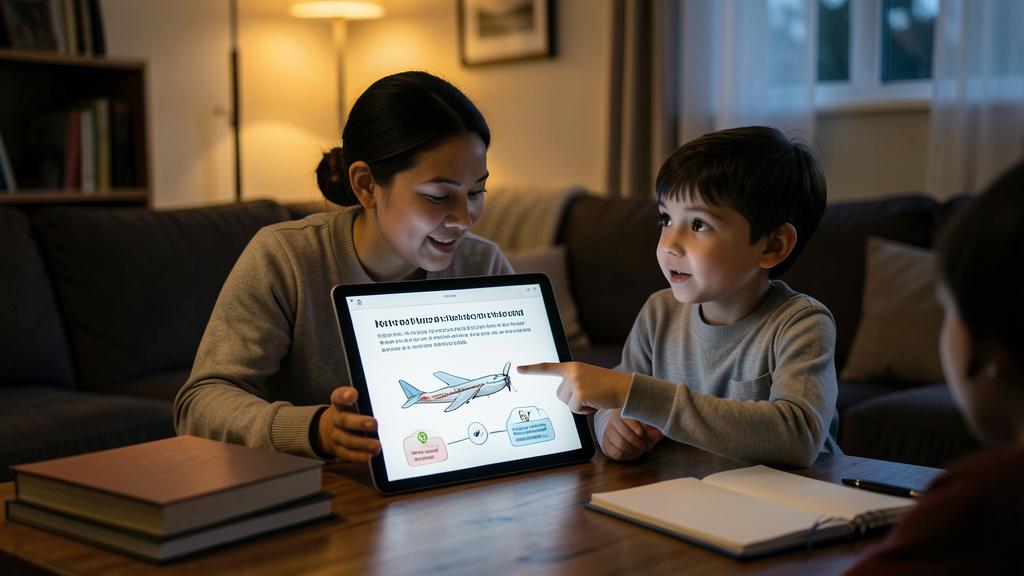
Caution: AI helps explain, it does not replace your presence or vigilance. Three precautions: PRESENCE — AI should not become a digital babysitter or an additional screen that isolates; the ideal use is shared and WITH you, not a child alone facing an assistant; the best moments are those where you explore together, AI feeding the conversation between you and your child without replacing it. VERIFICATION — AI can be wrong or oversimplify to the point of misleading (our guides when AI invents); you are the guarantor of what is transmitted to your child: be critical about important facts, cross-check with a book or a reliable source if needed. SUPERVISION and CONFIDENTIALITY — if your child uses AI, do so in an age-appropriate framework, with necessary protections and keeping the reins (their questions can lead to topics to address with you — our guides accompany your children on social networks). Finally, maintain the BALANCE: AI complements books, real experiences, exchanges, school, and nature — it does not replace them: a child learns first by living and manipulating. AI is a tool serving the parent-child relationship and awakening: valuable when it keeps the human at the center, problematic if it substitutes for it.

Frequently asked questions
How does AI help me explain a subject to my child?
It simplifies for a child: ask it to explain a concept « to a child of [their age] » and it adapts its vocabulary, length, and examples. It finds RELATABLE analogies (compare the abstract to something the child knows), helps answer « whys » in a chain without exhausting itself, reformulates when it doesn’t work (« explain it differently »), and suggests experiments to do together. It even helps you understand the subject yourself before explaining it. The best is to use it WITH the child or to prepare your explanation, keeping control and transforming it into a shared moment: AI helps you be the parent who can explain, even on subjects where you’re less comfortable.
Is it a good idea to let my child use AI alone?
Better a supervised and shared use than a child alone facing an assistant. AI should not become a digital babysitter or an additional screen that isolates: the best moments are those where you explore together. If your child uses it, do so in an age-appropriate framework, with necessary protections, and keeping the reins (their questions can lead to topics to address with you — our guides accompany your children on social networks). You remain the guarantor of what is transmitted to them (AI can be wrong), the mediator of the exchange, and the presence that counts. AI is a tool to enrich your role, not to replace it: keep the human at the center of learning.

Can we trust AI for explanations given to children?
As an aid to simplification, yes: it’s excellent for simplifying and finding relatable analogies. But be critical: AI can be wrong or oversimplify to the point of misleading (our guides when AI invents), and you are the guarantor of what is transmitted to your child. On important facts, verify, cross-check with a book or a reliable source, and reformulate with your own words. Use AI as a starting point that you validate, not as an absolute truth delivered directly to the child. This is precisely the benefit of a shared use: you filter and adapt, adding your judgment and the warmth of the exchange. Thus supervised, AI is a good ally for awakening; delivered without vigilance, it could transmit errors.
What to remember
AI helps parents explain complex subjects to children: its strength is to simplify for a child (ask for an explanation « for a child of [their age] »), find relatable analogies that make the abstract concrete, answer « whys » in a chain, and fuel curiosity (ideas for experiments, extensions). It helps you be the parent who can explain, even on subjects where you’re less comfortable, and can become a formidable tool for shared awakening and learning. The principle that makes all this beneficial: keep AI as a TOOL serving the parent-child relationship, never as a substitute. Use it WITH your child or to prepare your explanation, remaining the mediator (you filter, adapt, add the warmth of the exchange), not as a babysitter who answers for them. Three vigilances: PRESENCE (shared use, not a child alone facing a screen), VERIFICATION (AI can be wrong; you are the guarantor of what is transmitted), and BALANCE with other sources (books, real experiences, exchanges — AI complements them, does not replace them). The best moments are those where AI feeds the conversation between you and your child: their curiosity meets your attention, and a simple « why » becomes a beautiful opportunity to learn and exchange together.



Want to master AI and make it a real asset in your daily life? Our training programs accompany you at your own pace.
Leave a Reply
You must be logged in to post a comment.