
The mouse is believed to save us time: in reality, every round trip to it to click « Copy, » « Paste, » or close a window nibbles away seconds, hundreds of times a day. Keyboard shortcuts — these key combinations that execute an action instantly — are the best-kept secret of productivity. No need to know them all: a small handful, turned into reflexes, saves you hours each month. Here are the shortcuts that really matter, and how to adopt them effortlessly.
Why shortcuts change everything
The calculation is simple but striking: every time you let go of the keyboard to grab the mouse, aim at a menu, click, and return to the keyboard, you lose a few seconds AND your train of thought. Multiplied by the hundreds of actions in a day of screen work, this represents a considerable amount of time and real mental fatigue (each micro-interruption fragments concentration — our concentration guides). Keyboard shortcuts eliminate this back-and-forth: the action is done under your fingers, without leaving the keyboard, instantly. Beyond time, the real gain is FLUIDITY: when copying, pasting, undoing, and searching become reflexes, you stay in your task instead of constantly leaving it. It’s the difference between someone who SEEMS to fly on their keyboard and someone who struggles — often, it’s not a matter of talent, just mastered shortcuts. And the good news: these gains are accessible to everyone immediately, without installing anything; the shortcuts already exist everywhere, you just need to know them and get used to them.
Every time you reach for the mouse, you lose seconds and focus. Keyboard shortcuts keep you in the flow by letting you do everything without leaving the keyboard. It’s like driving with one hand vs. stopping at every turn.
The essential shortcuts to know absolutely
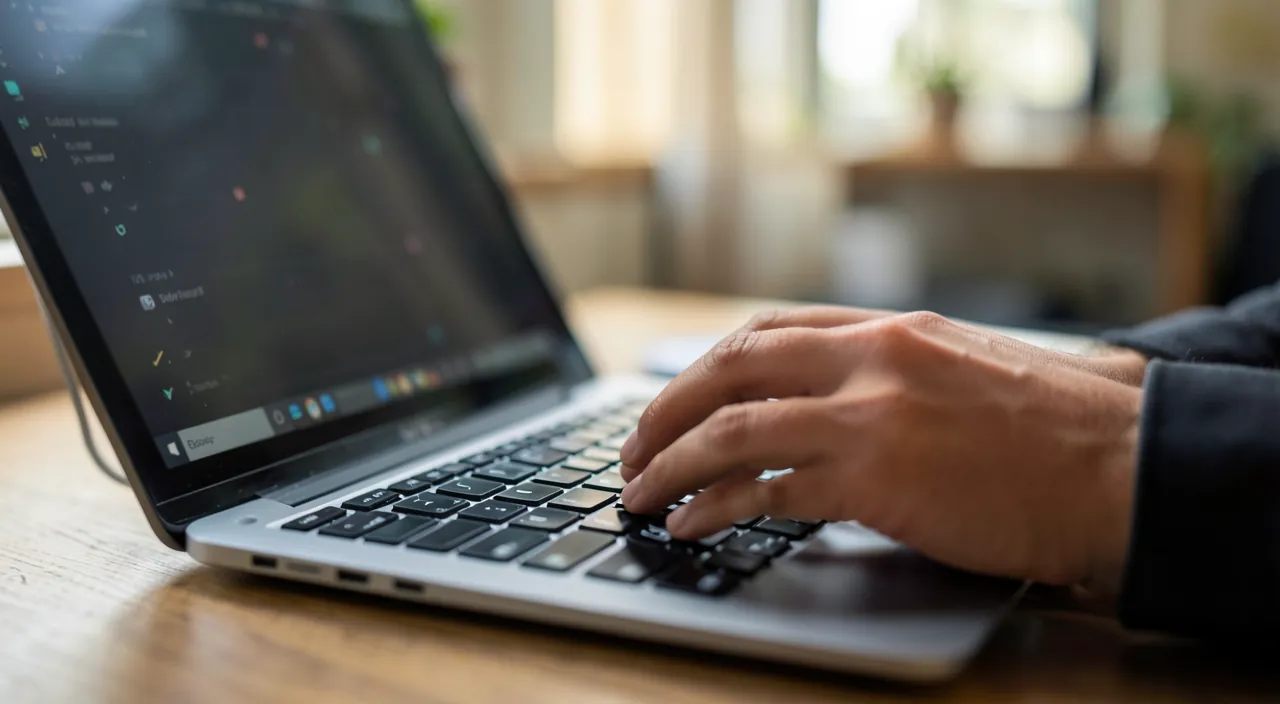
No need to learn dozens of combinations: here is the core that works EVERYWHERE (in almost all software), with the command key of your system (Ctrl on PC, Cmd on Mac). The universal essentials: Copy (C), Cut (X), Paste (V) — the king trio; Undo (Z), the savior that instantly fixes a mistake, and Redo (often Shift+Z or Y); Select All (A); Save (S), to do as a regular reflex to avoid losing anything; Find (F), to instantly find a word in a page or document (our effective search guides). The navigation essentials: switch applications (Alt+Tab on PC, Cmd+Tab on Mac) — switch from one window to another without the mouse; new tab (T) and close tab (W) in the browser; reopen a mistakenly closed tab (Shift+Ctrl/Cmd+T), which saves a lot of frustration. The daily useful ones: print (P), new document (N), and zoom (Ctrl/Cmd + or -) to enlarge a too-small text. That’s the essential: a dozen shortcuts that cover the vast majority of your actions. Master these before any other: they make the real difference.
A writer using Ctrl+C and Ctrl+V for copy-paste instead of the mouse saves about 30 seconds per action. Over 100 copy-paste operations in a day, that’s 50 minutes saved per week — time better spent writing.
The right reflex. Don’t try to learn everything at once: choose ONE or TWO shortcuts you don’t use yet and force yourself to use them for a week, until they become automatic. Then move on to the next ones. Start with the most profitable: if you still click on menus to copy-paste, force yourself to use Ctrl/Cmd+C and V; if you manually search in pages, adopt Ctrl/Cmd+F. A shortcut only saves time when it becomes a REFLEX — and a reflex is installed through repetition, not by memorizing a list. Two well-anchored new shortcuts are better than twenty vaguely known ones that are never used. In a few weeks of this method, your way of working on screen is durably transformed.

Going further and gaining even more
Once the core is mastered, a few tips to progress: the SHORTCUTS SPECIFIC to your favorite software — the one you use for hours every day (word processing, spreadsheet, email, editing) has its own shortcuts that multiply efficiency (our word processing, spreadsheet guides): learn a few specific to YOUR main tool, that’s where the gain is maximal; the display of shortcuts — most menus indicate the shortcut NEXT TO each command: by hovering over a menu, spot the shortcuts of the actions you do often (a painless way to discover them as you go); the window management — shortcuts to organize your screen (side by side, full screen) save comfort; the combination with automation — keyboard shortcuts combine with automation for even greater gains (our guides automate without coding); the accessibility — the keyboard is also a precious help for those who struggle with the mouse (our accessibility guides). The principle remains the same: PROGRESSIVELY, one or two shortcuts at a time, prioritizing those that match what YOU do the most. No need to become a keyboard virtuoso: a few dozen well-chosen shortcuts, turned into reflexes, are enough to work much faster and more comfortably than with the mouse alone.

Warning: some shortcuts differ depending on the system and the software — and adopt them progressively. Two nuances: the combinations VARY between PC (Ctrl key) and Mac (Cmd key), and some shortcuts are specific to a given software (the same gesture can do different things elsewhere): in case of doubt, check in the software menus, which usually display the shortcut for each command. Also beware of POWERFUL and irreversible shortcuts depending on the context (some close everything, quit without saving): know what a shortcut does before using it blindly, and keep the reflex to save regularly (Ctrl/Cmd+S). Finally, don’t get discouraged: trying to learn everything at once leads to abandonment; it’s the PROGRESSIVE adoption, one or two shortcuts at a time until the reflex, that durably transforms your productivity. The regularity of a small learning beats the ambition of a list swallowed and then forgotten.
Frequent questions
Which shortcuts to learn first?
The copy-cut-paste trio (Ctrl/Cmd + C, X, V), the undo (Z) that fixes mistakes, the save (S), the search in a page (F), and the application switch (Alt/Cmd+Tab). Add, in the browser, the opening and closing of tabs (T and W) and the reopening of a mistakenly closed tab. These few shortcuts cover the vast majority of your daily actions. Master them to the reflex before learning others: they bring the biggest time and fluidity gain.
Are the shortcuts the same on PC and Mac?
The logic is identical, but the command key differs: Ctrl on PC, Cmd on Mac. Thus, « copy » is Ctrl+C on PC and Cmd+C on Mac. Most common shortcuts transpose in this way. Some are specific to a system or a particular software: in case of doubt, the application menus display the shortcut next to each command. If you switch from one system to another, the adaptation is quick because the structure of the shortcuts is very similar: only the main key changes.
How to memorize shortcuts without effort?
Don’t memorize them by heart: adopt them through PRACTICE. Choose one or two new shortcuts, force yourself to use them for a week until they become automatic, then move on to the next ones. Also spot the shortcuts displayed in the menus of the actions you do often: you discover them naturally, as you go. A useful shortcut is a shortcut that has become a reflex: regular repetition, a few at a time, is much more effective than trying to swallow a long list at once.
What to remember
Keyboard shortcuts eliminate the back-and-forth to the mouse and, when combined over a day, save hours and concentration. No need to know them all: first master the universal core — copy/cut/paste (C, X, V), undo (Z), save (S), search (F), switch applications (Alt/Cmd+Tab), manage tabs (T, W, and the reopening of a closed tab). These are the ones that bring the biggest gain. Adopt them PROGRESSIVELY: one or two at a time, used until they become reflexes, rather than a list swallowed and forgotten. Then add a few shortcuts specific to YOUR main software (the most profitable), spotting them in the menus. Warning: the combinations vary between PC (Ctrl) and Mac (Cmd) and depending on the software, and some powerful shortcuts are irreversible — know their effect and save regularly. A few dozen shortcuts turned into reflexes are enough to work much faster and more comfortably: keyboard fluidity is not a talent, it’s a habit that is acquired.


Want to gain ease with your digital tools? Our personalized training adapts to your level.
Leave a Reply
You must be logged in to post a comment.