
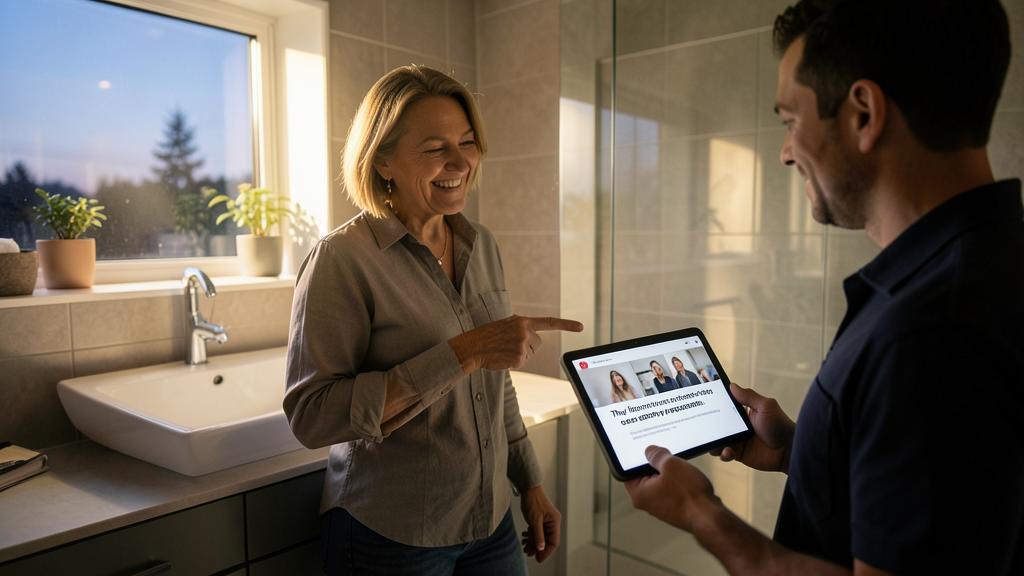
You can write « quality work, satisfied client » a hundred times on your website: no one will believe you at your word — and everyone will believe Martine, 54, who tells how you renovated her bathroom on time. Social proof is the most powerful persuasion mechanism on the web: visitors don’t believe sellers, they believe clients. Testimonials that sound genuine, case studies that demonstrate, logos and figures that reassure: here’s how to collect, write, and place the proofs that make people choose — honestly and legally.
Why proof beats argument (and which one to choose)
The psychological mechanism is documented: faced with uncertainty (choosing an unknown craftsman, therapist, or service provider), we imitate our peers — a « like me » client’s testimony reduces perceived risk far better than any promise from the provider. The hierarchy of proofs, in increasing order of power: logos and figures (« 120 kitchens installed, » « they trust us »): the reassuring background — never enough on its own; rated reviews (Google and platforms — our client review guides): the volume and average rating, checked BEFORE even arriving on your site; testimonials — the embodied quote (name, context, result) on YOUR pages, at the decisive moment; the case study — the full story of a mission (problem → intervention → quantified result): the queen of proof for complex services and high budgets — it doesn’t say « we’re good, » it SHOWS it by telling; and visual proof — before/after (work, gardens, touch-ups), the video of the client speaking: maximum authenticity. The right balance depends on the profession: e-commerce thrives on volume reviews, craftsmen on before/after and local testimonials, consultants on case studies — but all share the rule: a REAL and precise proof beats ten hollow phrases.
People trust other customers more than your claims. A detailed testimonial or case study showing real results works better than vague praise. Choose the right type of proof for your business.
A web designer shows a case study: “A local bakery had 0 online orders. After redesigning their site, they got 40% more bookings in 3 months. The client says, ‘We’re now fully booked on weekends!’”. This proves their work better than saying “we’re great”.

Collecting: the art of asking at the right time
Testimonials don’t fall from the sky — they’re requested, methodically: the timing — at the peak of satisfaction: the end of a successful project, the problem solved, the spontaneous compliment (« by the way, would you be willing to say it in a few lines? »: the client who just thanked you says yes 80% of the time); the facilitation — no one likes writing: ask three precise questions instead of « write a testimonial » (« what was the problem? How did it go? What changed? ») by email or form (our form guides) — the answers MAKE the testimonial; the assisted writing — offer to write FROM their words and have them approve (« here’s what I propose based on your feedback — is it accurate? »: the client saves time, you gain precision, honesty is preserved since they approve and sign); the explicit authorization — the written yes for the name, possible photo, usage (website, social media, brochure): the legal basis and politeness (and the level of anonymity is respected: « Claire M., Lyon » is better than total anonymity which weakens — but it’s the client’s choice); and the routine — the request integrated into the process (the end-of-mission email that thanks AND asks — our review guides for the platform side): two testimonials per month make twenty-four proofs per year — the collection builds itself once the request is a reflex.
The right reflex. Hunt for the precise testimonial, not the dithyramb: « great work, I recommend! » convinces no one — « quote received in 48h, project finished two days early, and they protected the stairs without us asking » sells for you. The secret is in your questions: ask for DETAILS (deadlines, before/after, the fear they had, the surprise they had) — the objections of your future clients (too expensive? not reliable? complicated?) find their best answer in the mouths of former clients: a good testimonial is an objection defused by a peer.

The case study: the proof that works
For services requiring reflection (consulting, large-scale work, websites, B2B), the case study is your silent salesperson — the structure that works, in one page: the client and their problem (two contextual sentences — anonymized if needed in B2B: « a firm of three partners » is enough): the reader must recognize themselves — that’s the primary function; the starting situation quantified when possible (the site that generated no calls, the store invisible on Google, the 15% of defects); your intervention told simply — the choices made and WHY (this is where your expertise shows without bragging: the reader sees how you think); the result — quantified, dated, honest (the +40% of appointments, deadlines met — and the limits acknowledged: a too-perfect case study smells fake); and the client’s quote that concludes. Golden rules: a REAL and verifiable case study (the client agrees, possibly reachable for major stakes — the callable reference is the ultimate B2B weapon), real photos (before/after for visual professions — our authentic photo guides), and two or three well-crafted studies rather than ten rushed ones: each targeting a TYPE of client (the reader must find « their » case). Place them on dedicated pages (good for long-tail SEO: « bathroom renovation [city] » — our local SEO guides) and as reinforcement for service pages.
Placing proofs where they matter
A poorly placed proof is useless — the placement map: the homepage — two or three short testimonials + key figures (the first social impression); the service pages — THE decisive placement: the testimonial SPECIFIC to the service, right next to the pitch and near the call-to-action (the visitor hesitates exactly there — that’s where a peer must speak to them); the pricing page — proofs of value near the prices (our guides: the testimonial « it was worth it » is worth gold there); the contact form and booking page — the last reassurance before the leap; the product sheets in e-commerce (reviews as close to purchase as possible); and OFF-site — social media posts (the testimonial in image, before/after — the most shareable content there is), quotes and brochures (the case study attached to the quote tips the scales), the physical storefront. The forms that perform: the short quote with first name/context/photo if agreed, the overall rating next to it (« 4.8/5 — 60 Google reviews » linked to the reviews: the verifiable proof), and the 30-60 second video for the convinced (a client speaking on camera by phone — imperfect, authentic, formidable). Everywhere, moderation: three relevant proofs beat a wall of twenty — proof is a condiment, not the dish.

Warning: fake reviews are prohibited — and they’re spotted. The law is clear (deceptive commercial practices: fake testimonials, bought reviews, « clients » invented expose you to real sanctions — and platforms track), and the public has an eye: stock image portraits (a reverse image search exposes them — NEVER illustrate a testimonial with a stock photo), marketing formulations in every mouth, unanimous five stars without a flaw. Conversely, imperfect authenticity builds credibility: the testimonial with its formulation awkwardness, the 4-star review that notes a small flaw, your professional response to a mediocre review (our review guides: the response to criticism is proof in itself). Trust is your asset: one discovered fake ruins it all — the real, on the other hand, is collected more slowly and lasts forever.
Frequently asked questions
I’m just starting and don’t have clients yet: what to do?
Startup proofs exist: test missions or launch pricing in exchange for honest testimonial (stated as such), proofs of competence (training, certifications, personal achievements shown), testimonials from your previous professional life (former employers, colleagues — on competence, not the service). And the first case study is crafted with the first client — it’s what primes the pump.

Can an unhappy client demand the removal of their testimonial?
Yes — consent can be withdrawn: remove it without discussion (that’s also why we keep written authorizations and a substantial collection: no testimonial is irreplaceable). Same reflex if the context changes (the cited company closed, the product disappeared): an outdated proof harms — the annual review of your testimonials is part of site maintenance.
Case study or portfolio for a visual profession?
Two levels: the portfolio shows (the before/after gallery that makes you drool — our guides), the case study tells (the context, constraints, solution — what sets you apart from the competitor with comparable photos). The winning combination for a craftsman’s site: the gallery in the showcase, two or three projects told in depth behind — emotion THEN demonstration.

What to remember
Your clients are your best salespeople — you just have to make them talk and be heard: the routine collection (ask at the peak of satisfaction, three questions that make the testimonial, proposed and approved writing, written authorization), the precision that convinces (details, figures, defused objections — never hollow dithyrambs), the case study for reflection services (problem → intervention → result, real and verifiable), and the strategic placement — the proof specific to each decision (service, price, contact), the Google rating in the banner, before/after on social media. All under one rule: REAL, only real — imperfect authenticity beats suspicious perfection, and one fake ruins everything. « They won’t believe you — they’ll believe Martine. » So go ask Martine: she’s probably happy to say it.


Your business deserves a real online presence: showcase site, store, SEO — we create the site that fits you.
Leave a Reply
You must be logged in to post a comment.