
Artificial intelligence is entering the world of education, sparking as much **hope** as concerns. A personalized tutor available at all times, aiding learning, but also the risk of cheating and dependency: AI is reshaping the way we learn and teach. How can we make the most of it for students and parents? This guide explores the opportunities and limits of AI in education, with clarity.
A tutor for everyone
The most exciting promise of AI in education is personalization. While a teacher must manage an entire class, AI can adapt to each student’s pace and level: re-explaining what isn’t understood, offering tailored exercises, answering questions without tiring. It’s like giving everyone a private tutor, patient and available at any hour—a luxury once reserved for a few.

Concrete opportunities
- Homework help: explaining a concept, unblocking an exercise, without giving the answer.
- Revision: being quizzed, actively testing one’s knowledge.
- Learning at one’s own pace: revisiting what’s challenging, without pressure.
- Accessibility: support for those who don’t have access to tutoring.
The right reflex. Encourage an AI usage that makes one think rather than provides answers. Asking AI to explain, guide, or quiz develops understanding; asking for the ready-made solution atrophies it. The difference is crucial for real learning.
The risk of ease
The downside is real: AI can become a **crutch** that prevents learning. A student who asks it to do their homework for them gets a result but learns nothing—and is left helpless on exam day. The danger is the illusion of knowledge: one believes they’ve mastered something because the work is done, yet they’ve absorbed nothing. The major educational challenge is learning to use AI as a comprehension aid, not a substitute for effort.
AI can trick students into thinking they’ve learned when they haven’t. The real test is whether they can explain the work themselves, not just copy answers.
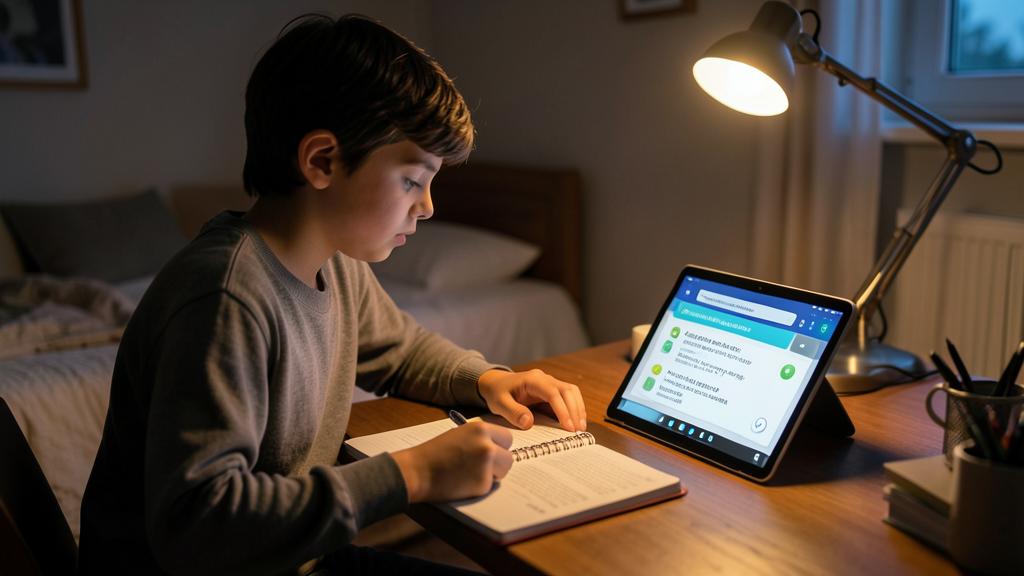
A high school student preparing for a math exam uses AI to check their homework. Instead of asking for the answers, they ask it to explain each step. When they struggle with quadratic equations, the AI provides a different approach—using real-world examples like calculating the trajectory of a basketball. The student practices solving problems on their own, understanding the concept rather than memorizing the solution.
The irreplaceable role of humans
No matter how useful AI is, it doesn’t replace teachers or parents. Transmission, motivation, human support, learning critical thinking and social skills remain at the **heart** of education. AI is a tool in service of learning, not a replacement for the pedagogical relationship. When properly supervised by adults, it enriches; left unsupervised, it can harm. Humans remain central.
To be supervised. Don’t let a child or teenager use AI unsupervised for learning. Without guidance, the temptation of ease often prevails, to the detriment of the effort that leads to learning. A dialogue on proper usage—understanding rather than copying—is essential.

Three virtuous uses to implement at home
Knowledge checks: before a test, the child asks AI to quiz them on the chapter—questions, corrections, explanations of mistakes. Testing oneself is the most effective revision method. Alternative explanations: when the lesson isn’t understood, asking « explain it differently, with a concrete example »—a second pedagogical chance, available at any hour. Feedback on work: the child writes their essay alone, then asks for constructive criticism—strengths, weaknesses, suggestions—before improving it themselves. In all three cases, AI makes the student work instead of doing the work for them: that’s the difference between a learning tool and a cheating machine.
Frequent questions
Does AI encourage cheating?
It provides the possibility, hence the importance of **supervision** and awareness. When used properly, it is instead a powerful learning tool.

At what age?
It depends on maturity and supervision. The younger the child, the more adult supervision is needed for beneficial use.
How can I tell if my child is having AI do their homework?
The simplest test is kind: ask them to explain their homework in their own words. Understanding is immediately apparent—and the conversation that follows, without accusation, is better than any technical monitoring.
Key takeaways
AI offers education a tremendous opportunity: personalized support, available to everyone, that helps with understanding and revision. But it also carries a real risk: becoming a crutch that prevents learning and creates the illusion of knowledge. The key is supervision: encouraging usage that makes one think rather than provides answers. And remembering that AI doesn’t replace teachers or parents: it’s a tool in service of learning, whose entire value depends on how it’s used.
Want digital support for your family?
Leave a Reply
You must be logged in to post a comment.