
Distributed tablets then returned, digital manuals that struggle, banning phones at school, the ENTs that parents endure, and the big swing back: after a decade of enthusiastic equipment, several pioneering countries are moving back towards paper while others accelerate — and the research is nuancing everyone. Where is digital education really at, what does the science of learning screens say, and the role of parents in a shifting landscape: an objective point on a topic that ignites dinner conversations.
The state of play: the decade’s swing
The contrasting landscape: the middle France — phones banned at school (the law applied, generally consensual — our guides), variable equipment across territories (departments-tablets and others — territorial digital equality remains a work in progress), generalized ENTs (the digital workspace — the notebook, notes, communication: the installed infrastructure, ergonomics… perfectible), and the rise of digital education (the digital skills certification, media education — the building blocks); the pioneers who are retropedaling — emblematic Nordic countries partially returning to paper (printed textbooks reinvigorated, handwriting rehabilitated — on the back of reading results: the signal that made the world take notice), and stricter screen restrictions for younger students everywhere; the accelerators — the educational AI that is surging (adaptive tutors, correctors — the new front: see below), and digital skills as a subject (coding, data — the school preparing for the world as it is); and the honest reading of the swing — neither the failure of digital nor its triumph: the end of magical thinking (equipment does not make learning — the decade has proven this at the cost of pioneers) and the entry into the age of TRI: what tool, for what learning, at what age — the only serious question, and research is beginning to answer it.
What the research says (beyond the slogans)
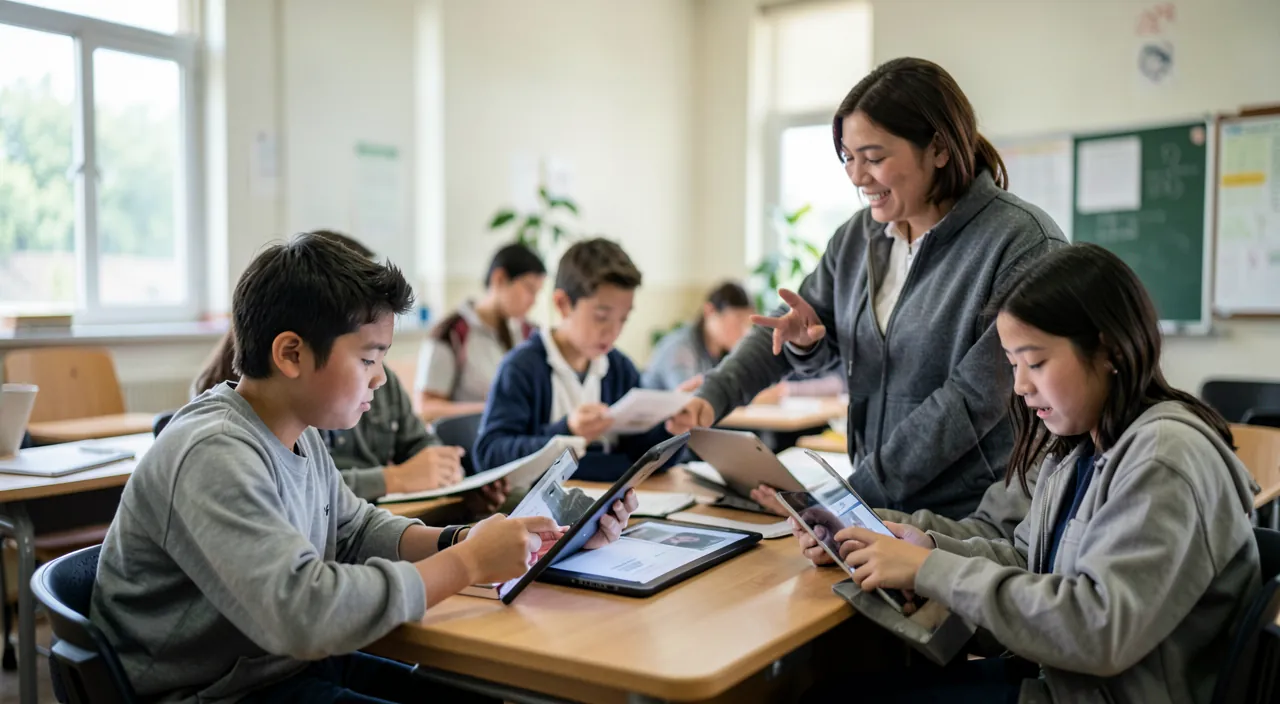
The consensus findings: the deep reading prefers paper — the most documented effect (better comprehension of long texts on paper — screens push for skimming: the modest but constant gap, especially among young readers and on demanding texts: the paper manual for fundamental learning has scientific arguments, not nostalgic ones); the handwriting builds — the act of writing helps memory and reading acquisition (studies on handwritten notes against typing converge — the pen is not an anachronism: it is a cognitive tool); the digital excels in targeted — domains where the screen beats paper exist: adaptive training (exercises that adjust to the level — documented progress in math and languages), simulations and visualizations (manipulated geometry, explored cells — the inaccessible made visible), accessibility (dys and disabilities — our guides: digital is an absolute revolution here, the subject where the debate does not exist), and individual pacing (advanced students fed, fragile ones caught up); the distraction is the hidden cost — multi-use devices in class distract (notifications, temptation — studies on attention in equipped classrooms: the measurable cost: hence the rising preference for dedicated and limited devices, and short, framed uses); and the master variable remains the teacher — the tool is worth what the pedagogy that employs it is worth (the same screen is excellent in guided use and useless in digital daycare: teacher training is the lever, far ahead of equipment: the final consensus everyone signs but few finance).
Research shows that paper is better for deep reading and handwriting, while screens are great for interactive learning and accessibility. The key is using the right tool for the right task, and teachers need proper training to make digital tools effective.
In a Finnish school, students using paper textbooks for literature classes showed 15% better comprehension than those using e-books, while the same students using digital simulations for science labs grasped complex concepts 20% faster than with traditional methods.
The right reflex. At back-to-school meetings, ask the three constructive parent questions — neither technophobe nor dazzled: « What digital uses for which learning? » (does the pedagogical answer exist — equipment for equipment is traceable), « How is attention protected? » (bridged devices, time frames), and « What do they learn ABOUT the digital? » (media, AI, data — the critical skill that counts more than the tool): teams that have reflected respond with pleasure — and parents’ questions fuel those that begin. The digital school is co-constructed: the informed parent is an ally, not a prosecutor.
AI in school: the new front (already here)
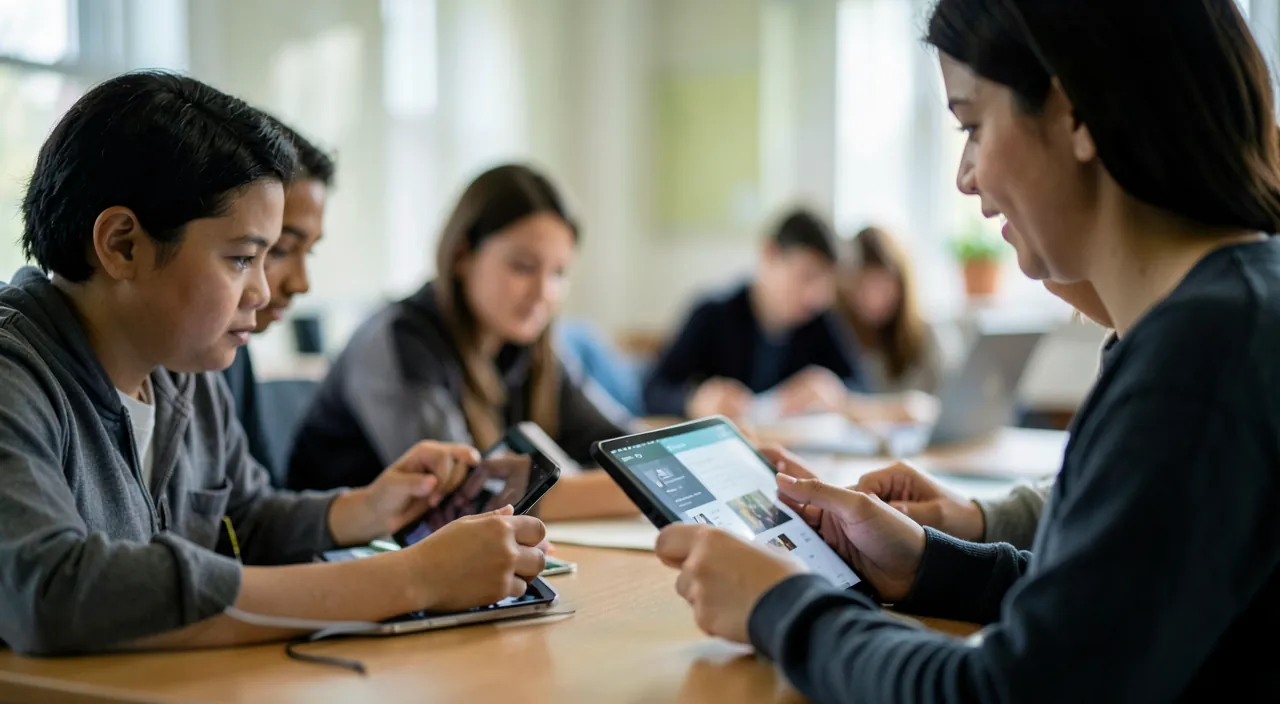
The subject that upended everything: the establishing uses — among students: AI as unofficial homework help (our guides — the fait accompli in middle and high schools: banning it is illusory, managing it is the challenge), among teachers: assisted preparation (support materials, differentiation — time freed up), among institutions: adaptive tutors arriving (personalized practice at scale — the real potential on training): the real questions — the integrity of learning (the AI-written assignment teaches nothing — the pedagogical answer goes beyond detection (flawed): rethought evaluations — oral, in-class performance, documented process — and the taught use: AI as a draft to question, never as a submission: our guides — the skill « working with AI without emptying oneself » is the emerging school skill), the usage gap (the student who does versus the one who dialogues — the gap widens by mastery, not access: school must teach the precise right usage because families are unequal), and the students’ data (AI tools fed by copies and learning profiles — the school data protection framework applies: validated tools by the institution, not personal accounts on public services — the parents’ watchpoint): and the family position that helps — the managed homework AI (our guides: the « explain to me » rule rather than « do it for me, » the draft shown, the conversation on what was understood): school and home aligned on the same message — AI as a learning tool, never a subcontracted brain.
The role of parents: school, home, balance
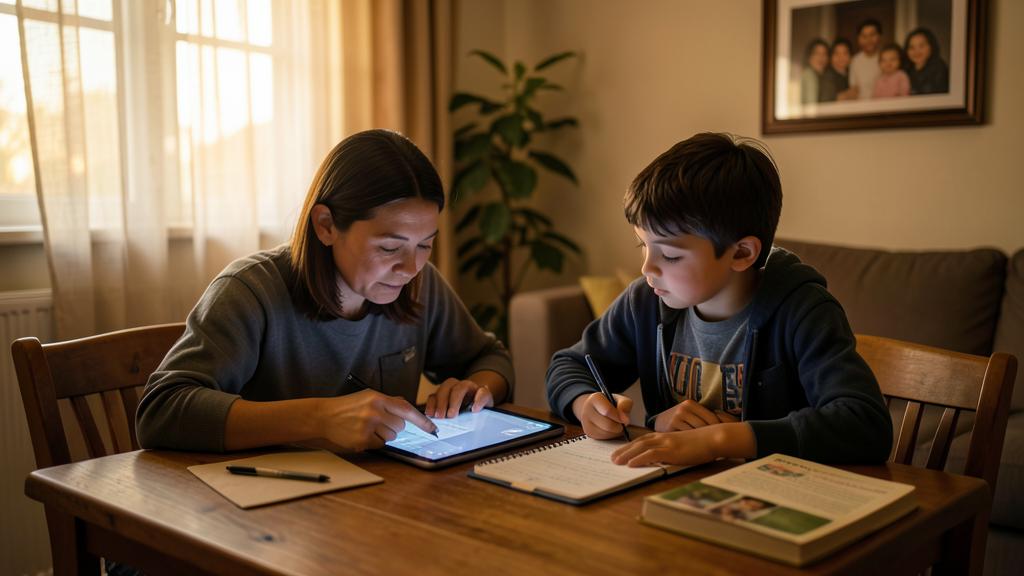
The family’s part in the subject: the ENT tamed — the school’s digital space as a tool for SOBRE tracking (the notebook and deadlines consulted with the child — autonomy is learned: the parent who checks everything forms a dependent; measured real-time grades consulted — compulsively refreshing the average stresses families more than informing: a weekly meeting suffices, our guides notifications are worth the grades), and school-to-family communication through the intended channels; the home that complements — the home screens framed (our guides — the school screen time does not justify domestic overuse: the overall balance is managed at home), paper rehabilitated without war (long reading on books, pleasure writing — the documented strengths of paper are cultivated at home since school arbitrates elsewhere), and digital skills nourished (coding clubs, creation — our guides: the child as a screen creator rather than a consumer): equity first — the digital homework presupposes equipment (families without printers or computers exist — the school must plan, the concerned parent must speak up: social funds and equipment loans exist, the silent shame penalizes the child: our guides the gap), and the parents’ voice — school councils and parent associations weigh on local digital choices (equipment, charters, uses: this guide’s informed debate has its place — the global balance is played out in your school council).

Be wary of the two caricatures that sterilize the debate. The school-screen topic attracts principled positions — and both miss the child: the anti-screen panic (school digital reduced to « factory of cretins » — adaptive, accessibility, and media education are thrown out with the bathwater: the child with dys is deprived of tools by principle, the victim of this caricature), and the technophile complacency (equipment as proof of modernity — tablets distributed without pedagogy that led to retropedaling: the public money in dead tablet cabinets is the victim of this one): the position that holds — the TRI by evidence (paper for deep reading, digital for adaptive and access, trained teacher as variable master, protected attention everywhere), and the humility before young research (definitive certainties of others have a decade of receding: the school deserves continuous adjustments, not revolutions by trend). The child is neither a total digital guinea pig nor a hostage to nostalgia — he is the user of tools that adults must choose well.
Frequently asked questions
My child does everything on the computer at high school: should I worry about his handwriting?
Maintained handwriting retains its benefits (mixed note-taking — the draft with a pen, the final with a keyboard — is an excellent documented compromise): encourage handwritten usages that remain (handwritten revision sheets memorize better — the practical argument that convinces teenagers more than nostalgia), and keyboard mastery is also learned (effective typing is a skill — our guides: the student who types fast takes better digital notes). Both hands, literally.
The school asks me to install apps on my child’s personal phone:
The question is legitimate (personal device requisitioned, school data on a private device — and the reverse: school apps with broad permissions on the child’s phone): inform yourself about the framework (the institution-approved tool, its permissions — our guides), request an alternative if the equipment is lacking or if the principle bothers you (one must exist), and configure what is installed (minimum permissions — our guides apps). The digital school also respects the family phone.
Do school bans on phones work?
Positive feedback converges (classroom attention, recovered playground sociability, reduced daytime bullying — schools that apply observe): with the limits of the perimeter (bullying migrates outside the walls — our guides: the home remains concerned): the rule held by ALL adults — parents included: the message « reachable via school life » replaces the direct SMS during the day, and that is very well. The phone-free school becomes a parenthesis of attention — one of the few consensus in the dossier: let’s savor it.
What to take away
School digital is leaving the magical decade for the age of TRI: research illuminates (paper for deep reading and handwriting that builds, screens for adaptive and access, simulations and accessibility — its undeniable revolution —, protected attention everywhere, trained teacher as variable master), the global swing corrects excesses (pioneers returning from all-tablet, AI already reshaping the cards — the integrity of learning and the taught use are challenges), and parents hold their role: the SOBRE ENT, the home that balances (paper cultivated, domestic screens framed, homework AI in dialogue), equitable without shame, and the three constructive questions at meetings. No panic, no complacency: tools chosen by evidence for children who will learn WITH and WITH the digital — because the world that awaits them will not ask them to choose a camp, but to think in both.

Want to understand and master the technologies that change your daily life? Our training programs enlighten you.
Leave a Reply
You must be logged in to post a comment.