
Satellite clusters lighting up the night sky, flat parabolas on rural rooftops, and a promise: ultra-high-speed internet EVERYWHERE — the isolated farm, the camper van, the sailboat, the forgotten village with fiber. The new generation of satellite internet has gone from niche gadget to real market — with its players (including one very media-friendly), real performance, pricing, and questions (the cluttered sky, dependency on foreign private actors). For whom it’s THE solution, for whom it’s a misunderstanding: the full story.
What has changed: low orbit has overturned everything
Yesterday’s satellite deserved its reputation (the geostationary parabolas at 36,000 km — a one-second latency that made video calls impossible and web browsing sluggish): the revolution is ORBITAL — the low orbit constellations (thousands of satellites at ~550 km — the signal travels 60 times shorter): latency drops to terrestrial levels (video calls, remote work, and even gaming become feasible — our guides), speeds reach those of a good entry-level fiber (dozens to over a hundred Mb/s real — varying with the load of the area), and installation has become domesticated (the DIY kit — the flat parabolic dish that self-aligns, the router, and a clear sky as the only technical requirement: the tree to the south is the number one enemy): the market — the dominant and media-friendly American player, competitors deploying (including the sovereign European project — see the questions), and simplified offerings (monthly subscription at the price of a big box, hardware for purchase or rental, nomadic formulas for mobiles): satellite has become a mass-market product — with a user manual and a precise audience.
The big change is that satellites now orbit much closer to Earth, making internet speeds and latency almost as good as land-based connections. This means you can do video calls, work remotely, or even play online games from places where you couldn’t before.
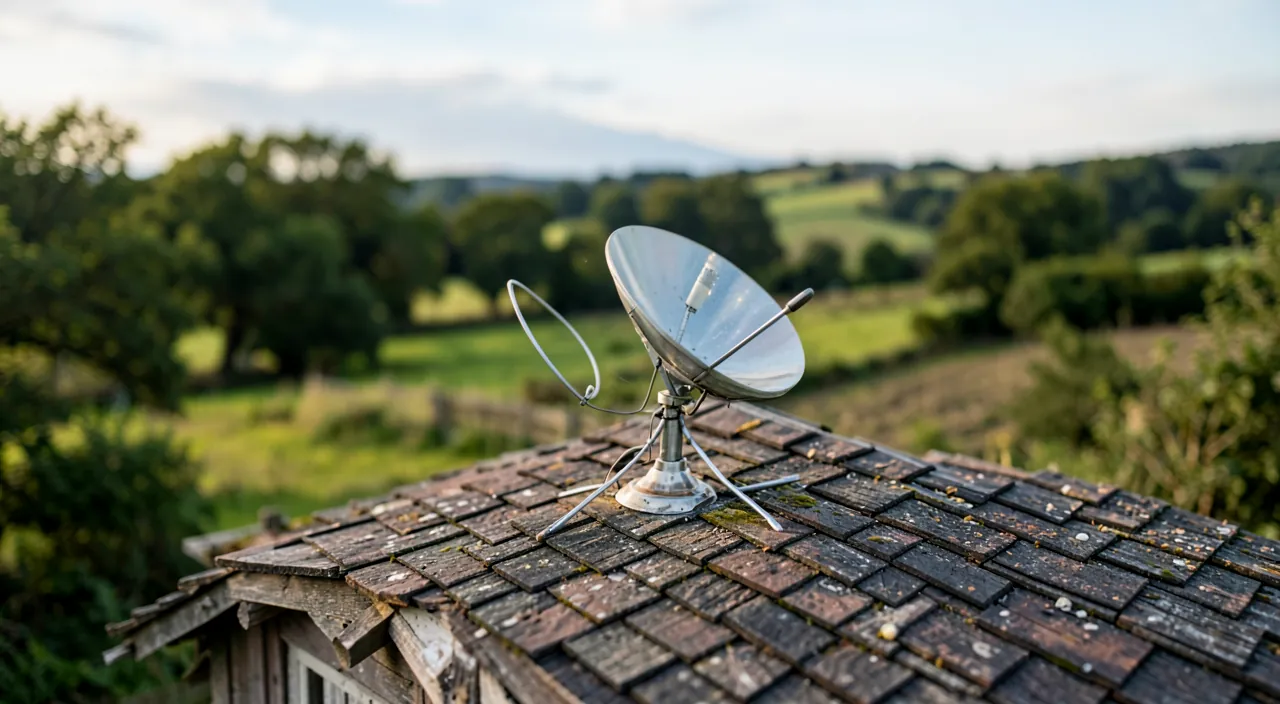
A farmer in rural France installs a low-orbit satellite kit on their barn roof. With clear skies, they get 80Mb/s download speeds and 20Mb/s upload, allowing their children to do online schoolwork and the farmer to run their business remotely. During peak hours, speeds might drop to 50Mb/s, but it’s still enough for video calls and streaming.
For whom it’s made (and for whom it’s not)
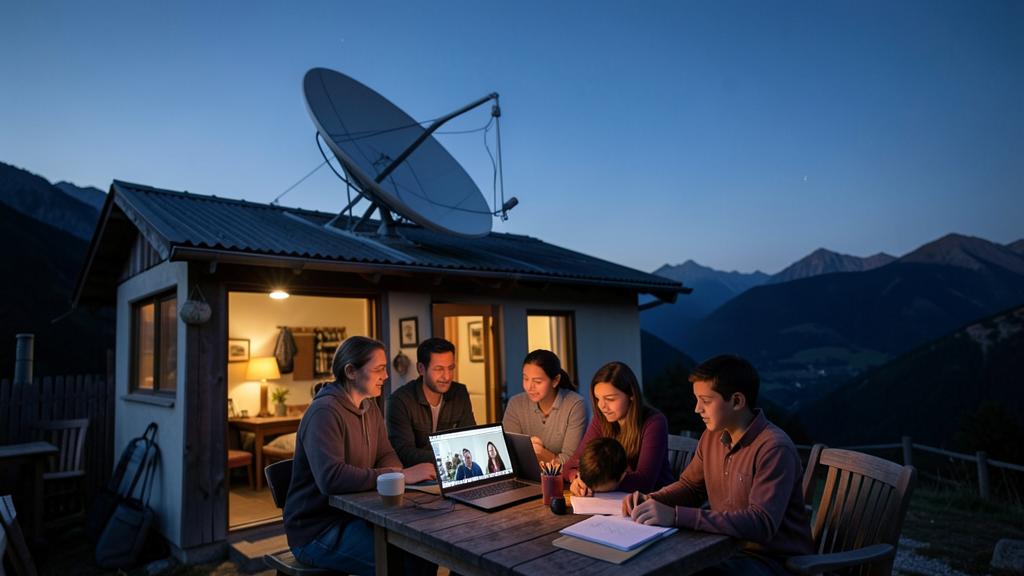
The honest sorting: the winning publics — the real white zone (the house without fiber or correct 4G — for satellite it’s DELIVERANCE: remote work made possible, smart home, distance learning for children: for these households, the debate is closed — it’s the only real option, and it’s good), the mobiles (the camper van and the boat — dedicated formulas follow the move: the revolution of nomads, at a high price), the isolated professionals (the mountain cabin, the farm, the construction site — the professional connection where nothing exists), and the emergency (the redundancy of a critical activity — fiber AND satellite in backup mode: our guides resilience — and emergency communications in disaster zones: satellite shines when the terrestrial network dies): the misunderstandings — the fibered zone (fiber is better, cheaper, and more stable: satellite is a bad purchase in this posture): the 4G/5G zone with correct availability (first the 4G box — our guides: often the solution for gray zones, to test before satellite), and impatience for connection (the announced fiber « in 18 months » — satellite as a bridge is calculable — with hardware included — against the wait: sometimes yes, often patience): and the usage realities to know before signing — variable speeds (the congested zone slows down during peak hours — promises read « up to »): extreme weather that disrupts (briefly — violent storms, heavy snow on the antenna), the electricity consumption of the kit (notable — details for nomads on battery), and a clear sky non-negotiable (the test via the AV app before purchase — the house at the bottom of the wooded valley disappoints).
The right reflex. Before subscribing to satellite, check the full range of terrestrial alternatives — in order of preference: the official fiber map consulted (connection sometimes available without the household knowing — and rural areas’ demand-based connection programs), the tested 4G/5G box (the cellular router with the data plan — the external antenna turning one bar into four: the solution for gray zones, half the price of satellite — our guides), local radio offers (the THD radio of communities — unknown, subsidized), and THEN satellite for the real white zone: the hierarchy that avoids the several hundred euro kit where an 80 euro 4G antenna sufficed. Satellite is the best last resort in the market — verify that it is indeed the last.

The questions that matter: the sky, sovereignty, dependency
The flip side of the miracle: the cluttered sky — the tens of thousands of satellites planned raise real questions: astronomy disrupted (trails in observations — astronomers alert, mitigations exist, the problem remains: our astronomy guides — the starry sky is also a heritage), space debris and collisions (low orbit is managed — deorbitations planned, incidents avoided: orbital traffic becomes a subject of global regulation), and the impact of launches; sovereignty — critical infrastructure in the hands of foreign private actors (unilateral decisions on coverage in conflict zones illustrated it — internet of a territory suspended to a business leader: the geopolitical lesson is learned), and the European deployment response (the EU’s sovereign constellation — the strategic challenge assumed: to follow, as it will structure future offers): individual dependency — a single operator for one’s connection (price hikes, changing conditions — the rural white zone customer is doubly captive: the competition that arrives is the best news for the sector): and territorial equity — satellite should not become an excuse for non-connection (rural fiber remains the public commitment — satellite fills, it does not dispense: the approach of communities subsidizing satellite kits while awaiting fiber is the right one): the informed consumer weighs all this — and votes with their subscription.
Satellite in your pocket: the quiet revolution of smartphones
The other satellite, one you might already have: the smartphone satellite connection — recent phones communicate with satellites WITHOUT parabolas (our guides — the first satellite SOS: emergency messages from the mountains without a network, the function that saves documented lives), and ongoing expansion (satellite messages on the latest models, shared location — the off-network that civilizes: hiking and navigation enter a new era — our guides), with current limitations (clear sky, guided aim, text only — satellite video calls will wait): the direct-to-cell is coming — constellations talking to standard phones (operator agreements with constellations: SMS coverage first, voice later — the mobile that captures everywhere is the realistic horizon of the decade): the practical consequence — mobile universal coverage will redistribute the cards (the mobile white zone on the way to extinction — and security usages transformed: our guides emergencies): and the current advice — knowing the satellite capabilities of one’s phone (the SOS gesture learned — our guides: the ignored function saves no one), and considering them in the purchases of adventurers (a criterion that rises). Satellite at home is chosen; the satellite in your pocket is coming for everyone — better to get familiar with it early.
Your smartphone can now connect directly to satellites, even when there’s no cell service. This lets you send emergency messages or share your location without needing a traditional network. Right now, it’s mostly for text messages, but soon you’ll be able to make calls too.
A hiker in the French Alps gets lost and falls, breaking their leg. Their smartphone has no cell signal, but they can still send an SOS message via satellite. Emergency services receive the location and coordinates, allowing rescue teams to find and help the hiker within 90 minutes.
Be wary of satellite scams and fake resellers. The hot market attracts (our guides): trapped « used » kits (equipment linked to an unpaid or stolen account — the satellite kit is verifiable before purchase: official transfer procedures exist, purchases outside them are a lottery), unofficial resellers who overcharge for « premium installation » (the kit installs itself — the real installation service exists for complex roofs, at fair prices: compare quotes), guaranteed speed promises (no one guarantees — offers are read), and hidden roaming fees for nomads (international roaming, pausable or not — the camper vanist reads the conditions of their own countries). And the classic of the exploited white zone: the door-to-door sales pitch « fiber will never reach you, sign up » — the official deployment map tells the truth (our guides door-to-door: the fabricated urgency signs the seller, not the offer).
Frequently asked questions
Is satellite good enough for serious remote work (including video calls)?
Yes in low orbit — latency finally allows it (daily video calls work — our guides): with the precautions of the variable (a critical meeting tolerates poorly the 18-hour peak load — Ethernet to the workstation, HD camera rather than 4K, and the backup plan of 4G sharing — our guides resilience are doubly valuable in satellite). The white zone remote worker benefits from a career — this is the key use case.
What is the concrete impact of weather?
The daily routine (normal rain, clouds) is not noticeable; extremes briefly disrupt (violent storms directly overhead, heavy snow accumulation — antennas heat up alone): a few minutes of degradation per episode — the order of magnitude of a box that struggles, not a complete outage. The real variable remains the area load — neighbors who equip share the beam.
Should we wait for the European constellation to equip ourselves?
The need does not wait (today’s white zone equips today — short-term commitments and transferable hardware preserve the future): the arrival of competition will play for ALL (prices, conditions — and the sovereign option for those who care): the right posture is the mobile consumer — equipped without being tied, informed of alternatives, ready to switch. As everywhere else, fundamentally: our guides subscriptions are valid up to orbit.

What to take away
Satellite internet has changed nature with low orbit: terrestrial latency, speeds of good entry-level fiber, DIY kit — DELIVERANCE for real white zones (remote work, family, isolated professionals), solution for nomads, redundancy for the cautious: after checking all terrestrial alternatives (fiber map, tested 4G box, community THD — the hierarchy that avoids unnecessary purchases), and reading the real (variable speeds, clear sky required, single operator). Fundamental questions arise (astronomers’ sky, sovereignty — the European constellation to follow —, satellite does not dispense of rural fiber), and the twin revolution is already in your pocket: the satellite SOS on phones — learn the gesture — and the direct-to-cell that will extinguish mobile white zones. The sky has become an infrastructure: it serves first those whom the earth had forgotten.


Want to understand and master the technologies changing your daily life? Our training programs enlighten you.
Leave a Reply
You must be logged in to post a comment.