
Phones that last for days, cars recharged in ten minutes, homes that store their own sun, electric planes: behind each of these promises lies the same discreet hero—the battery. Long the weak link in the electric revolution, it has become its technological battleground: laboratories and industries worldwide compete with announcements about tomorrow’s « miracle » chemistries. What are they really preparing, what is fantasy, and what will change your daily life? An accessible dive into the batteries of the future.
Why the battery is the nerve of the war
Storing electricity is THE key to the energy transition: without storage, no credible electric car, no fully useful solar or wind power (the sun doesn’t shine at night, the wind doesn’t wait for demand), no durable nomadic devices. Every battery improvement ripples everywhere at once—autonomy, cost, weight, safety, footprint. That’s why investments are colossal: improving the battery by 20% simultaneously transforms automotive, energy, and electronics. Few technologies have such a domino effect.
The most serious leads
- Solid electrolyte batteries: the star of announcements. By replacing the internal liquid with a solid material, they promise higher density (and thus range), faster charging, and increased safety (less risk of runaway). Long « five years away, » they are now entering industrialization—first commercial applications are arriving, and mass deployment will follow gradually.
- Chemistries without critical materials: reducing or eliminating cobalt and nickel, or even replacing lithium with sodium—abundant and inexpensive. Sodium-ion batteries, less dense but low-cost and robust, are already finding their place in entry-level vehicles and stationary storage.
- Next-generation anodes (silicon in particular): more capacity in the same volume, significantly faster charging—incremental but real gains, already being integrated.
- Massive stationary storage: for power grids, other priorities apply (cost and durability over compactness)—flow batteries, sodium, second-life automotive batteries: an entire ecosystem is being built.
The right reading reflex. When faced with an announcement of a « revolutionary battery, » ask three questions: does it work outside the lab (prototype ≠ product)? Is it scalable and at what cost? Who commits to a specific date and product? The history of batteries is a graveyard of spectacular announcements—and a quiet accumulation of real progress, a few percent per year, which, compounded, have changed everything. The battery revolution is a marathon for engineers, not a dramatic twist.
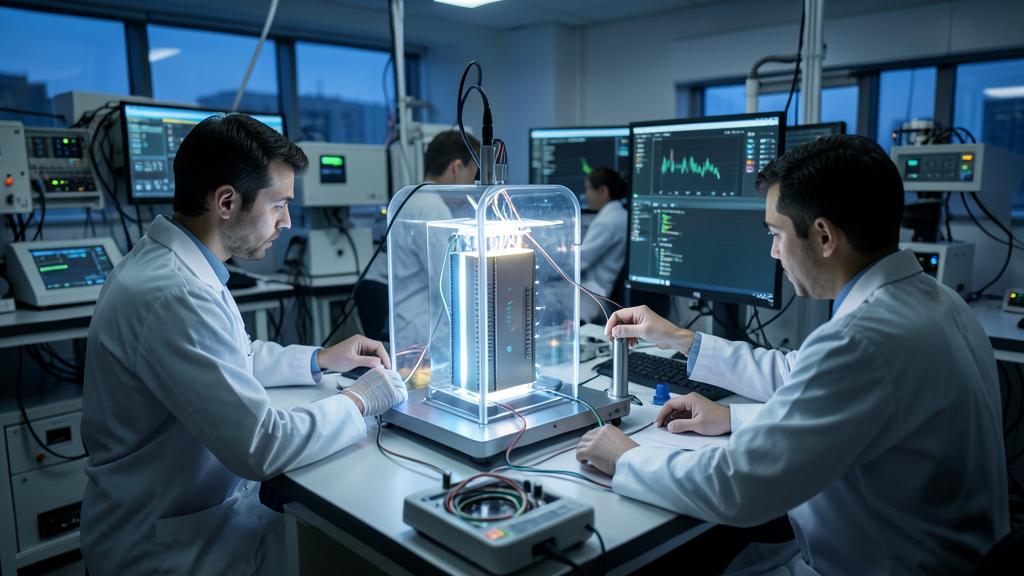
Batteries are improving in small, steady steps. Solid-state batteries will be safer and charge faster, while sodium batteries will be cheaper. These changes will make electric cars, home storage, and renewable energy more practical over time.
A Tesla Model 3 with a 75 kWh battery pack (using today’s lithium-ion tech) has a real-world range of about 300 km. With a future solid-state battery, that same pack could offer 400 km, and a 15-minute charge might restore 80% of its range—enough for a 320 km trip after a quick stop.
What this will change concretely
In the near future, the effects are clearly emerging. For vehicles: widespread comfortable ranges, recharges approaching the time of a break, truly affordable entry-level models thanks to cost-effective chemistries—and safer batteries. For the home: domestic storage coupled with solar becomes standard equipment, making self-consumption truly effective. For the grid: massive storage smooths renewable production and secures supply. For your devices: steady endurance gains—though often offset by more power-hungry uses, the eternal race. And everywhere, a cross-cutting issue: recycling, which is gaining momentum to close the material loop—the ecological and strategic condition of the entire system.

The remaining challenges
Three frictions temper the enthusiasm. Industrialization: moving from prototype to gigafactory is a capital, time, and expertise black hole—that’s where most « revolutions » die. Materials: extraction concentrated in a few countries, unequal social and environmental conditions, geopolitical dependencies—that’s why frugal chemistries and recycling are crucial. And safety-durability: a battery must last for years, in cold, heat, and shocks, without risk—every new chemistry must prove itself on this, the least spectacular but most demanding terrain.
To put into perspective. Don’t postpone a purchase waiting for the « miracle battery announced »: current technologies are already mature, durable, and guaranteed, and progress comes in continuous waves—there will always be something better in two years, as with any technological object. The right decision is based on today’s real products, not tomorrow’s press releases.

Frequent questions
Will solid-state batteries replace everything?
In the long term, they will take an important place where density and fast charging matter (high-end vehicles first, then wider adoption). But the future is plural: sodium for affordability and stationary storage, optimized current chemistries for the core market—each use has its chemistry.
Does the world have enough lithium?
Resources exist; the issues are the pace of extraction, its conditions, and its geography. The sustainable answer combines diversification (sodium), chemistry sobriety, and recycling—which will become a major source of materials.

Recharging in five minutes, myth or reality?
Ultra-fast charging is making real progress (chemistries, cooling, more powerful stations). The limit is now as much the electrical infrastructure as the battery—but « coffee break » charging is already here, and it’s enough for almost all uses.
What to remember
The batteries of the future won’t fit into a single miracle announcement: they are advancing on multiple fronts at once—solid electrolyte for density and safety, sodium for cost, improved anodes for charging, stationary storage for grids, recycling to close the loop. Concrete effects are already underway: generous ranges, lightning-fast recharges, home storage, affordable entry-level models. Keep the triple filter in mind when faced with announcements—out of the lab? scalable? dated?—and remember that this revolution is advancing in silence, a few percent per year: that’s how, cumulatively, it’s changing energy, transport, and our wallets.


Want to understand tomorrow’s technologies?
Leave a Reply
You must be logged in to post a comment.