
It is presented in turn as the end of all secrets, the promise of miracle drugs, or just a laboratory mirage: the quantum computer fascinates all the more because it is poorly understood. Qubits, superposition, quantum supremacy — behind the intimidating vocabulary lies a reality that is both more modest and more interesting than the fantasies. What can a quantum computer really do today, what does it promise for tomorrow, and why is your bank already interested? Explanation for everyone, guaranteed without equations.
The idea in two images
A classical computer manipulates bits: switches that are either 0 or 1, one or the other. A quantum computer manipulates qubits, which exploit the strange laws of particle physics: superposition — imagine a spinning coin, which is neither heads nor tails but a combination of both as long as it spins — and entanglement, this mysterious link that binds qubits like magic dice whose results are correlated at a distance. Consequence: where the classical computer tries possibilities one by one, the quantum computer can, for certain specific problems, explore an immense space of solutions « all at once » — and bring out the right answer. For these problems, the gain is not to go a little faster: it is to make possible what would otherwise take billions of years.

What NOT to believe
First clarification: the quantum computer will not replace your computer. It is useless for the vast majority of tasks — navigation, office work, games, common AI — where the classical computer remains unbeatable. It is a specialized machine, for a narrow family of problems: simulating matter at the atomic scale, optimizing systems with countless possibilities, and breaking certain cryptographic codes. Second clarification: current machines are fragile prototypes — hundreds or thousands of qubits, extremely sensitive to the slightest disturbance (hence the impressive cryostats near absolute zero), drowned in errors that must be corrected by mobilizing a large part of the machine. « Useful » quantum computing on a large scale requires millions of stable qubits: the road is long, and the steps taken — very real — are still laboratory milestones.
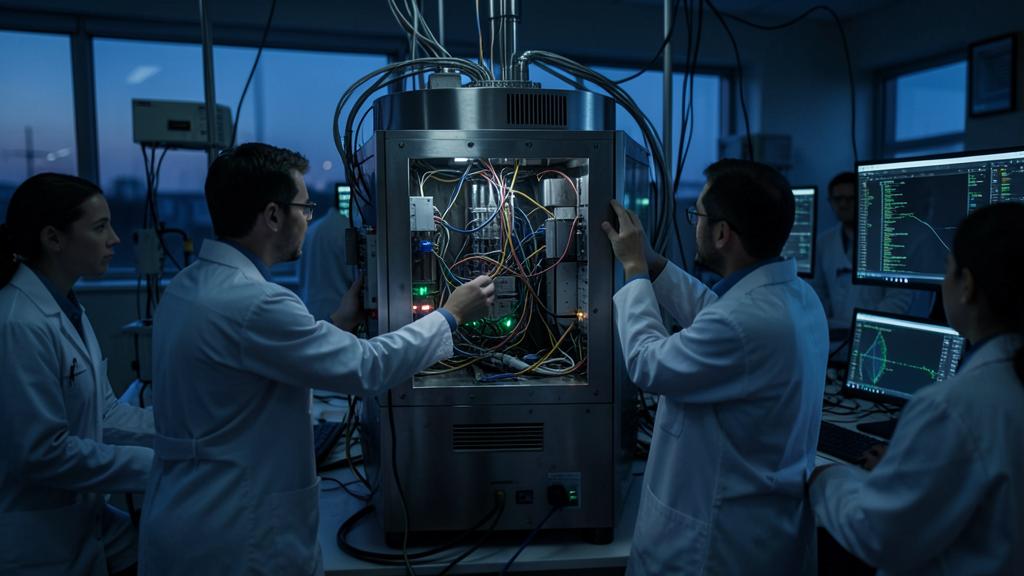
The right reading filter. When faced with a quantum announcement, one question is enough: has the machine solved a useful problem better than a classical computer — or an artificial problem tailored for demonstration? The media-recorded records almost all fall into the second category: scientifically significant, without direct application. The day quantum computing beats classical computing on a problem that matters (a molecule, a material), you will know: it will be the event — and it has not happened yet.

Why so much effort, then?
Because the promises, in its field, are immense. Matter simulation first: molecules, chemical reactions, and materials obey quantum laws — simulating them on a classical computer quickly becomes complex, while a quantum computer would be their natural simulator. Potentially at stake: accelerating drug discovery, designing better batteries, less energy-intensive fertilizers, and new materials. Optimization next: logistics, energy networks, finance — everywhere we seek the best solution among astronomical possibilities. And cryptography finally — the subject explaining why states and giants are investing billions without waiting: a sufficiently powerful quantum computer would break the codes that protect today’s communications, banks, and state secrets.
The crypto threat: the only urgent issue
Delicious paradox: the machine does not yet exist on a useful scale, but its threat is already acting. The reason: malicious actors can collect encrypted data intercepted today — to decrypt them tomorrow, when the machine exists (« harvest now, decrypt later »). That’s why the countermeasure is already underway: post-quantum cryptography — new encryption algorithms resistant to quantum, standardized, and being deployed in systems, browsers, and messaging, silently. For you, nothing to do: the migration is happening with technical players, and your updates will bring it. This is the only aspect of quantum computing that already concerns you — and it is being resolved without you.

To put into perspective. Beware of « decorative » quantum: miracle products, « revolutionary » investments, promises of imminent leaps — the word sells precisely because it is misunderstood. Serious deadlines are counted in years, probably in decades for transformative applications; anyone selling « quantum for next year » is mostly selling vocabulary.
Frequent questions
A quantum computer at home, one day?
Very unlikely — and pointless: these machines (cryostats, extreme isolation) are made for data centers, accessible remotely via the cloud, as are the current prototypes. Quantum computing will be a distant service, not a household object.

Are my passwords already in danger?
No: current machines break nothing useful, and post-quantum cryptography is being deployed precisely so that the future threat finds a closed door. Your real security urgencies remain phishing and reused passwords — not quantum physics.
Quantum and AI, same revolution?
No — two distinct fields, with opposite timelines: AI is transforming daily life now; quantum computing is a long-term bet on specialized problems. Their intersections (quantum for AI and vice versa) are still in research.

What to remember
The quantum computer is neither an imminent super-PC nor a mirage: it is a specialized machine in the making, promising in a specific area — simulating matter, optimizing the inextricable, breaking codes — and useless everywhere else. Prototypes are progressing, transformative applications are years away, and only one impact concerns you already: the silent migration to resistant cryptography, which is deployed via your simple updates. Keep the anti-hype filter (useful problem or demonstration?), leave the qubits to the laboratories — and remember the essential: the quantum revolution is a fascinating scientific marathon, worth following with curiosity… and without a rushed checkbook.

Want to decode tech without a headache?
Leave a Reply
You must be logged in to post a comment.