
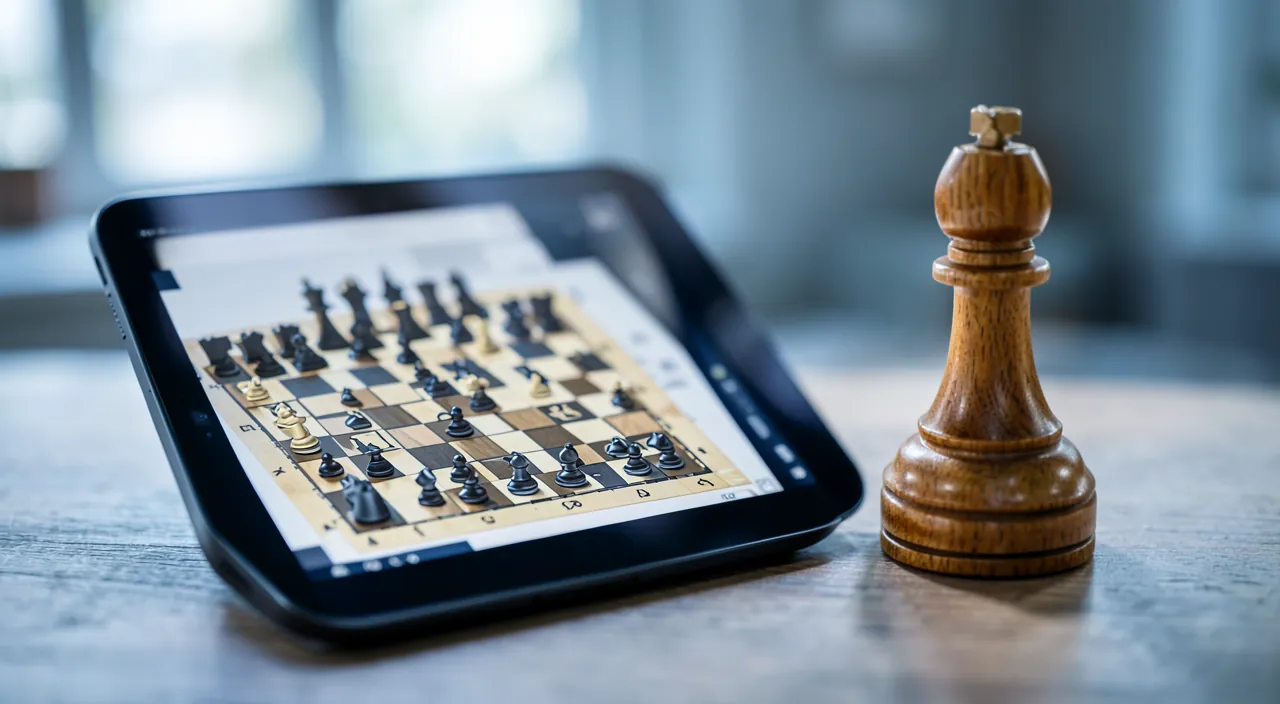
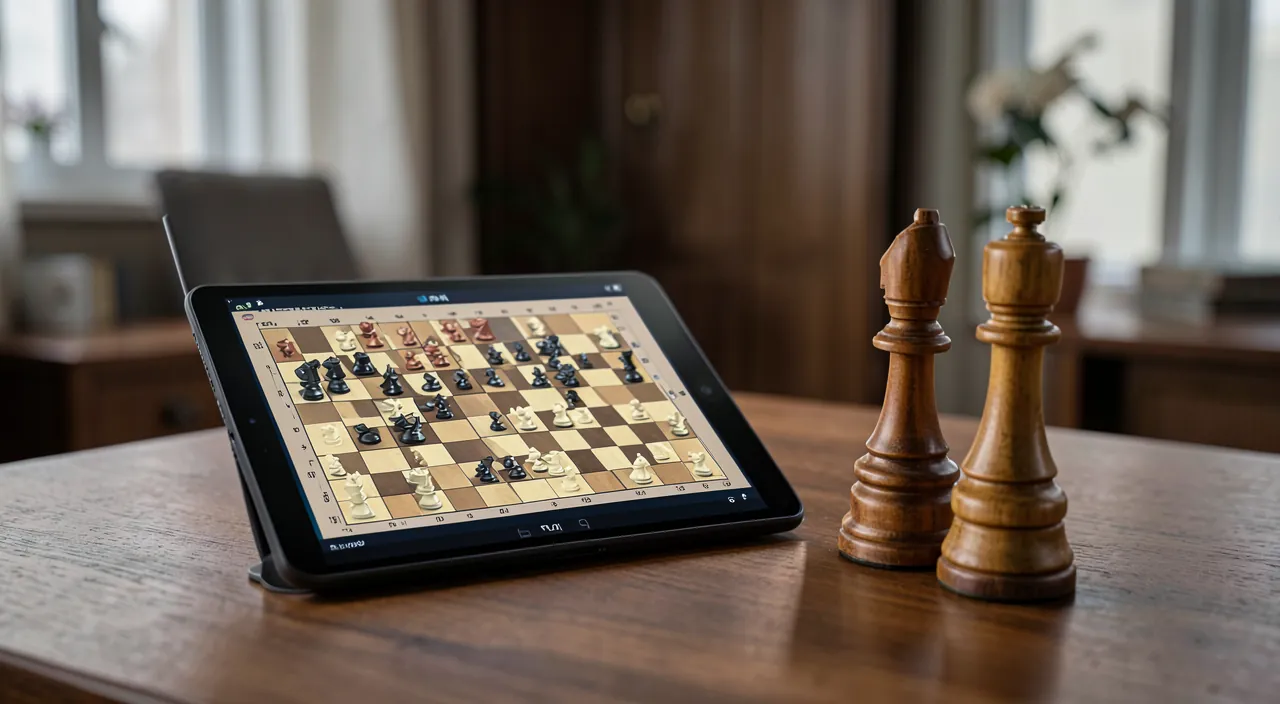
Chess is experiencing a remarkable surge in popularity, and for good reason: this millennia-old game, long considered difficult, is now more accessible than ever thanks to apps. On your phone or tablet, you can learn the rules, play against the computer at your level or against opponents from around the world, solve tactical exercises, follow lessons, and analyze your games to understand your mistakes. Whether you’re a complete beginner or a player looking to improve, an app can guide you at every step, mostly for free. Let’s see how these apps help you learn and progress in chess, and how to get the most out of them.
How a chess app helps you progress
Chess apps offer comprehensive support—here are their key advantages. **LEARN** the rules and basics: for beginners, tutorials explain how pieces move, the rules, and first principles; you start from scratch smoothly. **PLAY** at your level: against the **COMPUTER**, adjustable from very easy (ideal for starting without being crushed) to expert level; you progress at your own pace, without pressure. **PLAY** against others: face **HUMAN** opponents from around the world, matched to your level (thanks to a ranking system); the thrill of real play, anytime. **TACTICAL EXERCISES** (« puzzles »): solve situations where you need to find the right move; this is the most effective way to progress (spotting combinations, traps); do a few each day, like mental gymnastics. **STRUCTURED LESSONS**: courses on openings, principles, strategy, and endgames; a progressive and organized learning experience. **ANALYZE** your games: after a game, the app shows you your mistakes, the best moves, and where you could have played better; you learn from your errors, which is essential for progress. **TRACKING** and motivation: evolving rankings, statistics, challenges; you see your progress, which keeps you motivated. **WHAT IT’S GOOD FOR**: to **LEARN** from scratch (rules, basics); to **PLAY** as much as you want, at your level, against the computer or humans; to **PROGRESS** methodically (exercises, lessons, analysis); to **UNDERSTAND** your mistakes; and to keep **MOTIVATED** thanks to tracking and competition. **DEMOCRATIZED ACCESS**: where you once needed a club, a partner, books, and a teacher, an app brings it all together, often for free; chess has never been so accessible. The key idea: a chess app is a complete learning companion—it teaches you the rules, lets you play at your level (against the computer or opponents worldwide), helps you progress with tactical exercises and lessons, and analyzes your games to show you your mistakes. It brings together, often for free, what once required a club, a partner, and books. Whether you’re starting from scratch or looking to perfect your skills, it guides you at your own pace: the most accessible way to discover and enjoy this deep and fascinating game.

How to learn and progress effectively with an app
To progress effectively in chess with an app, here’s a proven method. If you’re a beginner, **LEARN** the rules first—follow the basic tutorial: piece movement, checkmate, special rules; don’t skip this step; foundations matter (our guides on installing an app safely). **PLAY** against the computer at an adapted level—start at an **EASY** level, where you can win and have fun; gradually increase as you improve; playing against too strong an opponent is discouraging. Do **TACTICAL EXERCISES** every day—this is the most important tip: solving a few « puzzles » each day is the most effective way to progress; you learn to spot winning combinations and avoid traps; it’s a quick and rewarding daily workout. **ANALYZE** your games—after each game (especially losses), use the analysis to understand **YOUR** mistakes: where did you play poorly? What was the right move? You learn a lot from your errors; never skip this step. Learn **PRINCIPLES**, not by rote—instead of memorizing move sequences, understand the **PRINCIPLES** (controlling the center, developing pieces, protecting your king, not giving away pieces); this leads to lasting progress; the app’s lessons teach them. **PLAY** against humans when you’re ready—facing other players at your level is stimulating and educational; the matching system finds you balanced opponents; it’s richer than playing against the computer. Choose the right **PACE** of play—to learn, prioritize games with enough time to **THINK**, rather than ultra-fast games where you play without thinking; reflection leads to progress. Be **PATIENT** and accept losing—you learn **A LOT** from defeats; losing is part of progress; don’t get discouraged, every analyzed loss is a lesson. **PRACTICE** regularly—a little each day (a few exercises, one or two games) is better than long, sporadic sessions; consistency builds progress. Have fun—keep the **JOY** of the game; that’s what will make you come back and progress effortlessly. In short: first learn the rules, play against the computer at an adapted level, do tactical exercises every day (the most effective), analyze your games to understand your mistakes, absorb principles rather than memorizing, play against humans when you’re ready, prioritize a pace that allows thinking, accept losing (you learn a lot), practice regularly, and have fun. This is the surest way to progress sustainably and enjoy this magnificent game.
The two best ways to improve are doing daily tactical puzzles (which train your brain to spot winning moves) and analyzing your games (especially the ones you lose). These are more important than memorizing fancy opening moves. Just 10 minutes a day on these exercises will make you a much better player over time.
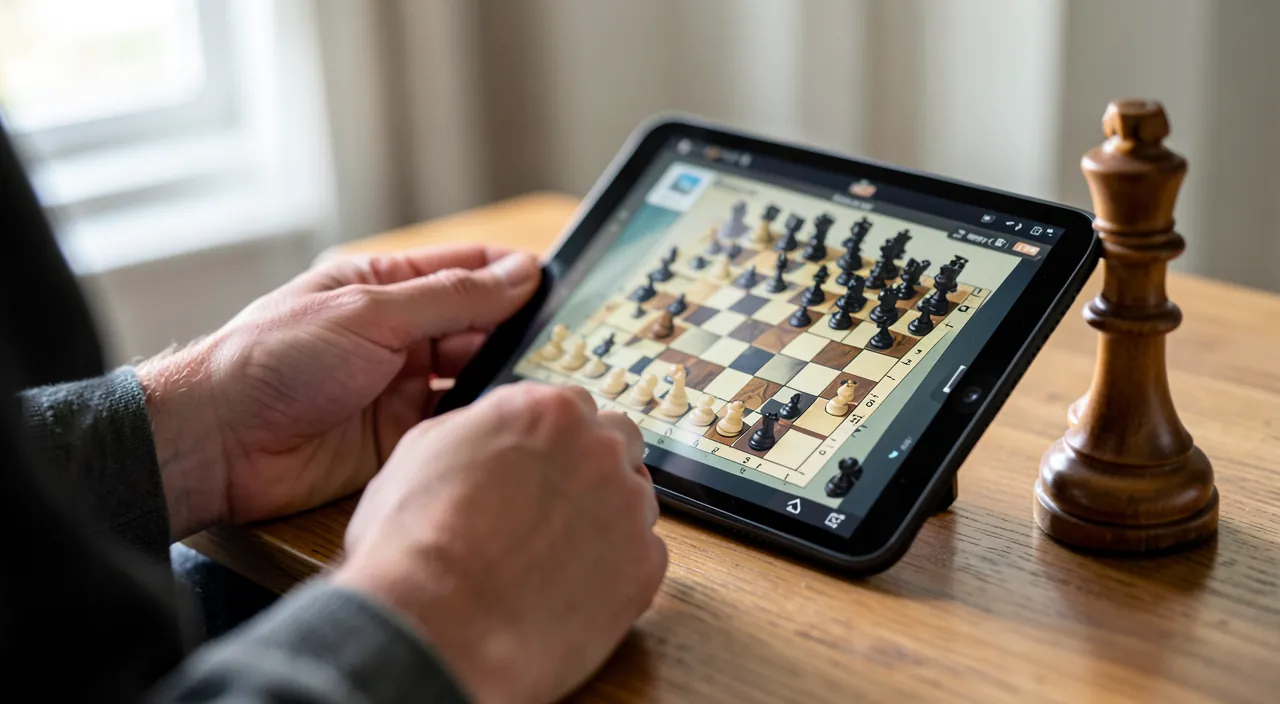
Imagine you’re playing as White against a 1500-rated opponent. You see a position where your queen is undefended. Instead of moving it, you notice your opponent’s rook is also undefended. The app shows you could win the rook immediately with a simple capture. This is exactly the kind of tactical pattern you’ll start seeing after doing daily puzzles – you’ll stop “giving away” pieces for free and start winning material instead.
The secret to progress: tactical exercises and analyzing your games. If you truly want to progress in chess—and not just play—two activities are far more valuable than any others, and apps make them wonderfully accessible. The first, the most effective of all: **TACTICAL EXERCISES**, often called « puzzles. » The principle is simple: the app presents a game position and asks you to find the best move (a combination that wins material, a checkmate, a trap to avoid). Why is this so educational? Because the vast majority of games, especially among amateur players, are decided by **TACTICS**: seeing (or not seeing) that you can take a piece, that you’re about to be checkmated, that an opponent’s move is a threat. By solving a few puzzles each day—it’s quick, ten minutes suffice—you train your eye to instantly spot these recurring patterns; little by little, you stop « giving away » your pieces foolishly and start seizing opportunities; this is the fastest and clearest progress you can make. Make it a daily habit, like a quick brain workout; it’s by far the best investment of your time. The second activity, just as crucial yet often neglected by beginners: **ANALYZING** your own games, especially the ones you’ve **LOST**. The natural tendency after a defeat is to quickly move on to the next game to « redeem yourself »; that’s a mistake, as you then repeat the same errors indefinitely. The winning approach is the opposite: after a game, take the time to review it with the app’s analysis tool, which shows you exactly where you played poorly, what the best move would have been, and when the game turned. By concretely understanding your mistakes— »ah, here I left my piece en prise, » « there I neglected my king’s safety »—you engrave them in your memory and gradually stop making them. You progress infinitely more by analyzing a loss than by chaining games without thinking. So combine these two pillars: daily tactical exercises to sharpen your vision, and systematic analysis of your games to learn from your mistakes. Add to that the fact of playing at a pace that allows you to **THINK** (ultra-fast games are fun but don’t teach much, as you play on instinct without calculating), and you’ll have the most effective recipe for lasting improvement. Tactics, analysis, reflection: these are the real keys, far more than memorizing openings, and apps offer them at your fingertips.
Choosing wisely and avoiding pitfalls
Chess apps are fantastic, but a few pitfalls lurk; here’s how to choose and play healthily.
- CHOOSING the app: several excellent chess apps exist, with very complete free features (playing, exercises, basic lessons, analysis); for most players, the free version is more than enough; paid subscriptions unlock mostly advanced courses and analyses; start with the free version (our guides on managing subscriptions).
- TOO STRONG an opponent: playing against a computer or players who are too strong is discouraging; adjust the level to stay in the fun and accessible challenge.
- FRUSTRATION from losses: losing is hard for some; remember that you learn from losing, and even great players lose; keep the game as a pleasure, not a source of stress.
- The trap of ULTRA-FAST games: very fast formats (« blitz, » « bullet ») are thrilling but addictive and not very educational (you play without thinking); to progress, prioritize slower games; reserve fast play for occasional fun.
- ADDICTION: online chess can become very engaging (chaining games for hours); set time limits; stay in control (our guides on managing screen time).
- CHEATING (by others): online, some cheat (by getting help from a computer); platforms fight against this, but it happens; don’t let a suspicious loss discourage you; play to improve, not just for the ranking.
- Don’t OVER-FOCUS on openings: beginners often think they need to memorize tons of openings by heart; that’s a mistake; at your level, understanding principles and working on tactics pays off much more; don’t drown in theory.
- DATA and your account: creating an account involves data; prioritize recognized platforms and secure your account (strong password); be careful that children playing online do so in a safe framework (our guides on protecting children online).
- OBSESSIVE ranking: rankings motivate, but anxiously clinging to them spoils the fun; see it as a progress indicator, not a judge of your worth; focus on learning and having fun.
- Don’t ISOLATE yourself: playing online is great; but chess is also lived in real life (club, friends, family); the human contact around a physical board has an irreplaceable charm; combine both.
In short: choose a recognized app (free is often enough), adjust the level to keep the fun, accept losses (they’re educational), prioritize games that allow thinking over addictive ultra-fast play, set limits (against addiction), don’t drown in openings (tactics and principles first), secure your account, relativize the ranking, and don’t forget the charm of « real » chess. Thus, the app remains a pleasure and a fantastic way to progress, without its pitfalls.
Warning: online chess can become addictive, especially in ultra-fast formats—set limits, and prioritize reflection over chaining games. This is a real and paradoxical trap: a game as noble and intellectual as chess can, in its online version, develop addictive mechanisms comparable to the most captivating games. The main culprit: **ULTRA-FAST** formats (often called « blitz » for a few-minute games, or « bullet » for one- or two-minute games). These lightning games are thrilling: a game lasts only a few minutes, the tension is high, you win, you lose, and above all, you can immediately start another… then another… then another. It’s the classic variable reward mechanism: the next game might be the beautiful victory, so you continue, and you can thus chain dozens of games and swallow hours without even realizing it, caught up in the « just one more. » The ranking that goes up and down with each game adds an emotional dimension that hooks even more: you want to « recover » the lost points, prove you’re better, and you start again. Result: you can spend a considerable amount of time playing, often at the expense of other activities, and sometimes in a state of tension or frustration that’s not pleasant. Additional irony: these ultra-fast games, in addition to being the most addictive, are also the **LEAST** educational, as you play on instinct, without taking the time to calculate or think; you can thus play a lot without progressing at all. To enjoy online chess without falling into this trap, a few safeguards are essential. Set **CLEAR LIMITS**: a number of games or a daily playtime, and stick to them; be especially wary of long blitz sessions that drag on. **PRIORITIZE**, especially if you want to progress, slower games that allow time to think, richer and less compulsive than fast play; reserve lightning formats for occasional fun, fully aware of their addictive power. **RELATIVIZE** the ranking: it’s a progress indicator, not a judge of your worth; don’t let the points race lock you into endless « revenge » sessions. And keep in mind what makes the **JOY** of chess deep: reflection, the beauty of a good combination, learning—far more than the score. Two complementary vigilances: if **CHILDREN** play online, frame their time and gaming environment (as with any online game); and secure your **ACCOUNT** (strong password). Finally, don’t forget « real » chess: around a physical board, with a friend, family, or in a club, the game regains its human and convivial dimension, without screens or ticking clocks. Online chess is a fantastic learning and pleasure tool; savor it, but keep control of your time and prefer the depth of reflection to the headlong rush of chained games.
Frequently asked questions
Can you really learn chess from scratch with an app?
Yes, absolutely, and it’s even one of the best ways to start today: an app can guide you from your very first move to a good level, at your own pace and mostly for free. Here’s why and how. For **TOTAL BEGINNERS**: chess apps offer tutorials that teach everything from the start—how each piece moves, what checkmate is, special rules—in an interactive and progressive way; you need no prior knowledge, the app takes you by the hand; it’s often more accessible and lively than a book, as you learn by handling and playing. To **PROGRESS** afterward: once the rules are mastered, the app continues to guide you; you can play against the computer at a very easy level (to practice without being crushed), do beginner-friendly tactical exercises, follow lessons on basic principles, and analyze your games to understand your mistakes; you thus gradually improve, from the level « I know the rules » to « I play correctly, » and beyond if you wish. **ADVANTAGES** over traditional methods: where you once needed someone to teach you, a playing partner, books, and a lot of patience, an app brings it all together: teacher (tutorials, lessons), partner (the computer, or online players at your level, anytime), exercises, and analysis; all of this, often for free, in your pocket; chess has never been so easy to learn. **LIMITS** to know: as with any self-learning, you need **REGULARITY** and personal motivation (no teacher to push you); and a human teacher or club can add value (personalized advice, camaraderie, conviviality)—the ideal, if chess passionates you, being to combine the app and, eventually, a club or games with others. But to **START** and progress well, an app alone is more than enough. In short, yes, you can perfectly learn chess from scratch with an app, and it’s even one of the best current methods: it teaches you the rules from the beginning, lets you play and progress at your own pace, and brings together for free what once required a teacher, partner, and books. With regularity, you’ll go from nothing to real playing pleasure; a club or human partner can then enrich the experience, but the app is a fantastic starting point, accessible to all.
Are these apps free?
Yes, for the most part: the best chess apps offer enough for free to learn, play, and progress widely; only advanced features are paid, which most players don’t need. Let’s take stock. What’s **FREE** (and it’s a lot!): on major chess platforms, you can generally, without paying: learn the rules, play as much as you want against the computer (at all levels) and against human opponents worldwide, do daily tactical exercises, follow basic lessons, and benefit from game analysis; for the vast majority of players, beginners and confirmed amateurs alike, this free offer is more than enough to learn and progress sustainably. Online chess is therefore, for the most part, accessible for free: it’s one of the great opportunities of our time for this game. What’s **PAID** (by subscription): **ADVANCED** features—unlimited and very detailed analyses, in-depth courses, unlimited exercises, premium educational content, advanced statistics; these supplements are aimed mainly at passionate players who want to work intensively on their progress; they’re useful for this audience, but by no means essential to learn and play well. The model is therefore the usual « freemium »: a very generous free base, and an optional subscription to go further. My recommendation: start and stay on the **FREE** version; explore everything it offers (it’s huge); only consider a paid subscription if, having become passionate, you feel a precise need for advanced features (typically, a lot of analyses and courses to progress seriously)—and only at that point, evaluating whether it’s worth it for you, and monitoring automatic renewals (our guides on managing subscriptions). Also be careful to choose a **RECOGNIZED** platform (for quality, account security, and data protection), rather than an obscure app. In short, yes, these apps are free for the most part: learning, playing without limit, and progressing cost nothing on major platforms; only advanced features (in-depth analyses and courses) are paid, and most players don’t need them. Fully enjoy the richness of the free version, and only pay if your passion truly justifies it.
Playing against the computer or against humans: what to choose?
Both have their merits and complement each other: the computer is ideal for starting and practicing without pressure, humans for a richer and more stimulating game; the best is to use both according to your progress and mood. Let’s compare. Playing against the **COMPUTER**, its advantages: you choose the **LEVEL** (from very easy to expert), which is perfect for **STARTING** without being crushed, then for gradually increasing difficulty; no social pressure (no one judges you, you can think calmly, retry); available anytime, instantly; ideal for practicing, testing ideas, learning serenely. Its limits: the computer’s play can seem a bit « mechanical » or artificial at certain levels, and it lacks the thrill and unpredictability of human play. Playing against **HUMANS**, its advantages: it’s more **RICH** and **STIMULATING**; humans play in a more varied, creative, sometimes disconcerting way than the computer; the thrill of playing against a real opponent, matched to your level thanks to the ranking, is motivating and educational; it’s the « real » game, with its tension and pleasure; and you progress by facing the diversity of human styles. Its limits: more pressure (the ranking, the real opponent); the risk, online, of encountering a cheater or unbalanced opponent; and fast formats against humans can become addictive (see above). How to **CHOOSE** based on your situation: if you’re a **BEGINNER**, first prioritize the computer at an easy level (to learn without stress and gain confidence), before facing humans; once more comfortable, **PLAY** against humans to progress in a richer and more stimulating setting; and keep the computer to practice calmly, test openings, or play whenever you want without pressure. In practice, the ideal is to **ALTERNATE** based on your mood and goal: the computer for serene training and learning, humans for thrill and real challenge. Don’t forget either humans « in real life » (friends, family, club), for the irreplaceable conviviality of the game around a physical board. In short, don’t choose one **AGAINST** the other: the computer is perfect for starting, practicing, and playing without pressure; humans, for a richer, more stimulating, and educational game; use both based on your level and desire, and also savor in-person games. Each has its place in your progress and playing pleasure.
What to remember
A chess app is a complete and remarkably accessible learning companion: it teaches you the rules from scratch, lets you play at your level (against the computer, adjustable, or against opponents worldwide matched to your strength), helps you progress with tactical exercises and lessons, and analyzes your games to show you your mistakes. It brings together, often for free, what once required a club, a partner, books, and a teacher: chess has never been so easy to discover and enjoy. Yes, you can perfectly learn from scratch with an app, and it’s even one of the best current methods. To progress effectively, remember the secret: two activities are far more valuable than any others—the **DAILY TACTICAL EXERCISES** (a few « puzzles » per day, the most rewarding workout, which trains your eye to spot combinations and stop giving away pieces), and **ANALYZING** your games, especially losses (concretely understanding your mistakes to stop repeating them, instead of chaining games without thinking). Add to that the fact of playing at a pace that allows you to **THINK**, absorbing principles rather than memorizing openings by rote, and practicing regularly: that’s the recipe for lasting progress. Start by learning the rules, play against the computer at an adapted level (to keep the fun), then against humans when you’re ready; accept losing, as you learn a lot. On the vigilance side, keep in mind that online chess can become **ADDICTIVE**, especially in ultra-fast formats (thrilling, but not very educational and time-consuming): set time limits, prioritize reflection over chaining games, and relativize the ranking (an indicator, not a judge). The best apps are free for the most part (learning, playing without limit, progressing); only pay if your passion justifies advanced features. Choose a recognized platform, secure your account, frame children’s play, and don’t forget the irreplaceable charm of « real » chess, around a physical board with others. Used with method and measure, an app is a fantastic way to discover, learn, and enjoy this deep and fascinating game, at your own pace and for the long term.

Want to go further with your phone and apps? Our practical training is made for you.
Leave a Reply
You must be logged in to post a comment.