
A few days at the office, a few days at home: HYBRID WORK — which combines in-person and remote work — has become a lasting feature in many organizations. Neither fully in the office nor fully remote, this mixed model has become a norm for many, with its advantages (flexibility, time savings, balance) and challenges (organization, social ties, work-life boundary, tools). Understanding what it changes and how to live it well is useful, whether you already practice it or are preparing for it. Here’s the lowdown on hybrid work that is becoming a lasting fixture.
Hybrid work: what has changed?
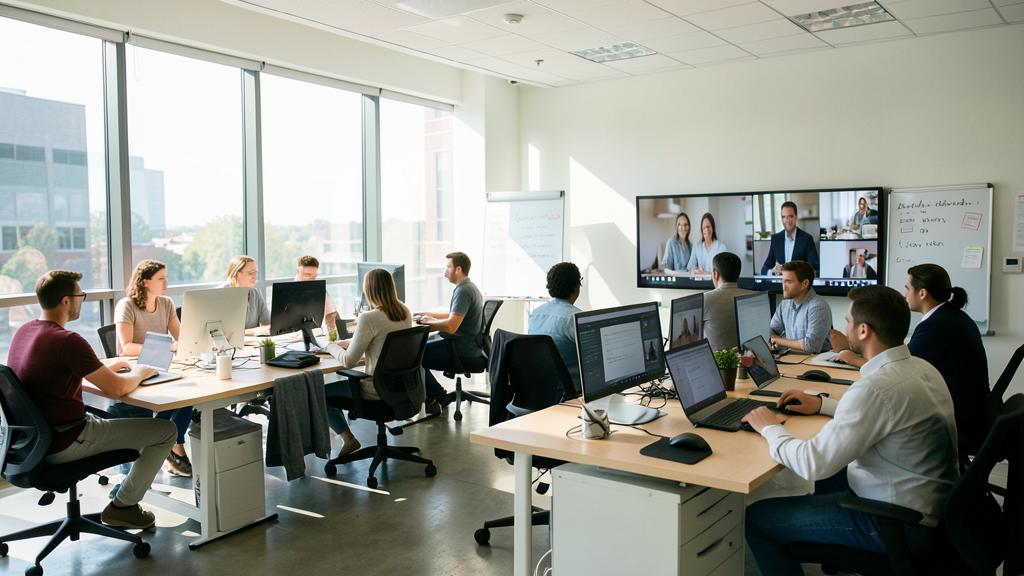
Let’s understand what hybrid work is and why it has taken hold. The DEFINITION: hybrid work combines IN-PERSON work (at the office, on-site) and REMOTE WORK (at home, or elsewhere at a distance); typically, you alternate: some days at the office, others at home; it’s neither the “all in-person” of before, nor the “all remote,” but a MIXED model; the modalities vary (fixed or flexible days, in-person/remote ratio, company rules). What has CHANGED: hybrid work has spread WIDELY and become a lasting fixture; what was marginal has become a norm in many organizations; driven by technological advancements (remote work tools), employee expectations (flexibility, balance), and a shift in mindsets; it’s no longer an exception but a common way of organizing work, here to stay. The ADVANTAGES of the hybrid model: FLEXIBILITY (organizing part of your work where you want/need to); TIME savings and reduced fatigue (fewer commutes on remote days); a better WORK-LIFE BALANCE possible; CONCENTRATION (some tasks are better done in the quiet of home); while keeping the benefits of IN-PERSON work (social ties, spontaneous exchanges, team cohesion, certain meetings and collaborations); hybrid work aims to combine the best of both worlds. The CHALLENGES and issues: ORGANIZATION (coordinating who is where, when; managing hybrid meetings); SOCIAL TIES and team cohesion (at a distance, you can feel isolated; maintaining the connection requires effort); the WORK-LIFE BOUNDARY (at home, work can encroach on personal life, and vice versa; difficulty “disconnecting”); TOOLS and technology (dependence on a good connection, video conferencing, and collaboration tools); EQUITY (ensuring those working remotely are not disadvantaged); MANAGEMENT (supervising a partially remote team). It’s NOT for all jobs: hybrid work mainly concerns “office” jobs (remote-friendly); many jobs (healthcare, retail, industry, trades, proximity services) cannot be done remotely; hybrid work therefore only concerns part of the workforce. What to remember to start: hybrid work combines in-person and remote work (office/home alternation), has become a lasting norm in many organizations; it offers advantages (flexibility, time savings, balance, while keeping the benefits of in-person work) but poses challenges (organization, social ties, work-life boundary, tools); it mainly concerns office jobs; understanding this model and knowing how to live it well is useful. Let’s dive deeper.

Living well with hybrid work
Hybrid work is beneficial if well organized; here are the keys to living it well. ORGANIZE your time and space: structure your days (especially when working remotely); if possible, have a DEDICATED workspace at home (to focus and separate work from personal life); plan your tasks according to location (concentration tasks at home, collaborations and meetings at the office, for example); take advantage of flexibility to organize optimally. PRESERVE the WORK-LIFE BOUNDARY: this is a major challenge of remote work; at home, work can encroach on personal life (difficulty “unplugging”); set CLEAR LIMITS: defined work hours, a dedicated space that you “leave,” turning off professional tools outside of work hours (the right to disconnect), not being reachable at all times; protect your personal time (our guides on disconnecting from work). MAINTAIN SOCIAL TIES: at a distance, you can feel isolated; keep in touch with your colleagues (regular exchanges, not just for work); take advantage of IN-PERSON days for human exchanges, cohesion, informal moments; in-person work retains all its value for social ties; don’t isolate yourself. MASTER the TOOLS: hybrid work relies on tools (video conferencing, messaging, file sharing, remote collaboration); learn to use them well (our guides on setting up your webcam and microphone for video calls, screen sharing); ensure a good INTERNET CONNECTION at home (essential—our guides on unstable connections); these tools, well mastered, streamline remote work. TAKE CARE of VIDEO CALLS: remote meetings are central; present yourself well (lighting, sound, framing), participate actively, manage “hybrid” meetings (some present, others remote: ensure those remote are included). MANAGE your CONCENTRATION at home: the home has its distractions (family, chores, temptations); create concentration conditions (dedicated space, work blocks, turning off personal notifications—our guides on turning off notifications); remote work requires self-discipline. PRESERVE your HEALTH: pay attention to posture (ergonomics of your home setup), breaks, physical activity (remote work can be sedentary), eye strain (screens—our guides on eye strain); and mental balance (not isolating yourself, not overworking). COMMUNICATE with your team and manager: in hybrid work, good communication is essential (informing about availability, progress; coordinating); trust and clarity replace the visual control of in-person work. FIND your BALANCE: the right in-person/remote ratio depends on you, your job, your team; take advantage of the benefits of each mode (concentration at home, social ties at the office). In summary, to live well with hybrid work: organize your time and space (dedicated space at home, tasks according to location), preserve the WORK-LIFE BOUNDARY (hours, disconnecting), maintain SOCIAL TIES (exchanges, in-person for the human aspect), master the TOOLS (video calls, good connection), manage your concentration and health (ergonomics, breaks, activity), and communicate well with your team; thus, hybrid work combines its advantages while mastering its challenges.
Hybrid work is about balancing office and home work. The main challenges are keeping work from taking over your personal life and staying connected with colleagues. To succeed, set clear work hours, use a dedicated workspace, and make sure to interact with your team regularly.
Imagine you work for a marketing agency with a 3-day in-office, 2-day remote schedule. On remote days, you focus on writing reports in your home office, then on in-office days, you join brainstorming sessions and team lunches. You turn off Slack notifications after 6 PM to separate work from personal time.
The two keys to successful hybrid work: preserving the work-life boundary and maintaining social ties. Among the challenges of hybrid work, two deserve special attention, as they make the difference between an empowering hybrid model and a forced one. ONE, PRESERVE the BOUNDARY between professional and personal life. This is THE big trap of remote work: when you work from home, the physical boundary between the office and home disappears, and work can ENCRACH on personal life (responding to a work message in the evening, “just doing one thing” after hours, never really unplugging), or vice versa (personal life spilling over into work); result: overwork, fatigue, difficulty disconnecting, stress. To preserve this boundary: set CLEAR WORK HOURS and stick to them; if possible, have a DEDICATED workspace that you “leave” at the end of the day (even symbolically: putting away the computer, closing the office door); TURN OFF professional tools (email, work notifications) outside of work hours (the “right to disconnect”—our guides on disconnecting from work); don’t be reachable at all times; protect your personal time as you would protect your hours at the office; this separation is essential for your balance and well-being. TWO, MAINTAIN SOCIAL TIES and cohesion. At a distance, you can feel ISOLATED, cut off from the team, deprived of spontaneous exchanges and informal moments that build connections; this isolation can weigh on morale and cohesion; to avoid it: keep in CONTACT with your colleagues (regular exchanges, not just functional ones; ask how they’re doing, maintain human connection); take FULL ADVANTAGE of IN-PERSON days for what works best together: human exchanges, team cohesion, collaborations, informal moments (coffee, lunch); in-person work retains all its value for social ties, which remote work cannot replace; use each mode for what it does best. These two keys complement each other: preserving the boundary protects your personal balance (not letting work take over), and maintaining the connection protects your social and professional balance (not isolating yourself); together, they make the difference between a hybrid work model that brings the best of both worlds (flexibility AND connection, autonomy AND team) and a forced hybrid model (isolation AND overwork). Successful hybrid work is not just a matter of tools or logistical organization: it’s mainly a matter of HUMAN BALANCE—between work and life, between autonomy and connection; by taking care of these two dimensions, you’ll get the most out of this lasting way of working.

Issues, limits, and best practices
Hybrid work, while established, has issues and limits that need to be understood to live it well collectively and individually. The issue of EQUITY: ensuring that remote workers are not DISADVANTAGED compared to those present (access to information, opportunities, recognition); the risk of a “double standard” (those in the office more visible/favored) is real; good organization and attentive management prevent this. REMOTE MANAGEMENT: supervising a partially remote team requires different approaches: more TRUST (you don’t “see” people working: you judge based on results, not presence), good COMMUNICATION, clarity on expectations; the visual control of in-person work gives way to trust and autonomy; it’s a shift in managerial culture. DEPENDENCE on TOOLS and CONNECTION: hybrid work relies on technology; a good home internet connection is ESSENTIAL; tools (video calls, collaboration) must be mastered and reliable; a connection or tool failure can block you; have backup solutions (backup connection, know how to troubleshoot). SECURITY and confidentiality: working remotely raises data security issues (secure connections, protecting company information, not mixing personal and professional data on devices, beware of unsecured WiFi networks—our guides on WiFi security); follow your company’s security rules. ISOLATION and well-being: excessive remote work can isolate and affect morale; hybrid work, well balanced, mitigates this (in-person work maintains the connection); watch your social and mental balance; don’t hesitate to prioritize in-person work if you feel isolated. SEDENTARITY and health: remote work can be sedentary (fewer commutes, sitting all day); move around, take breaks, take care of your ergonomics; pay attention to physical and mental health. THE RIGHT TO DISCONNECT: the work-life boundary being more blurred, the right not to be reachable outside of work hours is important; it is sometimes regulated; make it respected and respect it (don’t contact others outside of work hours). It’s NOT for EVERYONE: let’s remember that hybrid work only concerns remote-friendly jobs (office jobs); many jobs (healthcare, retail, industry, trades, proximity services) remain in mandatory in-person work; hybrid work is not a universal model. EVOLUTION and adaptation: hybrid work continues to evolve; organizations are adjusting their models (in-person/remote ratio, rules); it’s a balance that is still being sought, between employee expectations and company needs; there is no one-size-fits-all formula. The COLLECTIVE best practice: hybrid work works well when it is well organized (clear rules, equity, good tools, trust-based management) and when everyone contributes (communication, autonomy, respect for colleagues); it’s a collective as well as individual balance. In summary: hybrid work raises issues of EQUITY (not disadvantaging remote workers), MANAGEMENT (trust rather than control), dependence on TOOLS and connection, SECURITY of professional data, ISOLATION and well-being, SEDENTARITY, and the right to DISCONNECT; it only concerns office jobs; well organized (clear rules, equity, reliable tools, trust) and well lived individually (balance, connection, health), it combines its advantages while mastering its challenges; it’s an established model that continues to adjust.
Warning: beware of the blurring work-life boundary, isolation, and the security of professional data. Hybrid work has advantages, but also pitfalls to be aware of to live it well. Pitfall number one: the WORK-LIFE BOUNDARY that FADES; in remote work, without the physical separation of the office, work can invade personal life (responding to work messages in the evening/on weekends, “just doing one thing” after hours, never unplugging), leading to OVERWORK, fatigue, stress, even burnout; set CLEAR LIMITS: defined hours, a workspace that you leave, TURN OFF professional tools outside of work hours (right to disconnect), not being reachable at all times; protect your personal time (our guides on disconnecting from work); don’t let remote work turn you into an “always connected” person. ISOLATION: remote work can isolate you (cut off from the team, human exchanges, informal moments), affecting morale and cohesion; maintain the CONNECTION (regular exchanges with colleagues, taking advantage of in-person days for the human aspect); if you feel isolated, prioritize in-person work or increase contact; don’t neglect this social and well-being dimension. SECURITY of PROFESSIONAL DATA: working remotely exposes company information; follow your employer’s SECURITY RULES; use SECURED connections (beware of unsecured public WiFi—our guides on WiFi security), protect your devices and access, don’t mix personal and professional data in a risky way, beware of phishing (cyberattacks target remote work); security is a shared responsibility. DEPENDENCE on CONNECTION and tools: a poor internet connection or tool failure can block you; ensure a reliable connection at home, know how to troubleshoot common problems (video calls, connection—our guides), and have backup solutions if your work depends on it. SEDENTARITY and HEALTH: remote work can be sedentary and hard on the body (posture, screens); take care of the ergonomics of your setup, take BREAKS, move around, rest your eyes (our guides on eye strain); also pay attention to mental health (isolation, overwork). EQUITY: ensure (and the company must ensure) that remote workers are not disadvantaged; TRUST-based management (judging based on results, not presence) is necessary. Don’t CONFUSE hybrid work and “all remote work”; the interest of hybrid work is precisely the BALANCE (keeping the connection of in-person work); “all remote” accentuates isolation and the blurring of boundaries; in-person work has value. Finally, remember that hybrid work only concerns REMOTE-FRIENDLY jobs; it’s not a universal privilege, and many jobs remain in mandatory in-person work. By setting clear limits (work-life boundary, disconnecting), maintaining the connection (against isolation), respecting data security, taking care of your health, and ensuring equity, you’ll avoid the pitfalls of hybrid work and reap its true benefits: flexibility and balance, without overwork or isolation.

Frequently asked questions
Is hybrid work here to stay?
Yes, all signs indicate it has become a LONG-TERM fixture in many organizations. What was marginal or exceptional has become a COMMON NORM for many office jobs; hybrid work (alternating in-person and remote work) has spread widely and taken root, driven by several lasting factors: TECHNOLOGICAL advancements (remote work tools—video calls, online collaboration, cloud—make remote work smooth and efficient); EMPLOYEE expectations (many appreciate the flexibility, time savings, and balance that hybrid work offers, and seek it out); a shift in MINDSETS (remote work, once viewed with suspicion, is now accepted and deemed effective for many tasks); and the interest of COMPANIES (savings on office space, attractiveness for recruitment, team satisfaction). The hybrid model represents a sought-after BALANCE between all in-person (rigid, costly in commutes) and all remote (isolating); it combines the advantages of both; it’s this balance that explains its lasting rooting. THAT SAID, hybrid work continues to EVOLVE and adjust; organizations are refining their models (in-person/remote ratio, fixed or flexible days, rules); there are debates and adjustments (some companies are calling for more in-person work, others are expanding remote work); the exact balance is still being sought, and varies according to companies, jobs, cultures; but the FUNDAMENTAL TREND—a mixed model rather than a return to the all in-person of before—seems lasting. Let’s also remember that hybrid work only concerns REMOTE-FRIENDLY jobs (office jobs); many jobs remain in mandatory in-person work (healthcare, retail, industry, trades, proximity services); hybrid work is therefore not universal, but has taken root where possible. In summary: yes, hybrid work is here to stay; it has become a norm in office jobs, driven by technology, employee expectations, and the interest of companies, as a balance between in-person and remote work; it continues to adjust (models evolve), but the fundamental trend toward a mixed model seems lasting; preparing to live it well is therefore useful.
How to avoid being overwhelmed by work at home?
By setting CLEAR LIMITS between work and personal life: this is essential, as it’s the big trap of remote work. Without the physical separation of the office, work can easily invade your home and personal time (responding to messages in the evening, never unplugging, overworking); to avoid this, several reflexes. Set CLEAR WORK HOURS and STICK TO THEM: as if you were at the office, have a start and end to your day; don’t systematically overrun. If possible, have a DEDICATED WORKSPACE: a desk, a corner reserved for work, that you “leave” at the end of the day (close the door, put away the computer); this physical and symbolic separation helps you “unplug”; avoid working in living spaces (the bed, the couch) that mix everything. TURN OFF professional tools outside of work hours: deactivate work email notifications in the evening and on weekends; don’t check your work emails constantly; it’s the “right to disconnect” (sometimes regulated): you don’t have to be reachable 24/7 (our guides on disconnecting from work, turning off notifications). RITUALIZE transitions: without the commute that marked the break, create your own daily start and end rituals (a walk, tidying up your workspace, an activity that marks the shift to personal time). Don’t feel guilty about NOT being available outside of work hours: it’s legitimate and healthy; remote work is not “being reachable all the time.” Communicate about your availability: inform your colleagues of your hours; and respect those of others (don’t contact them outside of work hours). Protect your PERSONAL TIME as precious time, not as a variable for work. Also beware of the opposite: that personal life doesn’t invade work too much (hence the interest of hours and a dedicated space). If your company or manager fosters a culture of permanent availability: the right to disconnect is a subject to assert; work-life balance is important for your health and effectiveness. In summary: to avoid being overwhelmed, set clear hours and stick to them, have a dedicated workspace that you leave, turn off work tools outside of hours (right to disconnect), ritualize transitions, don’t be reachable all the time, and protect your personal time; this boundary between work and personal life is the key to healthy and lasting remote work.

Does remote work harm ties with colleagues?
It can, if poorly managed, but hybrid work, well lived, allows maintaining the connection; this requires effort. The RISK: at a distance, you lose spontaneous exchanges, informal moments (coffee, lunch, hallway discussions), human interactions that build the connection and team cohesion; remote work can therefore create a sense of ISOLATION, strain relationships, and affect cohesion; it’s a real challenge, especially in the case of intensive remote work. BUT HYBRID WORK mitigates this risk: by alternating in-person and remote work, it allows KEEPING in-person moments where the connection is cultivated; that’s the whole point of the mixed model compared to “all remote work” (more isolating); in-person work retains all its value for the human aspect. To PRESERVE the connection: take FULL ADVANTAGE of IN-PERSON days for what works best together—the exchanges, cohesion, collaborations, informal moments (don’t spend them isolated in a corner: go toward others, have lunch together, exchange); maintain CONTACT at a distance as well: regular exchanges with colleagues, not just functional ones (ask how they’re doing, maintain human connection, not just work emails); use the tools (messaging, video calls) to maintain communication and a bit of conviviality; participate in team moments (meetings, events). The COMPANY and management also have a role: organizing in-person times for cohesion, ensuring those remote are included, maintaining team culture. Beware of EQUITY: those remote should not be “forgotten” or disadvantaged compared to those present. If you feel ISOLATED: don’t hesitate to prioritize more in-person work, increase contact, talk about it; isolation weighs on morale and needs to be addressed. In summary: yes, remote work CAN harm ties with colleagues (loss of spontaneous exchanges, possible isolation), especially if intensive and poorly managed; but HYBRID WORK, by keeping in-person days, allows precisely preserving this connection—provided you take full advantage of in-person work for the human aspect and maintain contact at a distance; social ties don’t maintain themselves in hybrid work: they require effort (going toward others, exchanging, participating); it’s one of the key balances of successful hybrid work; in-person work remains precious for the human dimension that remote work cannot replace.
What to remember
HYBRID WORK combines in-person (office) and remote work (distance), in alternation; neither all in the office nor all remote, this MIXED model has become a lasting NORM in many office jobs, driven by technology, employee expectations (flexibility, balance), and the interest of companies. It offers ADVANTAGES: flexibility, time and fatigue savings (fewer commutes), better work-life balance, concentration at home, while keeping the benefits of in-person work (social ties, cohesion, exchanges); it aims for the best of both worlds. But it poses CHALLENGES: organization, social ties, work-life boundary, tools, equity, management. The TWO KEYS to successful hybrid work: PRESERVE the WORK-LIFE BOUNDARY (the big trap: work invades personal life; set clear hours, a dedicated workspace that you leave, turn off work tools outside of hours—right to disconnect; don’t be reachable at all times), and MAINTAIN SOCIAL TIES (against isolation: take advantage of in-person work for the human aspect, maintain contact at a distance). To live it well: organize time and space (tasks according to location), master the TOOLS (video calls, good connection), manage your concentration and HEALTH (ergonomics, breaks, activity against sedentariness), and communicate well with your team (trust, clarity). ISSUES and limits: EQUITY (not disadvantaging those remote), TRUST-based MANAGEMENT (judging based on results, not presence), dependence on tools and connection, SECURITY of professional data (secured connections, company rules, beware of phishing), isolation, sedentariness, and the right to disconnect. Beware: don’t let work invade your life (overwork), don’t isolate yourself, respect data security, and take care of your health. Hybrid work only concerns REMOTE-FRIENDLY jobs (office jobs); it’s not universal. It continues to ADJUST (models evolve), but the fundamental trend toward a mixed model seems lasting. Well organized (clear rules, equity, reliable tools, trust) and well lived individually (work-life balance, connection, health), hybrid work combines its advantages while mastering its challenges: flexibility AND connection, autonomy AND team; it’s an established model, from which you get the most by taking care of the human balance—between work and life, between autonomy and the collective.



Want to understand and master the technologies that are changing your daily life? Our training programs will enlighten you.
Leave a Reply
You must be logged in to post a comment.