
Close relatives’ distress, a child choking, an accident before your eyes: the minutes before emergency services arrive are where everything hinges — and most of us don’t know what to do, who to call exactly, or where the defibrillator next door is. A well-prepared phone changes each link: numbers and gestures at hand, automatic location transmission, defibrillator mapping, and citizen rescuers alerted within 400 meters. The apps that can save, the settings to make beforehand, and the gestures the screen will never replace: the guide that hopes it will never be needed.
The numbers and the right call reflex
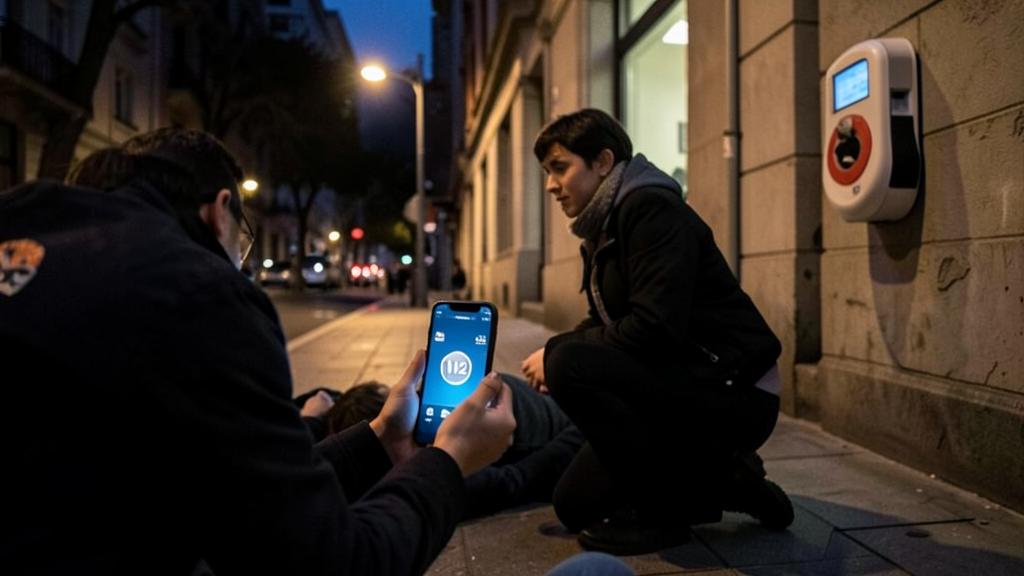
The essential base to know by heart (and display at home): the 15 (SAMU — the medical: distress, chest pain, suffocation), the 18 (firefighters — fire, accident, rescue), the 17 (police-gendarmerie), the 112 (the European universal — the number to remember if one: it routes to the right service, works throughout Europe, and passes on ANY available network — even without your operator, even a locked phone: our hiking guides), the 114 (emergency by SMS and video for the deaf and hard of hearing — to be known for oneself or close ones: the dedicated app exists), and the 15 that also advises (Sunday medical doubt — the medical regulator ORIENTS: calling to « know if it’s serious » is a LEGITIMATE use of 15 — better to have too many calls than a heart attack « that will pass » —; the right call — speak CALM and structured (where — the precise address first: if the call cuts, they know where —, what, how many victims, the condition), never hang up first, and do what the regulator says (the guided phone CPR — the live dictation of the cardiac massage exists and works: your ear is their tool) —; and the automatic location — modern emergency calls transmit the position (the AML — active by default: the 112 call from the trail sends your coordinates) — the phone does its part — yours is to know the numbers.
Prepare the phone: the settings beforehand (the time that counts)
Everything is configured on a peaceful Tuesday: the emergency medical file (our guides — the priority: allergies, treatments, emergency contacts — accessible to rescuers from the locked screen: filled for each home phone, seniors first), the designated emergency contacts (notified by SOS functions — and the ICE setting in contacts: the « In Case of Emergency » that rescuers look for) —; the SOS functions learned — emergency calls by buttons (five presses or continuous press depending on models — the repeated gesture once to learn: our guides — and set to avoid accidental triggering) —; the fall and accident detection (watches and phones — activated for those who rely on them: our guides) —; the recent satellite SOS (the out-of-network coverage: our hiking guides: the gesture learned before the trail) —; the official apps installed — the public alert app (localized danger alerts: flood, major incident: the official channel that complements sirens and the geolocated SMS alert system that arrives alone) —; the weather and alerts (our guides) —; and the home location app already in place (our guides: « Where is he? » answered in real emergency) —; and the prepared sharing — shared location within the family (papi’s distress localized: our guides) —; and the home address known by all (the child who can say the address to 15, the label next to the fixed phone for seniors: the reflex of another age that still saves).
The right reflex. Install the citizen rescuer app — the system that changes the statistics of cardiac arrest: recognized apps (those linked to SAMU and firefighters) alert nearby volunteers to a cardiac arrest (the 400 meters that make the minutes — CPR started before the ambulance multiplies survivals: each minute without CPR costs ~10% of chances) —; guide to the nearest defibrillator (the DAE map — check it once for your neighborhood: the supermarket, the town hall, the gym — knowing where it is is worth its weight in gold) —; and no formal skill is required (the app guides, 15 dictates — even imperfect hands beat the wait: inaction is the only bad choice). Registration takes five minutes — being « the one who was there and knew » is decided today.
The first minutes of an emergency are critical. Knowing the right numbers, having your phone set up with emergency contacts and medical info, and being part of a network of citizen rescuers can make all the difference. These steps take just a few minutes but can save lives.
In Paris, a 50-year-old man collapses in a café. A nearby citizen, who had installed a rescuer app, is alerted and starts CPR within 2 minutes. Another person retrieves a defibrillator from a nearby pharmacy. The man survives because of these quick actions.
The gestures in your pocket: learn beforehand, revise often
The app does not massage — it teaches: the first aid apps — the official references (the national rescuers’ apps — illustrated step-by-step gestures: choking, lateral position of safety, bleeding, CPR — consultable out of emergency to learn, and in emergency as a guided aide-memoire) —; situation-specific modules (the baby — different gestures from an adult: the parent who has revised once is no longer the same parent —; burns, poisonings with the numbers of poison centers) —; the true rehabilitation training — gestures are learned with the HANDS (the PSC1 training — one day, a modest price, everywhere in France: the useful birthday gift —; and free initiations at dedicated days: the app REVISES what the training has established — the winning sequence: PSC1 once, the annual app reminder) —; children are also trained (the life-saving gestures are taught at school — and at home: the child who can call 15 and say the address is a real link) —; and the home kit and info — an up-to-date first aid kit (the checklist app — and its car twin) —; displayed numbers (the emergency fridge: 15-18-112, the poison center, the family doctor, your address — the list that babysitters and grandparents find in three seconds) —; and the family meeting point (the nighttime fire is prepared in conversation: our guides: the emergency family plan is a dinner, not a bunker).
Special situations: road, travel, disasters, vulnerable relatives
The counts that matter: the road — safe accident handling before anything (the triangle, the vest, the warnings — over-accidents kill) —; localized calls (mile markers, the app that gives the exact position — and the eCall in recent cars that calls automatically) —; no moving the injured (except immediate danger — the golden rule taught in training) —; the travel — local numbers noted (911, the 112 European — the country guide’s travel emergency number) —; insurance and emergency repatriation accessible offline (the numbers in the wallet AND the phone) —; translated medical file (our guides: the allergy in the local language) —; major alerts — the national geolocated alert system (the strident SMS that alerts all phones in an area — it imposes itself alone: do not disable it) —; official guidelines followed (the public alert app, radios — social media rumors are NOT an emergency source: our guides) —; and the home resilience kit (water, flashlight, radio, batteries — official recommendations for a few days of autonomy: our guides on power outages) —; and the vulnerable relatives — the complete elderly system (the fall detection watch, dedicated tele-assistance — established services with their carried button: the proven solution that apps complement without replacing —; neighbors on the lookout) —; and specific vulnerabilities prepared (epilepsy, diabetes, severe allergies — the file, relatives trained in the dedicated gesture, the written protocol: the special emergency is prepared in the family with the doctor).
Beware of false emergencies and bad channels — emergencies have their parasites. Three derails to know: the indiscriminate calls that clog (15 for a cold, 18 for a cat stuck — overwhelmed regulators respond less quickly to real cardiac arrests: doubt calls, comfort waits — 116 117 for non-urgent medical care, pharmacy, teleconsultation: non-urgent channels exist, our guides) —; the emergency scams (the fake relative in distress — our deepfake guides: true emergency calls never ask for money —; the fake « firefighters » call selling dubious calendars or capturing donations — donations go to official channels) —; and the dubious tutorial gestures (viral « remedies » for choking or distress — the source of life-saving gestures is OFFICIAL: rescue organizations, 15 in real time — never a viral video: in emergencies, creative improvisation kills). Emergency is the moment when trust must be total — reserve it for channels that deserve it.
Frequently asked questions
Call or massage first, alone at a cardiac arrest?
Call FIRST (15/112 on speaker — the regulator guides the continuous CPR afterward: you won’t be alone), the defibrillator sent by a THIRD if there’s someone (you go get the defibrillator — the named designation works, the call to the public works not), and continue CPR until help arrives (hands in the center, strong and fast — 100-120/minute — without stopping: the regulator counts with you). A one-day training turns this paragraph into reflexes — that’s its exact price.
Can my locked phone be used for emergency services (and me for them)?
Both ways work: emergency calls pass without unlocking (the « Emergency » button on the lock screen — show it to the kids), and your medical file appears to rescuers from the same screen (if filled — our guides: the reason for the priority). Therefore, a third party’s unconscious phone also serves: the emergency called, its file consulted — the reflex to know in both roles.
What to put in a child’s phone for emergencies?
The minimal kit: parents’ numbers as favorites AND emergency contacts (callable from the lock screen), the 112 explained (when and how — the once role-play: « What do you say? »), the address memorized, and family location (our guides). And the reassuring rule taught: calling for a doubt never attracts trouble — the child who dares to call is the safety of the home.
What to remember
Emergency is won beforehand: the numbers above (112 universal, 15 that also advises, 114 for the deaf — and the address calmly said first), the prepared phone (medical file at the lock screen for the whole home, emergency contacts, SOS gestures learned, official alert app, shared family location), the network joined (the citizen rescuer app — five minutes of registration, the neighborhood defibrillator spotted), and the acquired gestures (one-day PSC1, official app in review, children included — and the emergency fridge displayed). All served by the discipline of channels: the true urgent to the true numbers, the non-urgent to 116 117, gestures to official sources — never to viral tutorials. Your phone can save a life — yours, a relative’s, an unknown 400 meters away: it just needs an hour of preparation. Take it this week — and we hope we never check that it was needed.
Want to go further with your phone and apps? Our practical training is for you.
Leave a Reply
You must be logged in to post a comment.