
The video game is the main playground of a generation — and like any playground, it has its corners: integrated purchases that create surprise bills, chats where strangers talk to your children, item exchanges that are well-organized scams, and inappropriate content just three clicks away. Banning would be as futile as it would be unjust (the game is also social, creative, and educational): the framework works — the settings by console and game, conversations that immunize, and the role of parents in a leisure activity they can understand by getting involved. A comprehensive guide to online children’s gaming, without panic or naivety.
Money first: integrated purchases, currencies, and chests
The first parental shock is the bill: understanding the economics of modern gaming — the « free » game lives off of integrated purchases (virtual currencies that blur prices — 1,200 gems at €9.99 each, requiring 1,500 for the coveted item — opacity is the design), season passes (subtle school rhythm subscriptions), and loot chests (random items against real money — documented casino mechanics, regulated in several countries: name it this way with the child, it’s the best vaccine); technical defenses, layer by layer: payment never recorded without a code (parental approval for each purchase — family settings on consoles and stores: our guides — and the code is not the date of birth), prepaid cards as physical budget (video game pocket money on gift cards — the capped amount that teaches budgeting — the ceiling pedagogy), and receipt verification (purchase emails that come to YOU); and the conversation on economics — the price reconverted (this skin is three cinema tickets), the value that disappears with the account, and misplaced pride: real players respect the level, not the store. The goal is not zero purchase — it’s the deliberate, budgeted, and assumed purchase: consumer competence starts in game stores.

Strangers and chats: the real subject
Online gaming is a SOCIAL place — with the rules of a public space: real risks without fantasy — the overwhelming majority of interactions are with ordinary players; serious cases do exist (the adult who approaches through the game — prolonged contact, virtual gifts, requests to move to a private message, then requests that escalate: grooming patterns are documented and often start with games) and are prevented by the framework more than fear; settings that fit — voice and text chat regulated by age (cut or limited to friends for the younger ones — each console and each major game has its communication settings: fifteen minutes per installed game, with the child), filtered friend requests, closed groups to strangers for the little ones; spoken rules — simple and repeated: never give your real name, age, school, or town (the username is a character — children understand this grammar very well), never switch from the game to a private message with someone you don’t know in real life — the golden rule of our guides: « if someone makes you uncomfortable, asks for photos or secrets: block them, show me, you will never have trouble for telling me » (the trust channel, always and again — it protects when filters fail); and parental presence — sometimes play with (the best observation post in the world), know the games and gaming buddies (real school friends’ usernames identified — the real circle in the virtual world).
The right reflex. Use the PEGI classification as a starting point — not as a packaging detail: the age (3, 7, 12, 16, 18) AND the pictograms (violence, language, integrated purchases, online interactions — the « integrated purchases » and « player interactions » descriptors are YOUR two parent alerts): the game is chosen like a film — by looking at the classification, then a real gameplay video (five minutes of online gameplay show more than any box art), then a parent decision (PEGI informs, you decide — and the « all my friends play it » argument is discussed, it doesn’t decide). Console restrictions then align with the chosen age: consistency between stated and set rules builds the credibility of the framework.

Time, sleep, balance: the framework that holds
The universal question (« he plays too much ») is handled structurally, not by daily conflict: the screen guidelines from our guides applied to gaming — predictable time slots rather than constant negotiation, sleep sanctuarized (the console OUT of the bedroom at night — hidden nighttime gaming is the first destroyer of adolescent sleep), technical limits reinforced (console time controls — the time shown to the child, the console warning: the tool ends clock debates); specifics of online gaming to understand — the « can’t quit » part (team matches penalize quitting: the « last match » announced before launch is more realistic than cutting mid-game — the rule that respects the game respects itself better), limited events that create urgency (organized FOMO — name it); counting signals (our mental health guides: the bundle — sleep, school, abandoned activities, mood, isolation — not raw hours: the passionate one who is doing well plays a lot and lives; the one who is struggling plays to escape — the response is conversation and help, not a dry confiscation); and the full balance, not the empty one — sports, offline friends, projects: the game takes the place left free (the full real-life agenda is the best « time limit » ever invented). And your sincere curiosity — « show me your world » — is worth all control software: the proud child who explains is the one who will also talk when things go wrong.
Digital playground scams: skins, accounts, and fake gifts
The gaming ecosystem has its dedicated scams, calibrated for young users: object and skin scams — the « free V-bucks generator, » the site that « doubles skins, » the too-good exchanges: child-targeted phishing (identifiers given = account stolen — and full gaming accounts are resold: the black market is real): the simple rule — nothing is free outside the official game, NEVER its identifiers elsewhere than on the official page (the lifelong phishing lesson, learned from skins: turn each attempt into a lesson — « look how well it’s imitated »); the protected account like a real one — unique password, two-factor authentication (games offer it — activate it together: often rewarded with in-game bonuses, the industry has understood the pedagogy), and a separate parent account (the child does not play on the account that holds the credit card); streamers and contests — fake giveaways, « click to win »: source verification applies to idols too; and in-game harassment — party insults are blocked and reported (existing tools work — learn together the report/block gesture: it’s a digital citizenship reflex), followed harassment (the same ones returning, raids) is documented and treated (our guides — screenshots, reports, and the 3018 if it spills out of the game): the digital playground has the same laws as the real one — don’t leave a child there without teaching them to call an adult.
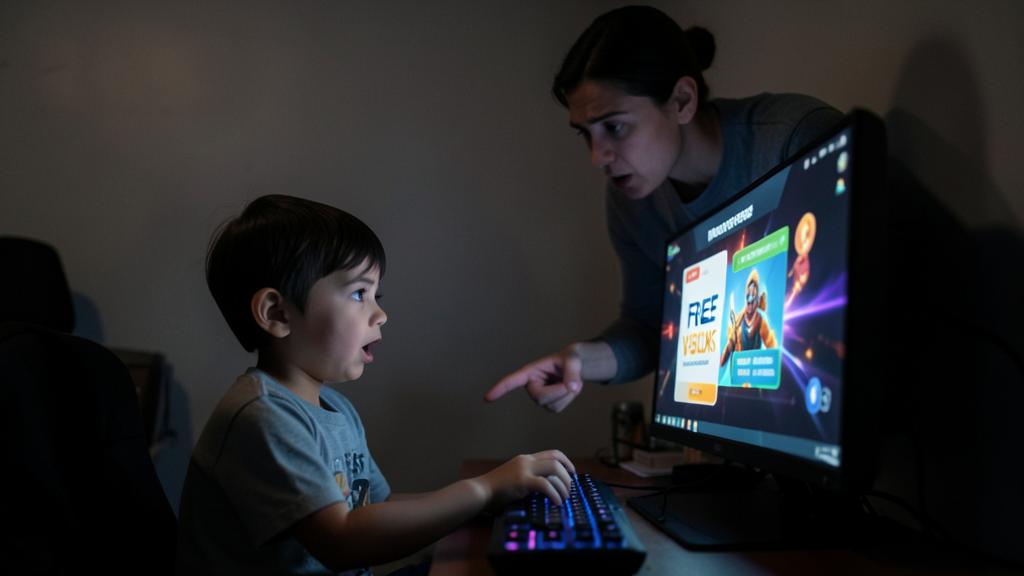
Games use tricks to make kids spend money, like loot boxes that are like gambling. Parents can set up protections, like requiring a code for purchases, and teach kids about real money values. The goal isn’t to stop all spending, but to make it thoughtful.
In Fortnite, a child might want a rare skin that costs 1,500 V-Bucks (the game’s currency). The game might offer a deal: 1,200 V-Bucks for €9.99, but the child needs 1,500. This makes the price unclear. A parent can explain that €9.99 is about the cost of three movie tickets, helping the child understand real-world value.

Be wary of streaming and Discord — the out-of-game that escapes settings. Modern gaming spills over: the child WATCHES as much as they play (game videos and live streams — where content and language follow no PEGI: a 7-year-old game commented by a vulgar streamer is the classic balancing act — video platforms have their own parental controls: set them too, our guides), and communities live on external discussion servers (game Discord servers — default adult spaces, no real-age moderation: for minors, servers are chosen — the school one, identified friends — and invitations from strangers are refused as everywhere). The gaming framework that ignores the PERIPHERAL of gaming (videos, external chats, forums) misses half the subject — rules travel with the child, not the console: it’s all about the conversations rather than the settings.
Frequently asked questions
My child wants a game « everyone is talking about » but classified above their age:
The classification has reasons (watch the real gameplay before deciding — five minutes of video show real violence or online atmosphere); the refusal is then based on concrete reasons, and an alternative is proposed (games of the same genre at their age almost always exist). And if you yield with awareness (the older, more mature, the game limits): cut the chat and play together first — yielding with a framework is not yielding in full.

Do games make people violent or addicted?
The research is nuanced (our mental health guides): no simple causal link to violence; problematic use exists (a minority — the recognized condition is diagnosed by professionals, not parental irritation) and is identified by a bundle (the life that narrows around the game). The mass response remains balance and framework; the real trouble response, support; both start with the same thing: a parent who watches and talks.
At what age is online gaming with chat?
Gradually, like everything else (our first phone guides): local and solo gaming first, then online without chat, then chat BETWEEN IDENTIFIED FRIENDS (closed friend list) towards the end of primary school, opening in stages won in middle school — each step with its conversations. There is no universal age: there are prepared and released children — the difference is entirely on your side.

What to remember
Online children’s gaming secures in four areas: money (code-approval for each purchase, prepaid cards as a budget, named chests for what they are), strangers (age-regulated chat, the username character that says nothing true, never a switch to a private message, and the trust channel sanctuarized — ultimate protection), time (predictable time slots, console out of the bedroom, the « last match » announced before, monitored bundle signals), and scams (nothing is free outside the game, protected account with two-factor authentication, learn to report/block together) — not forgetting the peripherals (videos and external servers) that only conversations cover. PEGI informs, settings align, your curiosity protects: video games are a world where your child grows — visit it with them: it’s both the best parental control and often excellent moments — controller in hand.

Any doubts about your security, an appliance to check or clean? Our support service guides you step by step.
Leave a Reply
You must be logged in to post a comment.