
It’s decided—or almost: the first phone arrives, for starting middle school, solo trips, or simply because « everyone has one. » This moment involves much more than a purchase: it’s the organized entry of a child into the digital world—and it succeeds through preparation, not through prohibition or laissez-faire. Which device, which settings BEFORE handing it over, which family rules, which long-term support: the complete checklist for parents, step by step.
Before buying: the right time, the right device
Upstream decisions: the timing—there’s no magic age, but a combination of factors: real need (independent trips, activities), maturity (does he take care of his belongings? does he respect agreed-upon rules?), and the environment (middle school is the de facto social tipping point): the question isn’t « what age » but « ready for what »—and a phone WITHOUT social networks at 11 isn’t the same as full access (that’s the whole point of settings); the device—refurbished is the way to go (first phone = drops, losses, forgetfulness: a simple model from two or three generations ago, guaranteed, at a fraction of the new price—our refurbished guides), with a serious case and tempered glass as standard; the graduated alternative to consider—the child’s smartwatch (calls/messages to approved contacts, location, zero apps) covers the « reachable during trips » need for younger kids without opening the internet: an excellent intermediate step; and the plan—locked (non-exceedable data envelope: learning about quotas without surprise bills), small volume (data sobriety encourages home Wi-Fi—so under your roof), and in the parent’s name (the contract and recourse remain adult). Finally, the pre-conversation—the phone is introduced with its rules, not « discovered »: the child who participates in setting the framework respects it twice as much—it’s documented and it’s logical.
The first phone is a big step, but it’s not just about the device. It’s about choosing the right time, the right phone, and the right rules. A refurbished phone with a protective case is a smart choice. A smartwatch can be a good middle ground for younger kids. And always talk about the rules before giving the phone to your child.
A 10-year-old starts middle school and needs a phone for emergencies. The parents choose a refurbished iPhone SE (2020 model) with a sturdy case and tempered glass. They set up a family plan with a 5GB data limit and a strict screen time schedule. They also discuss the rules, like no social media at first and no phone in the bedroom at night. The child is involved in the process and understands the responsibilities that come with having a phone.

The setup: two hours that make all the difference
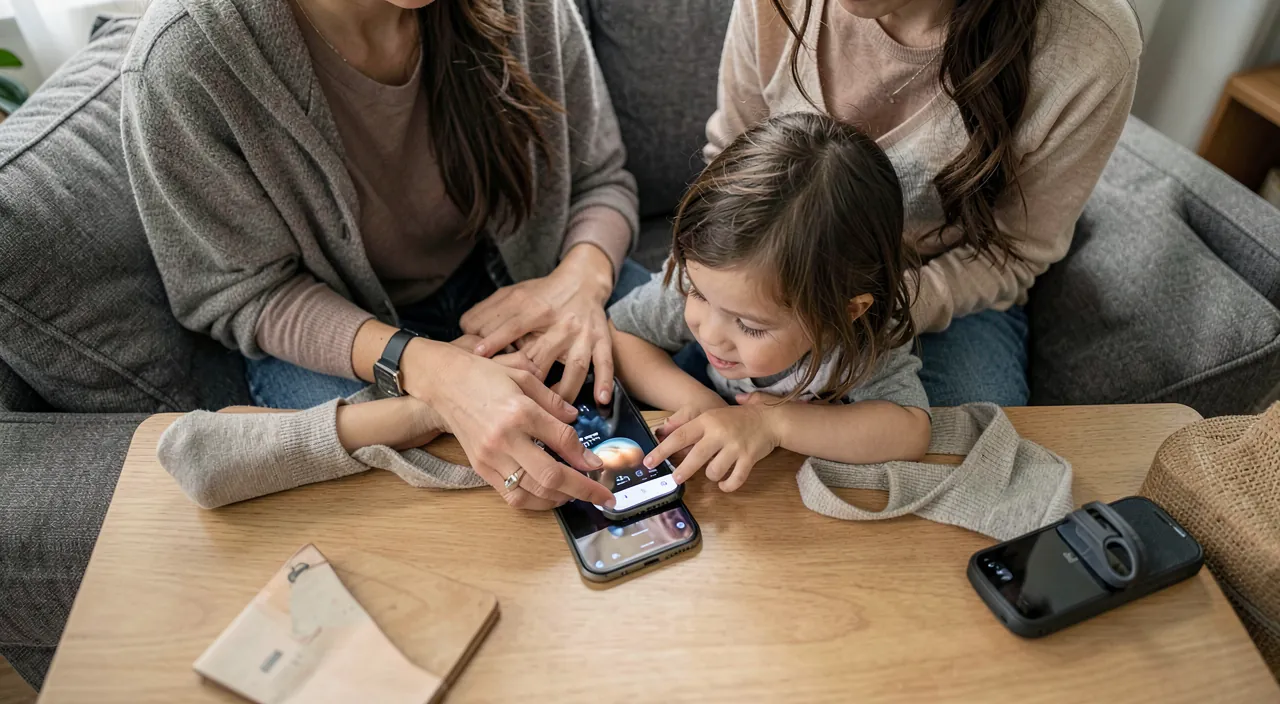
The handover is prepared—the device is configured BEFORE (ideally together, while explaining): the child account—never the phone on a parent’s account or an « adult » account with a fake birth date: the declared child account (in Apple/Google Family Sharing) activates age protections across the entire ecosystem and YOUR parental controls; the parental controls (Screen Time/Family Link—our detailed guides): parent code unknown to the child, app purchases and installations subject to your approval (the central lever: each app is discussed—this is where social networks are allowed or not), age limits for content, reasonable screen time by category, and the screen curfew—non-negotiable: the phone sleeps OUTSIDE the bedroom (charger in the living room: the number one rule of all pediatricians—sleep is what the phone threatens first); the communications—contacts managed from the start (no strangers popping up), messaging limited to agreed-upon ones; the family location sharing—shared both ways and STATED (transparency, not hidden surveillance: « we see each other »—our guides revisit this in adolescence); the basic protections—strong code (that they choose), active backup, « Find My » tested (loss = first statistical disaster), web filtering enabled; and the new device cleanup—no social networks at the start (they’ll come in stages—each opening being a conversation), the few useful apps installed together (family messaging, music, maps for trips).

The right reflex. Write the family phone contract—one page, written TOGETHER and signed by both sides: the hours (curfew, not at the table), the places (bedroom at night: no), the uses (apps = ask; strangers = we talk about it; photos of yourself and others = the rules), the parent’s commitments ALSO (respect for conversation privacy except in case of alert, no sneaky reading, setting an example at the table—the contract that only binds the child is a rule, not a contract), and the golden clause: « no matter what happens online, you can come to us—priority will be to help you, not to confiscate ». This blunt and repeated phrase is the best security system ever designed: the child who isn’t afraid of confiscation shows the problem IN TIME.

Conversations that protect more than settings
Settings filter; education immunizes—the topics to open early, simply, and to revisit often: strangers and fake profiles (« online, you’re never sure who’s talking »—the reflex: any strange request from a stranger OR a « friend » who changes tone = show it to the parent, no shame); photos—the two irreversible rules: what’s sent can never be taken back, and you don’t photograph/share others without consent (yours and theirs—the privacy is protected both ways, from day one); bullying—recognizing it (suffered OR witnessed: the witness who speaks protects), screenshots as evidence, the 3018 number (against digital violence against young people) posted at home; scams and traps adapted to age (too-good-to-be-true gifts, codes never to give, in-game purchases—the parental approval technically frames them, the conversation makes them understood); and self-image—the harmful streams (comparison, filters, quantified popularity): the core subject of digital adolescence (our screen and mental health guides), which is prepared now with a simple phrase: « what you see online is a showcase, not real life. » None of these conversations is a big speech: they’re regular minutes, often in the car or kitchen—the best classrooms in the world.
Next: loosening gradually, keeping the connection
The initial framework is meant to EVOLVE—that’s its credibility: the regular review (every quarter or at each justified request): what has matured is loosened—extended time, app granted, management autonomy—explicitly, like earned trust (controls that never loosen become a prison to circumvent: circumvention is actually the signal that it’s time to renegotiate, not relock); the entry of social networks—the big milestone: delayed without drama (legal ages exist and are getting stricter), then accompanied—the first account is created TOGETHER (private, real contacts, settings done together) with the agreed-upon « open-door » period; the signals to watch—not raw hours but shifts: degraded sleep, abandoned activities, plummeting mood, anxious secrecy (our mental health guides—the combination counts, and the response is conversation, school, doctor if needed); and your exemplarity, the free lever that everyone knows and forgets: the contract rules that YOU follow (table, bedroom, behavior) weigh more than all the settings. The final goal has never been control: it’s a 16-17-year-old who is autonomous, with healthy reflexes, managing alone—the successful parental control is the one that has become unnecessary, step by step.
The rules around the phone should change as your child grows. Regularly talk about how things are going and adjust the rules as needed. When your child is ready, you can let them have more freedom, like using social media. But always keep an eye on their behavior and set a good example yourself.
A 13-year-old has had a phone for a year with strict rules. The parents notice that the child is responsible and follows the rules well. They decide to have a conversation and agree to let the child have access to social media, but with some conditions: the account must be private, only real friends can be added, and the parents can check it occasionally. The child also agrees to keep the phone out of the bedroom at night and to talk to the parents if anything makes them uncomfortable online.

Beware of the two classic extremes—they produce the same result. The all-forbidden (phone « naked, » total surveillance, sneaky message reading) creates expert circumvention (the second account, a friend’s phone, hidden apps—teens are technically better than most parents) and above all breaks the channel: the child in difficulty won’t come to the one who confiscates. The all-trust (« he’s reasonable, » zero settings, zero conversation) leaves a child alone facing systems designed by adults to capture—this isn’t trust, it’s absence. The path that works is boringly middle: a real AND adjustable technical framework, regular conversations, a sanctuarized trust channel. It’s more work than the two extremes—but it’s also the only one that works.
Frequent questions
Smartphone or « keypad phone » to start?
The basic phone (calls/SMS) is a respectable option for pure reachability—but it excludes support (no parental controls, and the child experiences digital elsewhere, without you): many families prefer the VERY restricted smartphone, which allows learning together. The child’s watch remains the ideal intermediate for elementary school; in middle school, the restricted smartphone becomes the realistic path.

The school bans phones: so what?
The rule applies and is supported (turned off in the bag or locker depending on the school—the law frames usage in middle school): the middle schooler’s phone is for BEFORE and AFTER class, which is fine. Take advantage to set the mirror rule at home: homework is done with the phone out of the room—concentration is also learned.
Who pays—and what to do in case of breakage or loss?
A responsible framework that works: the device offered (refurbished), the mandatory case, and the child’s contribution to repairs in case of negligence (pocket money, symbolic monthly payments): the value of objects is learned there. « Find My » tested and the unlock code make loss manageable (our guides): we erase, we don’t panic—and school/home insurance sometimes covers it: check before paying for often expensive dedicated insurance.

What to remember
The first phone succeeds in four steps: the mature decision (real need, maturity, refurbished + locked plan—and the child’s watch as an intermediate step); the complete setup BEFORE handover (declared child account, app approval, screen curfew outside the bedroom, transparent location, « Find My » tested); the family contract signed by both sides—with the golden clause that sanctuarizes recourse to parents; and the ongoing support: short and regular conversations (strangers, photos, bullying, self-image), loosening in earned steps, exemplarity, and the real signals monitored (sleep, mood, isolation). Neither all-forbidden nor all-trust: a framework that protects AND a connection that stays open—because the best parental control has never been software: it’s a child who knows they can tell you everything. The phone can arrive: you’re ready.

Want to gain confidence with your digital tools? Our personalized training adapts to your level.
Leave a Reply
You must be logged in to post a comment.