
Generate a stunning image from a simple phrase, turn text into an animated video: what was once magical is now accessible to everyone. AI-powered image and video generation tools have exploded, and their results are impressive. But between real potential and concrete limitations, you need to know what you’re talking about to use them intelligently — without falling into traps.
Where is image generation at?
This is the most mature field. In just a few seconds, from a natural language description (a « prompt »), you get often stunning visuals: illustrations, realistic photos, logos, product staging. The quality has reached a level where, for many common uses, the result is directly usable.
The applications are endless: illustrating a blog post, creating visuals for social media, prototyping an idea, imagining an atmosphere. For a small structure without a graphic design budget, it’s a small revolution of autonomy and speed.
AI video: the new frontier
Video generation is younger, but it’s progressing at a staggering speed. You can now produce short clips from text or animate a static image. The results can be spectacular on short, controlled shots.
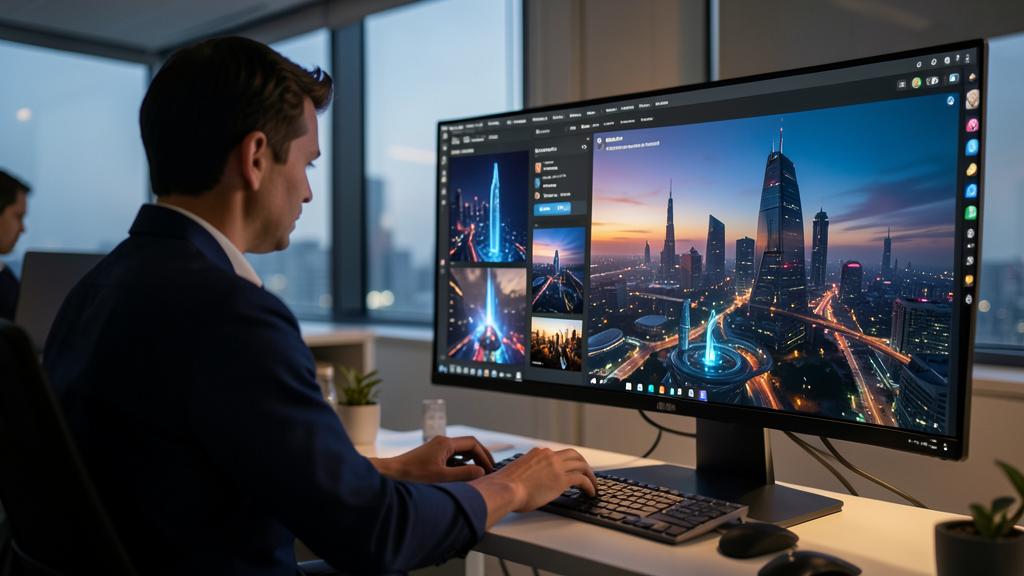
That said, video remains more delicate than images: maintaining a character’s consistency from one shot to another, managing complex movements or long sequences is still difficult. We excel at short and aesthetic; we still struggle with long narratives and precision.
The right reflex. The quality of the result depends greatly on the prompt. Be descriptive: specify the subject, the style, the lighting, the angle. « A cat » gives an average result; « a red cat sleeping on a windowsill, soft morning light, photographic style » changes everything.
AI video is getting better fast, but it still can’t handle long, complex scenes as well as short, simple ones. For now, it’s best for short, artistic clips rather than full movies.
Imagine you want to create a 10-second video of a futuristic city. A well-written prompt like “A neon-lit cyberpunk city at night, rain reflecting the lights, 4K cinematic style” will give much better results than a vague one like “A city at night.” The first will look like a movie scene, while the second might be blurry or generic.
Limits to keep in mind
As impressive as they are, these tools have known weaknesses. They sometimes struggle with precise details — hands, readable text in the image, exact proportions. They can produce inconsistent results that need to be regenerated several times. And they reflect the biases of their training data, which requires a critical eye.
Another limit: AI doesn’t always replace a professional. For a brand identity, a work of high artistic value, or a very specific rendering, the human eye and know-how remain superior. AI is a fantastic accelerator, not a universal replacement.
Legal and ethical questions
Generating an image raises still-evolving legal questions: who owns an AI creation? Can it be used commercially? Conditions vary depending on the tools, and it’s wise to read them. Ethical issues are added: imitating the style of a living artist or creating « deepfakes » raises real issues of respect and truth.
Avoid this. Never create misleading visuals featuring real people without their consent, and always check the commercial usage terms of the tool before selling or sharing an AI creation. Technical ease does not erase legal and moral responsibility.
How to get started
- Start with images, more mature and easier to master than video.
- Practice prompts: it’s a skill that quickly improves with practice.
- Keep a critical eye: regenerate, select, edit if needed rather than publishing the first draft.
- Respect the legal framework: check usage rights before any public or commercial dissemination.
Frequently asked questions
Can these images be used for a business?
Often yes, but it depends on the tool and its offer. Read the commercial usage terms, which vary from service to service.
Do you need technical skills?
No. The only « skill » needed is knowing how to describe what you want. The rest is accessible to everyone.
What to remember
AI-powered image and video generation is a remarkably powerful tool, already usable for images, promising for video. It makes you autonomous, fast, and creative — provided you keep a critical eye on quality, refine your prompts, and respect the legal and ethical framework. Well used, it’s a fantastic accelerator; poorly used, a source of trouble. It’s up to you to use it wisely.
Do you want to create visuals and videos with AI?
Leave a Reply
You must be logged in to post a comment.