
Booking a medical appointment, filing taxes, applying for a job, monitoring children’s schooling: most of life’s administrative and social tasks now go through screens. For millions of people—elderly, precarious, isolated, or simply uncomfortable—this forced digitization is a barrier. The digital divide isn’t just an abstract concept in official reports: it’s the neighbor who gives up on aid because they don’t know how to fill out an online form, the parent who panics at the sight of a digital school platform. A snapshot of a societal issue—and what each of us can do, at our own level.
Three divides in one
We talk about « the » digital divide; there are three, which compound. The access divide: poorly covered areas, missing or outdated equipment, unaffordable plans for tight budgets—you can’t use what you don’t have. The usage divide: owning a smartphone doesn’t mean knowing how to fill out an online form, attach a document, or manage a password—e-digital illiteracy affects a significant portion of the population, far beyond just seniors. And the confidence divide: the fear of doing something wrong, of being scammed, of « breaking everything »—which paralyzes just as much as ignorance, and which every publicized scam worsens. Any serious response must address all three: equipment without support is useless, and vice versa.
The digital divide isn’t just one problem—it’s three. Some people can’t access the internet, others don’t know how to use it, and many are too scared to try. Fixing it means solving all three issues at once.
Imagine a 65-year-old retiree in a rural area with slow internet. They have a smartphone but struggle to upload documents for their pension. Even if they get help, they might avoid online banking out of fear of scams. This person faces all three divides at once.

Who is affected (spoiler: not just the elderly)
The cliché of the overwhelmed senior masks reality: the divide cuts across all ages. Elderly people, of course, many of whom face the total digitization of their procedures alone. But also young people who are very comfortable on social media and lost in front of an administrative form or an attachment—the ease of entertainment is not administrative competence. Precarious workers whose equipment is limited to a small-screen phone—try writing a CV on a five-inch screen. Residents of poorly served areas. And people with disabilities, facing online services that are far too rarely accessible. The divide isn’t a generational issue: it’s an inequality issue, which digital technology amplifies when it’s not corrected.
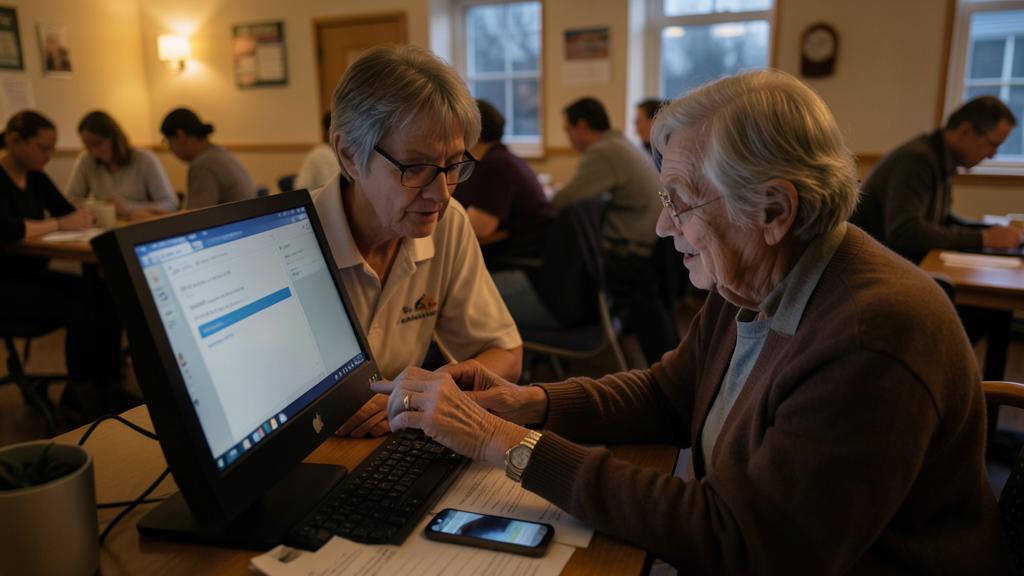
The right reflex (if you’re helping a loved one). Don’t do for them: do with them. Taking the mouse and clicking everywhere « because it’s faster » maintains dependence; guiding the hand, explaining each step, letting them retry—even slowly—builds autonomy. And write down the steps together on a paper sheet: the medium the person already masters is the best bridge to the one they’re learning.

What is being done—and what is missing
Solutions exist and are progressing: support centers (digital spaces, libraries, town halls, associations) where trained mediators help with procedures and teach the basics; equipment and connectivity aid programs; refurbished devices, which provide decent hardware at an affordable price; and a slow awakening among public service designers—simplifying processes, maintaining alternatives. Because that’s where the problem still lies: as long as an essential service only exists online, without a counter or backup phone, digitization excludes. Keeping human alternatives for essential procedures isn’t nostalgia: it’s the condition for modernization to leave no one behind.
An issue that concerns us all
Why should we care if we’re comfortable ourselves? First, because the divide affects almost every family—a parent, a neighbor, and one day, potentially, each of us facing interfaces that evolve without waiting for us. Then because its costs are collective: unclaimed rights, less monitored health, increased isolation, weakened democracy when information and services elude part of the population. Finally, because the solution is largely distributed: beyond public policies, every patient helping hand—a guided procedure, a jargon-free explanation, an hour given to an association—concretely repairs a piece of the divide. Few causes offer such a direct link between individual action and real impact.
- Unclaimed rights
- Less monitored health
- Increased isolation
- Weakened democracy

Not to forget. People struggling with digital technology are the favorite targets of scams—precisely because they doubt their bearings. Support must always include a protection component: the golden rule (« before paying, giving a code, or clicking: ask someone you trust »), and an environment where admitting a doubt or a mistake never invites mockery. Digital autonomy without security is a poisoned gift.
Frequently asked questions
Won’t the divide resolve itself with the generations?
No: interfaces and requirements evolve faster than acquired skills, and each generation produces its left-behinds (precariousness, disability, remoteness). Without continuous inclusion efforts, the divide shifts but doesn’t close.

Where to direct a struggling loved one?
To nearby support centers: libraries, municipal digital spaces, mediation associations, public service welcome points. A quick search—or a call to the town hall—usually finds the closest contact.
How to help without being an expert?
Patience is better than expertise: guiding a procedure, explaining without jargon, reassuring. If you know how to send an email and fill out a form, you know enough to help someone who doesn’t.

What to remember
The digital divide is threefold—access, usage, confidence—and cuts across all of society, far beyond the generational cliché. At a time when essential procedures are being digitized, it becomes a rights divide: addressing it requires support policies, the maintenance of human alternatives, services designed for all—and a diffuse mobilization where every individual help counts. If you’re comfortable with digital technology, you hold a valuable skill: shared with patience—in doing with, never for—it concretely changes lives. Exclusionary modernity isn’t inevitable: it’s a collective choice, which often begins around a kitchen table, in front of a shared screen.


A loved one needs digital support?
Leave a Reply
You must be logged in to post a comment.