
Composing a melody, creating a soundtrack, producing a track without knowing how to play an instrument: artificial intelligence makes music creation accessible to everyone. With a few instructions, you can generate background music, accompaniments, or even complete tracks. Simple curiosity or creative revolution? This guide explores what AI allows today in music, its practical uses, and its limitations.
Music within everyone’s reach
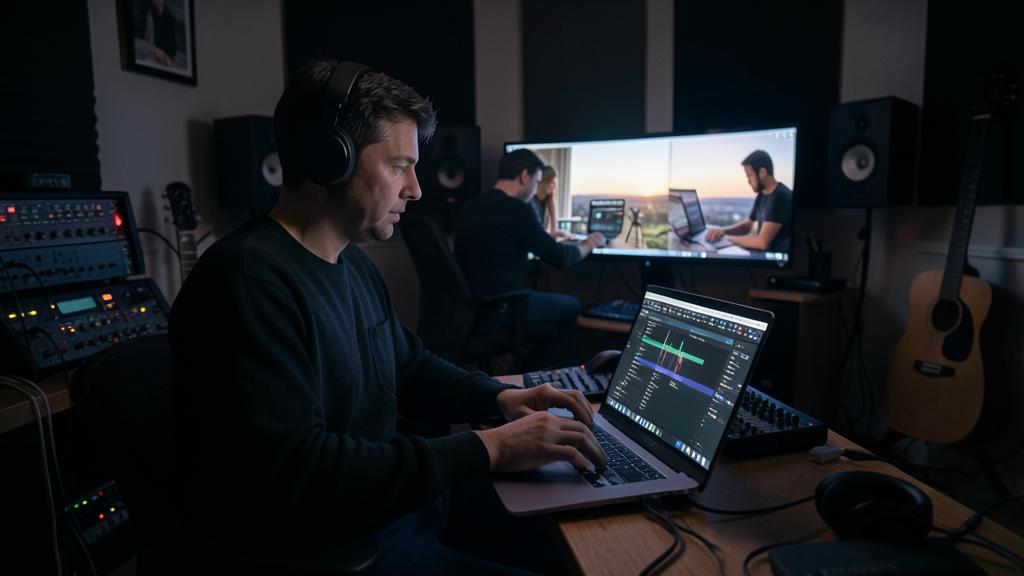
Creating music traditionally required years of instrument training or mastery of complex software. AI lowers this barrier: from a description—a style, a mood, a tempo—it generates music in a few moments. This accessibility opens creation to those who lacked the training or time, while offering musicians a new tool for exploration and inspiration.
AI lets anyone create music quickly by just describing what they want. You don’t need to know how to play an instrument or use complex software.
Using a tool like Suno or Udio, you could type “epic orchestral music for a fantasy trailer” and get a full track in seconds, ready to use for a YouTube video.
What AI allows you to create
- Background music: for a video, a podcast, a presentation.
- Accompaniments: a base to sing or play over.
- Ideas and inspiration: exploring melodic paths.
- Complete tracks: in a given style, from a simple description.
The right reflex. Be precise in your description: the musical style, the desired mood, the tempo, the instruments wanted. Like with image generation, the more detailed your request, the more the result matches what you have in mind. A vague request gives generic music.
A fantastic tool for creators
For those who produce content—videographers, podcasters, creators—AI solves a recurring problem: finding royalty-free and suitable music. Generating a custom soundtrack, without licensing concerns, is a significant time and peace-of-mind saver. Music is no longer an obstacle or an expense, but an element you create on demand, perfectly tailored to your project.

The limits and the questions
AI music impresses, but has its limits. It excels at functional music and moods, less at the deep emotion and artistic originality of a true human work. Questions of rights and ethics also arise: who owns a generated music? Can you imitate an artist’s style? These issues, still evolving, call for caution in commercial use.
To check. Before commercially using music generated by AI, verify the tool’s terms of use and associated rights. The legal framework is evolving, and what seems free is not always entirely so. Caution avoids unpleasant surprises, especially for public distribution.
First track: the steps to follow
To go from curiosity to a concrete first try: 1. Choose a specific use—a background for a video, a work ambiance, a song attempt. 2. Describe in one sentence the style, tempo, and mood (« calm acoustic instrumental, guitar and piano, morning ambiance »). 3. Generate several versions—variability is high, the third is often the best. 4. Refine through successive tweaks: « slower, » « no percussion, » « happier. » 5. Check the license before any public use. In thirty minutes, you’ll have a usable track—and above all, understood through practice what the tool can do for your projects.
Frequently asked questions
Do you need musical knowledge?
No to generate basic music: a simple description is enough. Knowledge helps refine and guide the result, but is not essential.
Is the generated music royalty-free?
It depends on the tool and its offer. Always check the terms before commercial use: rules vary from service to service.
Can you create a song with lyrics?
Yes: recent tools generate sung tracks from your lyrics or a given theme. Vocal quality is improving quickly—amazing for demos and personal projects, still uneven for demanding professional use.

What to remember
AI makes music creation accessible to everyone: background music, accompaniments, complete tracks from a simple description. It’s a fantastic tool for content creators, solving the issue of royalty-free music. It excels at functionality, less at deep artistic emotion. Be precise in your requests, and always check rights before commercial use. Far from replacing musicians, it democratizes creation and opens new possibilities: everyone can explore its potential.
Curious about AI-assisted creation?
Leave a Reply
You must be logged in to post a comment.