
Starting to run: the most common resolution — and the one most quickly abandoned, almost always for the same reason: you run too fast, too long, too soon, you suffer, you get discouraged. This is exactly the problem that running apps solve: progressive programs that turn a true beginner into a 30-minute runner in eight to ten weeks, a vocal coach in your earbuds, measurable progress that keeps the flame alive. Here’s how to start well — the app, the program, and the pitfalls that ruin beginnings.
The secret of beginner programs: walk first
The “couch to 5K” programs share a proven method: walk-run alternation — the first sessions look like “1 minute of running, 2 minutes of walking, repeated 8 times,” and the ratio gradually reverses over the weeks until 30 minutes non-stop. This isn’t a “weak” method: it’s THE method — the heart and muscles progress quickly, but tendons and joints adapt slowly: alternation gives the latter time to catch up with the former, and that’s precisely what the motivated beginner who goes out for 20 minutes of straight running doesn’t allow (classic result: shin or knee pain by week 3, and quitting). The app orchestrates everything: the vocal coach in your earbuds announces each transition (“run… walk…”) — no watch to check, you just listen and follow; sessions unlock in order; and the golden rule is built in: three sessions per week, never two consecutive days — recovery is part of the program, not laziness.

The key is to start slow. Your heart and muscles can handle more than your joints at first. Alternating walking and running lets your body adapt safely, so you don’t get injured and quit.
A 35-year-old beginner starts with “1 minute run, 2 minutes walk” for 8 cycles (total 24 minutes). By week 6, they’re running 20 minutes straight. Without the app, they might have tried 20 minutes of running on day 1 and injured their knees by week 3.
Choosing your app: families and the right criterion
The offerings are divided into families: guided beginner programs (apps dedicated to “couch to 5K” and beginner sections of major running apps) — the number one choice to start: it’s the program that matters, not the stats; complete tracking apps (the big names in running) — maps, paces, history, community challenges: perfect when you already run, sometimes intimidating before; apps with immersive audio coaching (narrated runs, enthusiastic coaches, meditations in motion) — excellent against boredom, the true threat of beginnings; and the app built into your phone or watch (Health/Fitness, connected watch apps) — enough to measure without installing anything. The honest choice criterion for a beginner: the one that will get you out next Tuesday — a structured program with an encouraging voice beats all the stats in the world: try two in a week, keep the one whose sessions speak to you, and beware of subscriptions — the essential beginner functions are widely available for free: the premium subscription can be discussed when you run, not before.
The right reflex. Set the app to announce time, not pace during the first weeks — and if it shows your speed, ignore it completely: the only goal of a beginner is to finish the session while being able to hold a conversation (the breathing comfort test — if you can’t talk, you’re running too fast, no exceptions). Pace will come naturally months later: in the meantime, running “too slowly” doesn’t exist — it’s even the definition of success.
Equipment and measurement: the essentials, no more
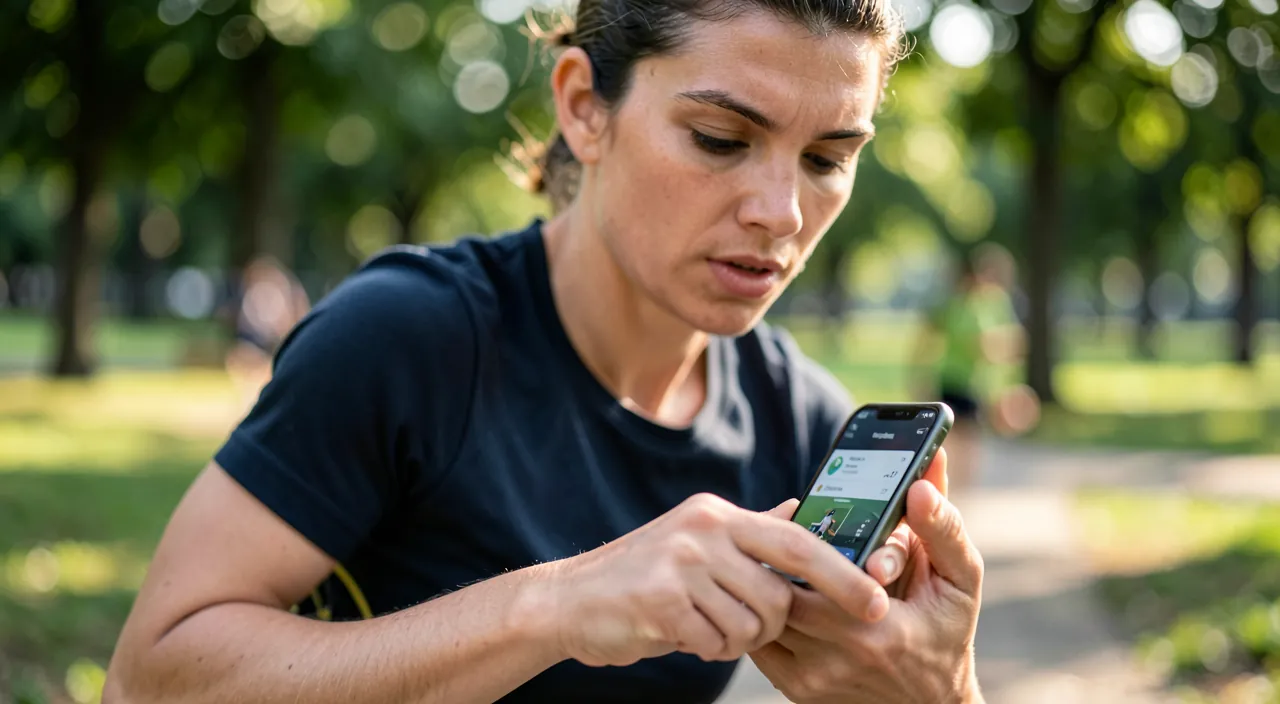
Beginner running has a huge advantage: it requires almost nothing — but that “almost” matters: real running shoes (the only mandatory investment — city sneakers don’t cushion well and cause injuries: an entry-level running model, ideally tried in a specialty store, is more than enough); the phone carried comfortably (armband, belt, or zipped pocket) with earbuds for the coach — the phone’s GPS measures distances very accurately; the smartwatch is a comfort, not a requirement: it frees up pockets and adds heart rate (interesting later — at the start, the conversation test replaces it perfectly); and the weather set in advance: the program session moves to another day, it doesn’t get canceled — the app that sends its reminder and the outfit prepared the night before are the two best allies of consistency. On the measurement side, let the app record everything (it will sync to the Health app), but only look at two numbers: the sessions completed this week (attendance is THE metric) and the duration of continuous running that increases — the two curves that tell the real story.
Lasting through the long haul: motivation, plateaus, and beyond
The program lasts ten weeks; running, however, settles (or not) into habits — the levers that make the difference: ritual consistency — same days, same time (e.g., Tuesday, Thursday, Saturday mornings): the decision made once and for all costs less than three weekly negotiations with yourself; missed sessions downplayed — the program pauses, resumes, or repeats a week: ten weeks that take fourteen are a total success (the app lets you replay a week — use it without shame); the social dimension in chosen doses — a running partner or a challenge with friends in the app multiplies attendance, comparisons with fast strangers undermine it: set the social aspect according to your temperament; and the post-program — the 5K reached, three paths: consolidate (run three 30-minute sessions while enjoying — perfectly legitimate and sustainable), lengthen (10K programs take over), or set a date — signing up for a local race in three months is the best motivation engine ever invented: a 15€ registration is worth all the premium subscriptions.

Watch out for pain that isn’t soreness. Muscle soreness at the start is normal (symmetrical, diffuse, gone in 48 hours); localized and persistent pain — shin, knee, Achilles tendon, foot — are warning signs: they require immediate rest (not “run slower on it”), and a consultation if they persist — continuing turns an adaptation into a months-long injury. Same vigilance beforehand for long-time sedentary people, significant overweight, or those with cardiac history: medical clearance before the program is the first session. Running rewards patience magnificently — and punishes haste dearly: that’s its only real rule.
Frequent questions
I can’t run for a minute straight: is the program for me?
Yes — it’s exactly for you that it exists: start with the fast walking weeks that good programs offer as a prelude, then the gentlest alternations. The uncrossable minute today will fall in two weeks — it’s the most universal (and encouraging) experience of beginner programs.

Treadmill or outdoors?
Both work for the program (on a treadmill, the app counts time — transitions work the same). Outdoors wins in the long run: variety, light, and the “outing” effect that does good mentally. The pragmatic ideal: outdoors by default, the treadmill as a weather backup — the best session is the one that happens.
The app offers me “heart rate zones”: should I pay attention to them?
Not yet — zones require a watch, calibration, and above all a level where they add something. The conversation test replaces them completely for the first six months. The day you prepare for a 10K with varied sessions, they’ll become interesting — each thing in its running time.
What to remember
Starting to run succeeds when three things align — and the app provides all of them: a progressive program with walk-run alternation (the method that lets joints catch up with the heart), a vocal coach that takes care of all management during the effort, and visible progress that fuels motivation. Your contributions: real shoes, three ritual time slots per week, pace ignored in favor of the conversation test, and respect for localized pain. In ten weeks — fourteen with life getting in the way, and that’s fine — 30 minutes of continuous running: what seems impossible today will be your warm-up next year. The only session that counts is the first one — the app is waiting for you, the sidewalk too.

Want to go further with your phone and apps? Our practical training is made for you.
Leave a Reply
You must be logged in to post a comment.